


Looking for the real thing? Browse authentic Medieval & Crusader rings, each piece one of one, individually authenticated, with documented provenance. For the background, see the guide to ancient jewelry.
What are antique celtic rings? Definition and historical context
Antique celtic rings are historic rings that display motifs commonly labelled Celtic, such as knotwork, spirals and interlace, and that usually date to early medieval or later periods in the British Isles and neighbouring regions. These descriptions are working estimates rather than firm attributions, and dating can depend on metal type, construction, and documentation, so treat catalogue dates as probabilistic when documentation is limited.
On many museum objects and archaeological finds similar motifs appear across metalwork and illuminated manuscripts, a pattern described in major museum scholarship that links these designs to Insular art traditions, not to a single uniform culture, and that places many examples in roughly the early medieval period Metropolitan Museum of Art timeline on Insular art.
See behind the listings on Instagram
Read the buying framework below to learn how to check provenance and condition without pressure; it is designed to help you ask the right questions.
Collectors should note that commercial listings often give a single date or a neat origin for convenience. In practice, workshop attribution, form, and wear consistent with age are used together to estimate period, and these are best corroborated by provenance and independent references. For browsing examples, see the Celtic Rings collection.
Definitions used here follow museum practice: an ancient ring or antiquity is described by form and motif, such as an intaglio bezel or looped hoop, and by contextual evidence from finds or catalogues. See the rings collection for related forms. When a listing lacks supporting documentation, regard the description as an informed hypothesis rather than a definitive statement.
Common Celtic motifs and what they meant in early medieval contexts
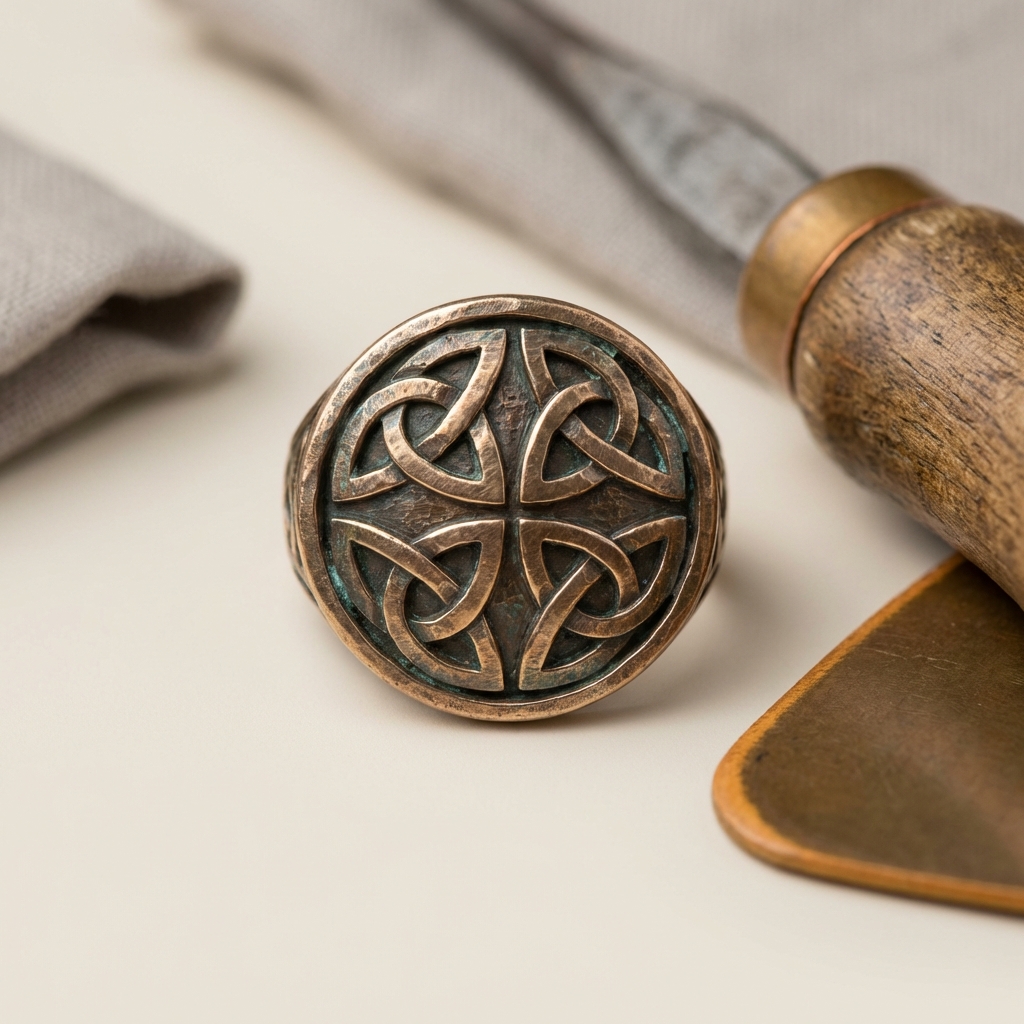
Knotwork, interlace and spirals are the visual vocabulary buyers will most often see on antique celtic rings. Knotwork describes continuous interlacing lines; interlace often frames panels or borders; spirals appear as isolated decorative units or paired motifs. On rings these designs can be incised on bezels, cast in low relief, or formed as part of the hoop or shoulders.
Scholars emphasise caution in assigning a single symbolic meaning to these motifs. Museum literature and recent studies note that motifs were reused across many contexts and were adapted into Christian objects, so interpretation often relies on the object type and its find context rather than on the motif alone The iconography of the Hunterston brooch and related early medieval material, Proceedings of the Society.
For example, a ring with interlace around an intaglio may have been decorative, devotional, or status-related depending on the setting where it was found, and museum catalogues typically present multiple possible readings rather than a single explanation.
How Celtic motifs became part of Christian art, including the Celtic cross
Many major museum accounts and art historians describe the incorporation of earlier regional motifs into Christian visual culture in the British Isles, rather than a simple replacement of older forms, and they document knotwork and interlace in manuscripts and metalwork from roughly the 7th to the 9th centuries Encyclopaedia Britannica on Celtic Christianity.
Many Christians can wear Celtic jewelry when the motifs are used devotionally or as cultural heritage, but individual decisions should consider intent, denominational guidance, and whether the piece has clear provenance and conservation support.
The Celtic cross, as used in early medieval settings, developed when the Christian cross was combined with a circular boss or ring, a formation visible in carved high crosses and portable metal objects and described in museum catalogues as a distinct Insular development rather than an imported symbol British Museum on the Celtic cross.
Because motifs moved between media, the same knotwork found on a manuscript page can appear on metalwork without necessarily carrying an identical theological message; context and documented use are the best guides to likely intent.
Religious perspectives: can Christians wear antique celtic rings?
Views among Christian communities vary. Many mainstream churches and denominations regard manifestly Christian uses of Celtic imagery, such as crosses or devotional emblems, as acceptable for personal devotion or as cultural heritage, while some conservative groups may express concern when similar designs are framed as endorsing non-Christian practices or syncretic belief systems Church of England guidance on religious symbols and cultural context.
When deciding, consider intent and context: are you wearing the ring as a devotional symbol, as an expression of cultural heritage, as ornament, or primarily as an antique and collector object? Personal conscience and local community norms are appropriate guides when the symbolism is contested.
Language matters. When you describe a piece, qualify symbolic claims: say that a motif "appears in Christian contexts" or that the dating "is estimated" if documentation is incomplete. This approach respects both historical complexity and the feelings of those in a faith community.
A practical buying framework for antique celtic rings
Start by prioritising pieces with clear provenance, explicit condition and restoration notes, and independent references; these elements together make a listing credible and help you judge dating and symbolism claims. Institutional catalogues and reputable collection histories are the most reliable comparators when they are available British Museum on the Celtic cross.
Essential documentation to request includes collection history, prior ownership notes, verification letters, and detailed condition or restoration reports that state what was stabilised or repaired. If these items are missing or vague, treat precise dating with caution.

Ask for photographs showing repairs under magnification and request measurements and metal testing reports if available. Example questions to sellers include: "Can you provide documented prior ownership?", "Are there condition photos of the repair?", and "Which catalogue or institutional comparison supports the suggested dating?"
Reading condition, restoration and provenance statements on listings
Restoration notes typically describe whether work was stabilising, cosmetic, or invasive. Stabilising work usually aims to prevent further loss and is positive for preservation; cosmetic or invasive repairs may alter surface details or patina, which affects historical integrity and how the object should be displayed.

When restoration is reported, request before and after photographs and written notes on materials used. If a listing is silent about restoration, ask directly whether any soldering, replacement elements, or surface consolidation has been performed and whether documentation exists for that work.
Provenance statements are strongest when they include collection history, prior sales or exhibition records, and verification letters from recognised specialists or institutions. Absence of such references does not prove inauthenticity, but it does reduce certainty about dating and origin.
Caring for antique celtic rings: conservation basics
Conservation guidance for historic metal jewellery emphasises gentle handling and restraint in cleaning. Avoid abrasive cleaning, control humidity in storage, and use padded compartments to prevent wear; museum conservators provide this core advice to preserve patina and historical surfaces Vamp and Victoria and Albert Museum conservation guidance on jewellery care.
basic handling and storage checklist for historic rings
Follow conservator advice for severe damage
Patina is often evidence of age and past handling; aggressive polishing can remove it and erase important clues about an object's use and manufacture. If a ring appears fragile, consult a professional conservator before attempting any cleaning beyond gentle dusting with a soft brush.
For long term storage, keep rings in stable, low humidity environments and avoid leather or acidic materials that can transfer corrosive compounds. If you plan to wear an antique ring occasionally, limit exposure to water, lotions, and activities that might stress soldered joins or thin shanks.
Common mistakes and red flags when buying antique celtic rings
A frequent mistake is accepting a precise date or workshop attribution based solely on a seller's short description. Dating is often an estimate that should be supported by independent catalogues or provenance documentation rather than a single line in a listing.
Other red flags include missing provenance, vague condition statements, or pressure language promising a quick sale; such signs should prompt further questions. Similarly, listings that conflate modern reproductions with antiquities without clear labelling are a common source of buyer confusion.
Emotion and symbolism can also lead to mistakes. If a purchase is motivated by spiritual meaning, take time to check context and community views so the item aligns with your beliefs and local practices. Ask for clear documentation before accepting symbolic claims.
Making a decision: respectful display, wearing and sharing
Use a short decision checklist that balances historical, religious and conservation concerns: verify provenance, confirm condition and restoration notes, reflect on personal intent, check denominational comfort, and plan for conservation and storage. Prioritise documented provenance and conservator advice when in doubt.
When you describe or share a piece, use historically informed phrasing: say that a motif "appears in Insular Christian contexts" or that dating "is estimated based on style and comparison". This language respects both historical nuance and listeners who may hold different religious sensibilities. Our Q&A on the history of Celtic rings explores these issues.
Collectors who wish to wear a ring in worship or as cultural expression should consult community leaders if concerned, and if displaying or lending a piece consider including a short documentation note about condition and provenance so viewers understand its historical background.
Look for detailed provenance, clear condition and restoration notes, independent references or catalogue comparisons, and ask the seller for magnified photos and prior ownership documentation.
Aggressive cleaning can remove patina and historic surface evidence; follow conservator guidance and use only gentle dusting until a professional assessment is available.
Not necessarily; meanings vary by context and intent, and many Christian communities accept use of Celtic motifs when worn devotionally or as cultural heritage.
More from Aurora Antiqua
References
- The Book of Kells, The Library of Trinity College Dublin
- Celtic knot, English Wikipedia, Wikimedia Foundation
- The iconography of the Hunterston brooch and related early medieval material, Proceedings of the Society
- Ring, Victoria and Albert Museum, London
- Brooch, Victoria and Albert Museum, London
- Archaeological materials, Icon, The Institute of Conservation (UK)
- E.C.C.O. Professional Guidelines (II): Code of Ethics, European Confederation of Conservator-Restorers'
- J. Paul Getty Museum Collection Policy, Board of Trustees
- Ancient Gems and Finger Rings: Catalogue of the Collections, The Getty
- Catalogue of a collection of ancient rings formed by the late E. Guilhou, Dumbarton Oaks