


Looking for the real thing? Browse genuine ancient rings for sale, each piece one of one, individually authenticated, with documented provenance. For the background, see the guide to ancient jewelry.
What people mean by an ancient jade ring
When collectors ask about an ancient jade ring they are combining two questions: what material the band is made from and whether the object was made in an earlier historical period. The term jade covers two distinct minerals, jadeite and nephrite, which differ in composition and structure and usually require instrumental identification; this distinction is central to understanding why visual judgement alone is limited GIA jade guide
See behind-the-scenes checks on @auroraantiqua
Download a short checklist of photos, measurements, and condition notes to help document rings before you ask for testing.
For buyers, the word ancient should be tied to context and documentation, such as collection history, sale records, or museum-style provenance, rather than a single visual impression. Museums and conservators combine surface wear, documented find history, and analytical data when they assess likely antiquity, so expect professional opinions to reference more than looks alone Metropolitan Museum jade overview
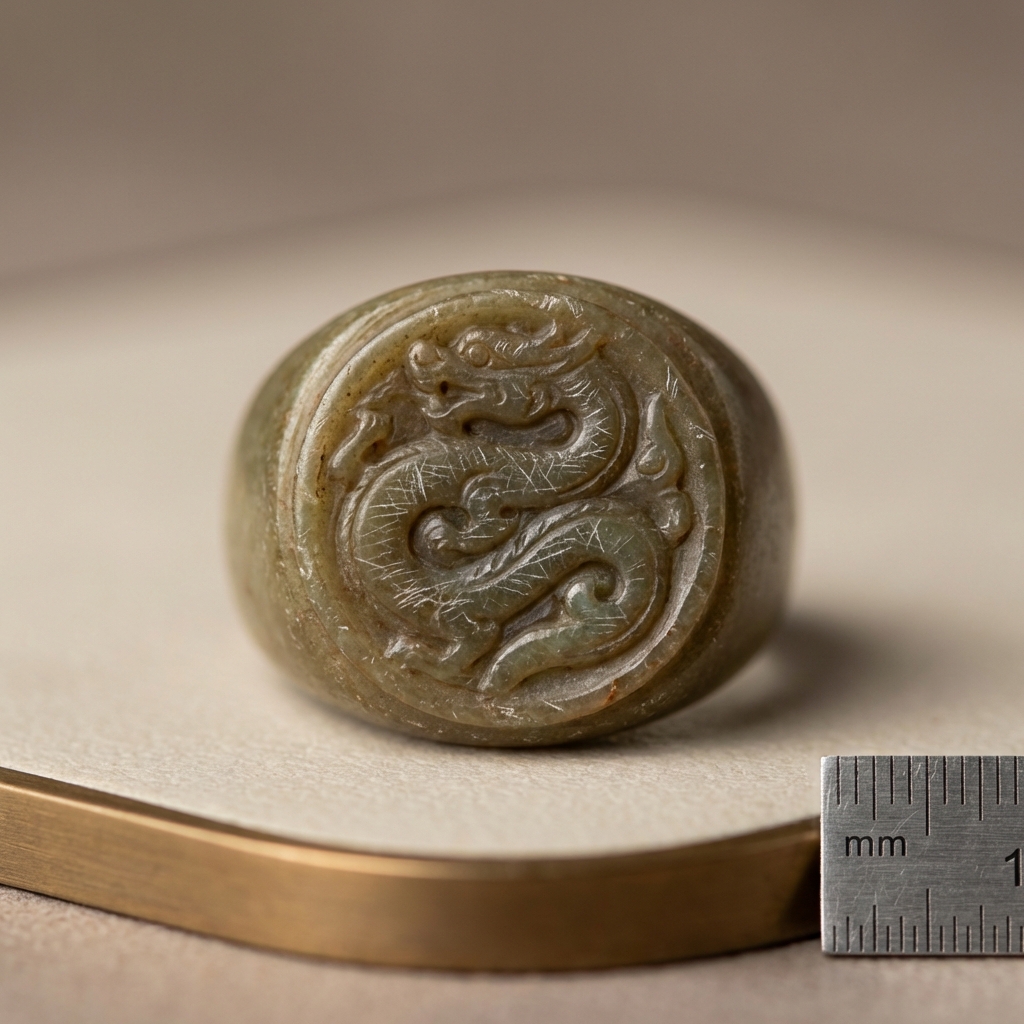
Condition expectations are important. Many genuine antiquities show softened edges, microabrasion, and surface weathering that reflect centuries of handling or burial; these features are common and often consistent with age, but they do not on their own prove date or geographic origin.
Short history and carving traditions that shape appearance
Across regions and eras, workshops produced characteristic motifs and styles that affect how a ring looks. In some cultures intaglios or bezel-carved motifs were favoured, while in others simple hoops or symbolic motifs dominate; this variation helps set plausible attributions but does not replace physical testing. Museums use stylistic comparisons alongside other evidence when making assessments Metropolitan Museum jade overview
Tool use also leaves traceable signatures. Period-typical carving techniques, such as abrasives and hand-tools used before modern rotary equipment, tend to produce specific surface marks and softened profile transitions. Conservators examine these marks when building a case for likely antiquity, but they also note that replication of old-style tool marks is possible with skill and modern tooling.
Stylistic similarity can support a preliminary judgement, particularly when combined with consistent condition notes and provenance, yet it rarely provides conclusive dating on its own without supporting analytical data.
How mineralogy changes what ancient jade looks like
The two minerals commonly called jade are mineralogically distinct: jadeite is a pyroxene while nephrite is a tremolite-actinolite amphibole, and they show different microscopic textures and density spectroscopic analysis of nephrite. That mineral difference affects how each material takes a polish, how light passes through it, and how carving marks appear under magnification GIA jade guide

Jadeite and nephrite often look and feel different in subtle ways. Nephrite typically has a fibrous, interlocking texture that can produce a slightly waxy sheen, while jadeite tends to be granular at microscopic scale and can reach higher translucency in very fine specimens. These textural contrasts are useful to a trained eye or a gemological microscope but are not definitive without instrumental confirmation Gem-A jade overview
Color and translucency vary widely across both minerals, from opaque dark greens to near-translucent pale greens and whites, and these properties are influenced by chemistry and later alteration. Because color can change with burial, handling, or chemical alteration, it is unreliable to use color alone to establish age or origin The Jade Enigma (Gems & Gemology, Spring 1982), Gemological Institute of America (GIA), USA
Visual signs often seen on ancient jade rings
Collectors and conservators look for age-consistent surface changes such as microabrasion in high-wear zones, softened tool-cut edges around bezels and shoulders, and burial-related weathering or encrustation. These features often appear together in museum collections and can support an overall assessment when tied to provenance notes British Museum conservation notes
Microabrasion and softened edges occur where repeated contact or polishing smooths sharp tool marks over decades or centuries. Burial can add altered surface textures, subtle staining, or mineral accretions that change the stone's surface sheen. Observing how these signs distribute across a ring can be informative; for example, uniform wear on both inner hoop and bezel is more consistent with prolonged use than isolated abrasion.
It is important to remember that modern treatments, dyes, and skilful forgeries can mimic many of these surface signs. Experienced examiners therefore treat visual cues as indicators that increase or decrease confidence, not as proof by themselves.
Simple in-hand tests and what they can and cannot show
There are practical, non-invasive checks that a buyer can do in hand or request from a seller before committing to a purchase. One familiar cue is thermal response: true stone generally feels cool to the touch compared with metal or plastic, and jade often has a relatively high heft for its size due to its specific gravity; these tactile impressions can guide a preliminary assessment Gem-A jade overview
A buyer should combine careful photographic and magnified documentation with non-destructive screening such as portable Raman or FTIR and specific-gravity checks, and commission an independent lab report when provenance or screening is ambiguous.
Magnification is particularly useful: a close look with a loupe or microscope can reveal a fine fibrous texture in nephrite or a granular texture in jadeite, along with period tool marks that may suggest hand-carving. Photographs that include magnified detail shots can be very helpful when buying from images, but remember that photography can hide or exaggerate surface features.
These simple checks are helpful first steps, but they cannot reliably detect composites, resin stabilisation, or modern dyeing. Treat results from in-hand tests or photos as preliminary and plan non-destructive instrumental screening for anything of significant value.
Recommended non-destructive instrumental checks
The accepted practical workflow for distinguishing jadeite from nephrite and for spotting common treatments relies on non-destructive instrumental methods. Portable Raman and FTIR spectroscopy are commonly used because they identify mineralogical signatures without sampling, making them suitable for historical material where preservation is essential Identification of Bleached and Polymer-Impregnated Jadeite, Gemological Institute of America (GIA), USA FT-IR overview
Specific-gravity measurement and high-magnification microscopy are valuable complementary steps. Density helps differentiate broad groups of materials, and microscopy can confirm internal textures or reveal modern tool marks and resin fills. Combining these methods creates a stronger, non-destructive case about material identity Gem-A jade overview
Limitations remain: some provenance questions and subtle treatments may require further lab techniques, and surface-only analyses can struggle to attribute exact geographic source. Still, the portable Raman plus FTIR workflow with density checks is the practical standard many specialists use today.
When to get an independent lab report and what to ask for
There are clear situations where an independent laboratory report is warranted: the item is high value, the provenance is uncertain, visual and stylistic signals conflict, or the buyer is unsure about restoration or treatment. In such cases a lab report reduces uncertainty by citing methods and diagnostic data that support the material identification Metropolitan Museum jade overview
A responsible lab report should state the methods used, for example Raman or FTIR, and provide diagnostic data such as Raman peak positions or density values. These details let a buyer verify the test approach and compare results, and they form a stronger evidentiary basis than a simple statement of 'jade' without underlying data LMHC Information Sheet 11: Jade and related Materials, Definitions, Laboratory Manual Harmonisation Committee
Request portable Raman or FTIR screening when material or provenance is unclear
Ask lab to list methods and key diagnostic values
When you send images or a ring for testing, include full documentation: clear photos, measurements, and any provenance or condition notes. These contextual materials help the laboratory interpret results in light of condition and possible restoration history.
A practical step-by-step assessment workflow
Step 1: Document. Start with high-resolution photos that show the ring in natural light and include scale. Photograph the hoop interior, bezel, shoulders, and any carved surfaces. Record measurements, weight if available, and detailed condition notes such as repairs or stabilisation treatments.
Step 2: Inspect. Use magnified detail shots or an in-person loupe check to look for microabrasion, softened edges, and micro-tool marks. Ask the seller for close-up images of tool marks and the stone surface, and compare those features with published museum images when possible British Museum conservation notes
Step 3: Screen. When practical, arrange non-destructive screening with portable Raman or FTIR plus a specific-gravity check. These steps can often be done without sending the object away and provide strong preliminary data about whether the material is jadeite, nephrite, or another substance Kunststoffe als Imitationen für Edelsteine und organische Substanzen (plastic imitations of gems), Deutsche Gemmologische Gesellschaft portable Raman study
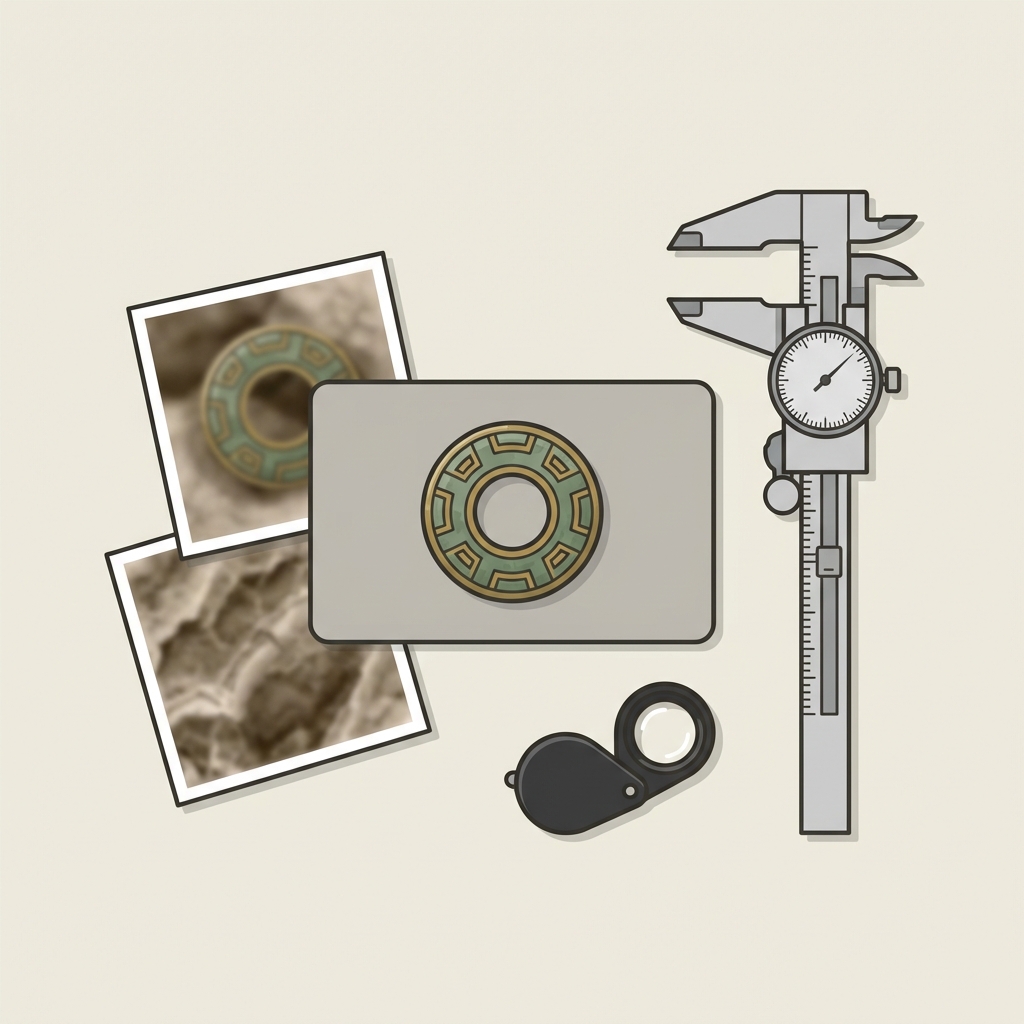
Step 4: Verify. For high-value items, or when screening yields ambiguous results, commission a formal lab report that lists methods and diagnostic values. Keep all communications and reports with the object files for future reference and potential resale or loan to institutions.
Decision criteria checklist for buying an ancient jade ring
Minimum documentation to request before committing: clear provenance or collection history when available, full condition notes and restoration descriptions, and any existing lab report or screening results. If these are absent, treat the purchase as higher risk and request testing Metropolitan Museum jade overview
How to weigh signals: good provenance with consistent condition notes can outweigh some ambiguous visual signs, but lack of provenance increases the need for testing. If a ring shows age-consistent wear and the seller provides robust documentation, that is a stronger combination than visual cues alone.
Price sensitivity: when provenance or lab data are missing, consider lowering an offer or walking away. The absence of documentation or testing raises uncertainty about treatment and origin; budget accordingly for the cost of screening if you proceed.
Common mistakes and pitfalls to avoid
Relying on color alone is a frequent error. Both jadeite and nephrite span a wide color and translucency range, and alterations from burial or handling can change appearance, so color should not be used as a decisive test The Jade Enigma (Gems & Gemology, Spring 1982), Gemological Institute of America (GIA), USA
Another trap is ignoring restoration and modern treatments. Resins, dyes, and composites can convincingly imitate age and surface texture, and only instrumental testing can reliably detect some of these interventions. Ask sellers for explicit restoration notes and any conservation history The Journal of Gemmology, 2009, vol. 31, nos. 5 to 8, Gemmological Association of Great Britain (Gem-A), London
A final common mistake is accepting vague authenticity claims without documentary backup. Request specific provenance language, prior ownership notes, and any lab reports rather than general statements of authenticity.
Practical examples and buyer scenarios
Photo-only purchase scenario. If you are buying from photos, request targeted images before committing: full lighting, scale shots, interior band detail, and magnified close-ups of the bezel and any carved motif. Ask for measurements, weight, and explicit condition notes to help your preliminary assessment British Museum conservation notes
High-value ambiguous ring. For an expensive or ambiguous listing request provenance documentation and arrange non-destructive screening. If screening results are unclear, commission an independent lab report that cites Raman, FTIR or density values. Retain copies of all correspondence and reports as part of the object's documentation.
Document every step. Save seller messages that describe prior ownership, repairs, or conservation work and include those notes when you seek a lab opinion. Thorough documentation supports clearer interpretation of test data and protects you if questions arise later.
Caring for an ancient jade ring and preservation notes
Handle gently and avoid harsh chemicals. Cleaning should be minimal and conservative; often a soft brush and distilled water are safest when condition notes do not indicate sensitive stabilisation or soluble consolidants British Museum conservation notes
Restoration history affects care. Stabilised or repaired rings may have adhesives or fills that react to solvents or heat, so follow restoration notes before attempting any cleaning. Keep documentation with the object to inform future conservators and potential buyers.
Store the ring in stable, moderate conditions away from extreme humidity or direct sunlight, and keep records of condition and any conservation work with the object files.
Summary: a cautious, evidence-first approach
Visual cues such as microabrasion, softened edges, and burial-altered surfaces are useful indicators but not decisive proof of antiquity. The accepted practical standard is to combine careful documentation, magnified inspection, and non-destructive testing such as portable Raman and FTIR to reduce uncertainty LMHC Information Sheet 11: Jade and related Materials, Definitions, Laboratory Manual Harmonisation Committee
Follow the workflow: document thoroughly, inspect with magnification, screen with non-destructive methods, and commission a lab report when necessary. Save provenance and condition records and make them part of the object's permanent file.
How a curated seller frames documentation and condition notes
Reputable curators typically include a period description, condition notes, restoration and conservation statements, and provenance or prior ownership details when available. These elements help buyers understand what they are seeing and why a seller assigns a particular period or attribution Metropolitan Museum jade overview
A useful question to ask sellers is whether they can share magnified images, measurements, and any prior lab reports. Brands that work as curators will often offer clear restoration notes and describe what was stabilised, repaired, or intentionally left untouched.
Aurora Antiqua frames listings with condition notes and, when available, provenance references to help collectors weigh visual signs against documentation before deciding to proceed.
Further resources and reading
Authoritative resources are the best next step for deeper study. Gemological guides and museum pages offer reliable background on jade mineralogy and conservation practices, and specialists can explain testing methods in more detail GIA jade guide
When consulting a specialist or lab, bring high-resolution photos, measurements, provenance notes, and any earlier condition or restoration reports. Be prepared to discuss the object's use history and any treatments the seller mentions, as these contextual details inform analysis and interpretation British Museum conservation notes
Open questions remain in source attribution and some treatment detection limits, so plan testing and expect occasional follow-up analysis if results are ambiguous.
From photos, request high-resolution and magnified views, measurements, and clear condition notes. Look for consistent wear, softened edges, and period tool marks, but treat visual signs as suggestive only and seek screening or lab testing for confirmation.
In-hand cues like cool feel and relative heft can suggest stone, but they are not definitive; non-destructive instrumental checks such as Raman or FTIR are required to reliably distinguish jadeite and nephrite and detect some treatments.
A useful report names the methods used, for example Raman or FTIR, and provides diagnostic data such as Raman peak positions or density values, together with any observations about treatments or restoration.
More from Aurora Antiqua
References
- The Jade Enigma (Gems & Gemology, Spring 1982), Gemological Institute of America (GIA), USA
- LMHC Information Sheet 11: Jade and related Materials, Definitions, Laboratory Manual Harmonisation Committee
- Identification of Bleached and Polymer-Impregnated Jadeite, Gemological Institute of America (GIA), USA
- The Journal of Gemmology, 2009, vol. 31, nos. 5 to 8, Gemmological Association of Great Britain (Gem-A), London
- Kunststoffe als Imitationen für Edelsteine und organische Substanzen (plastic imitations of gems), Deutsche Gemmologische Gesellschaft
- The Gemstone Book, CIBJO Blue Book, Coloured Stone Commission, CIBJO, The World Jewellery Confederation
- 16 CFR Part 23, Guides for the Jewelry, Precious Metals, and Pewter Industries, Federal Trade Commission, eCFR
- What Is Jade Gemstone, Gemological Institute of America
- Understanding Jade And Its Importance In China, Gem-A, The Gemmological Association of Great Britain
- PubMed Central