


Looking for the real thing? Browse genuine crusader rings for sale, each piece one of one, individually authenticated, with documented provenance. For the background, see the guide to medieval jewelry.
What archaeologists mean by ring-money: definition and historical context
Terminology: ring-money, penannular rings, and ancient celtic ring money
Archaeologists use the term ring-money to cover a set of metal rings and penannular hoops from Iron Age and La Tene Europe that do not fit a single purpose label, and they treat the category as flexible because context determines function. For example, some finds appear to have circulated as exchange units or metal stock while others were clearly personal ornaments or symbolic rings; this interpretive approach is explained in syntheses of museum and field research British Museum blog on ring-money and Iron Age exchange. Is Celtic Ring Money Real?
That flexibility matters because labels like currency or jewellery can mislead without information on where a ring was found and what else was deposited with it. Excavation reports and collection catalogues are essential to any reliable reading of a ring's role at the time it was used National Museums Scotland research on ring-money.
Geographically, the ring-money category spans continental La Tene zones and Insular contexts, so regional differences are normal; similar ring shapes appear in different places and times, and that variation is why scholars emphasise site context and associated finds when assigning a function Antiquity article on function, deposition and regional variation. See the Celtic Rings collection.
Celtic ring-money could represent metal stock, a medium of exchange, or symbolic jewellery depending on site context, associated finds, and manufacturing traits; confident readings rely on provenance, stratigraphy, and, when needed, scientific analyses.
As a result, a short description or a motif alone should not be taken as definitive proof of a ring's use as money or as a purely symbolic object. (See a historical discussion A Defence of Ring-Money.)
Common Celtic motifs and their possible meanings
Several motifs frequently occur on Celtic rings and related metalwork, though their meanings are not fixed. Interlace and knotwork designs are widespread in La Tene and later Insular art and can suggest group styles, decorative tradition, or symbolic references that vary by region and period Cambridge University Press on La Tene art motifs.
Spirals, triskeles and other geometric patterns are another common group of motifs. These forms may have carried cosmological, directional, or protective associations in some contexts, but the same patterns can survive across generations so attributing a single meaning to them without supporting context is risky Antiquity article on ring-money function and variation.
Zoomorphic and hybrid animal forms-stylised beasts, birds or serpents-appear on bezels and hoops and can be read as status markers, identity signals, or amuletic motifs depending on where and how they were found. Museum catalogues show these motifs are part of broader iconographic repertoires across La Tene and early medieval Insular traditions Cambridge University Press on La Tene art motifs.
Because motifs continue across periods and places, motif-based dating and symbolic readings remain provisional unless they are tied to stratified finds, secure collection histories, or scientific dating methods.
Materials and manufacture: what physical features tell us
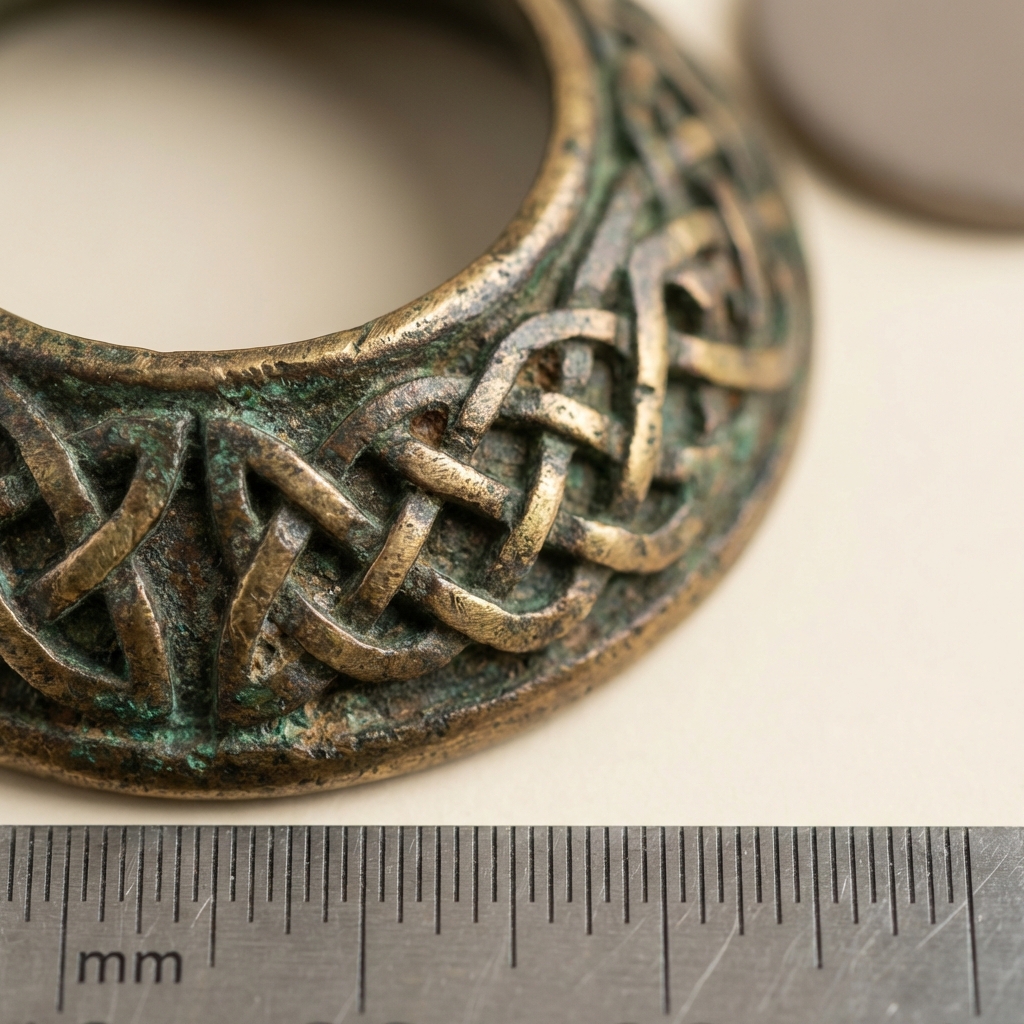
Manufacturing indicators such as whether a hoop was cast as a single piece or worked from sheet, the shape and proportion of a bezel, and visible tool marks can help distinguish local workshops from later copies. These features are routinely recorded in museum catalogues and excavation reports and are useful when comparing a listing to published examples National Museums Scotland research on ring-money.
Measurements, patina, and high-resolution photographs of seams and tool marks are especially valuable for remote assessment. Clear images that show where the metal was filed, soldered, or reworked allow a specialist to judge manufacturing sequence and likely repairs British Museum blog on ring-money and Iron Age exchange.
Photo and measurement checklist for assessing ancient rings
Use consistent scale in millimetres
For collectors this means asking sellers for millimetre measurements, a scale photo, and close shots of any solder lines or filing traces rather than relying on a single catalog image.
A step-by-step checklist for evaluating symbolism and date
Begin every assessment by checking the documentation provided with a listing. Provenance elements such as a findspot, excavation report, or earlier collection history provide the strongest basis for interpreting symbolism and dating, and museum practice emphasises these items as primary evidence Iron Age, National Museum of Ireland, Dublin. For general overviews see popular summaries of ring money.
Next, review the physical evidence in the listing. Request high-resolution photos showing both faces, the inner hoop, and any tool marks, plus explicit measurements and weight where possible. Restoration and condition notes should say what was stabilised, repaired or left untouched National Museums Scotland research on ring-money.

Consider the likely level of confidence you need for a purchase. For lower-value or clearly documented pieces, good photographs and plausible provenance may be sufficient. For higher-value or ambiguous items, a specialist report or compositional analysis will materially improve certainty about attribution and dating Iron Age, National Museum of Ireland, Dublin.
Provenance and documentation: why they change interpretation
Provenance information is central because a stratified findspot or a documented excavation places a ring in time and social context. Where stratigraphy and associated finds are recorded, interpretations about whether a ring served as metal stock, jewellery, or a ritual deposit become far more secure Antiquity article on deposition and regional variation.
Useful documentation includes excavation reports, collection histories, verification letters, and explicit condition and restoration notes. Museum catalogues typically present these items in standardised form and are a model for what collectors should request from sellers National Museums Scotland research on ring-money.
Common mistakes and pitfalls collectors should avoid
Relying on motif alone for dating is a frequent error. Similar decorative patterns persist across centuries and regions, so a ring that looks La Tene in style might be a later copy or reuse; scholars caution against motif-only attribution in the absence of contextual evidence Cambridge University Press on La Tene art motifs.
Another common pitfall is overlooking restoration or modern repairs. Repairs can alter apparent manufacturing traces and introduce modern joins that mask original construction, so clear restoration notes are essential to judge condition and integrity Iron Age, National Museum of Ireland, Dublin.
A third error is proceeding from low-resolution images or incomplete listings. Without measurements, clear patina photos, and tool mark close-ups, any attribution has high uncertainty and the buyer may be unable to check claims about symbolism or age British Museum blog on ring-money and Iron Age exchange.
Practical examples: three scenarios for interpreting a Celtic ring
Case study 1. A ring with interlace knotwork and a clearly recorded findspot in a stratified excavation. When a ring with a recognisable interlace pattern comes from a sealed context with associated datable finds, scholars can more confidently link the motif to a regional workshop or period. The presence of stratigraphic recording and associated artifacts changes a motif reading from speculative to evidence based Antiquity article on function and deposition.
Case study 2. A plain hoop recovered from a hoard. Plain or simple hoops sometimes function as metal stock rather than personal jewellery, particularly when they occur in hoards with other small ingots and fragmented metal. Metallurgical analysis and hoard context help decide whether such a piece circulated as exchange metal or served a decorative role Journal of Archaeological Science reports on metallurgical studies.
Follow @auroraantiqua for behind the scenes finds and restorations
If you plan a purchase, pause after the case studies and list three immediate checks: ask for provenance and excavation details, request high-resolution photos with scale and close-ups of tool marks, and consider a specialist report for uncertain or high-value pieces.
Case study 3. A zoomorphic bezel offered with uncertain provenance. A ring with animal-style decoration can look convincingly ancient, but without a documented findspot, its symbolism and date remain ambiguous. In these situations, a compositional test or a specialist assessment that compares alloy and manufacture to published examples can materially strengthen or weaken a stylistic attribution Journal of Archaeological Science reports on metallurgical studies.
Across these scenarios the same motif can be read differently depending on evidence. A knotwork design in a sealed context supports a regional cultural reading, while the same pattern without context should be treated as a useful stylistic clue rather than definitive proof of meaning.
Responsible collecting: summary and practical next steps
Quick buying checklist: request high-resolution photos with scale, explicit measurements and weight, condition and restoration notes, and any provenance documentation such as excavation reports or collection histories. These items form the core evidence for assessing a ring's symbolism and likely date Iron Age, National Museum of Ireland, Dublin.
Seek specialist reports or metallurgical testing when a piece is high value or the attribution is uncertain. Recent work shows that compositional and contextual analysis can clarify circulation networks and workshop practices, although more targeted sampling is still needed across regions Journal of Archaeological Science reports on metallurgical studies.
Aurora Antiqua presents curated ancient rings spanning Roman, Greek, Byzantine, Islamic, Celtic, medieval, and post medieval periods with condition notes, restoration notes, and provenance references when available, to help collectors make evidence-based decisions while avoiding overconfident attributions. See our rings collection.
Motifs like interlace, spirals, and animal forms can suggest identity, protection or status, but their meanings vary by region and period and are tentative without contextual evidence.
Material type, alloy characteristics, manufacturing traces such as cast versus worked hoops, bezel style, and tool marks are key indicators used alongside measurements and patina.
Request provenance details, excavation or collection history, condition and restoration notes, high-resolution photos with scale, and any specialist reports available.
More from Aurora Antiqua
References
- Iron Age, National Museum of Ireland, Dublin
- L'anneau sigillaire d'Arégonde, femme de Clotaire Ier, découvert à Saint-Denis, Bulletin de la Societe
- Turoe Stone, Heritage Ireland, Office of Public Works (Ireland)
- The Book of Kells, The Library of Trinity College Dublin
- Celtic knot, English Wikipedia, Wikimedia Foundation
- About us, International Association of Dealers in Ancient Art
- Object ID, International Council of Museums
- Research report: export licensing and provenance, GOV.UK, Department for Culture, Media and Sport (DCMS)
- Hallmarking Process, The Company of Goldsmiths of Dublin, The Assay Office (Dublin Castle)
- | Antiquity Journal