


Looking for the real thing? Browse authenticated ancient artifacts, each piece one of one, individually authenticated, with documented provenance. For the background, see the guide to ancient jewelry.
Quick answer: what a scarab ring meant and why it matters for buyers
The scarab motif in ancient Egypt is most commonly linked to the god Khepri and themes of rebirth and the daily solar cycle, a symbolic association that explains why scarabs appear widely in personal and funerary contexts; museum overviews set this interpretive foundation for reading scarab imagery and meaning Oxford Research Encyclopedias: Khepri and the scarab.
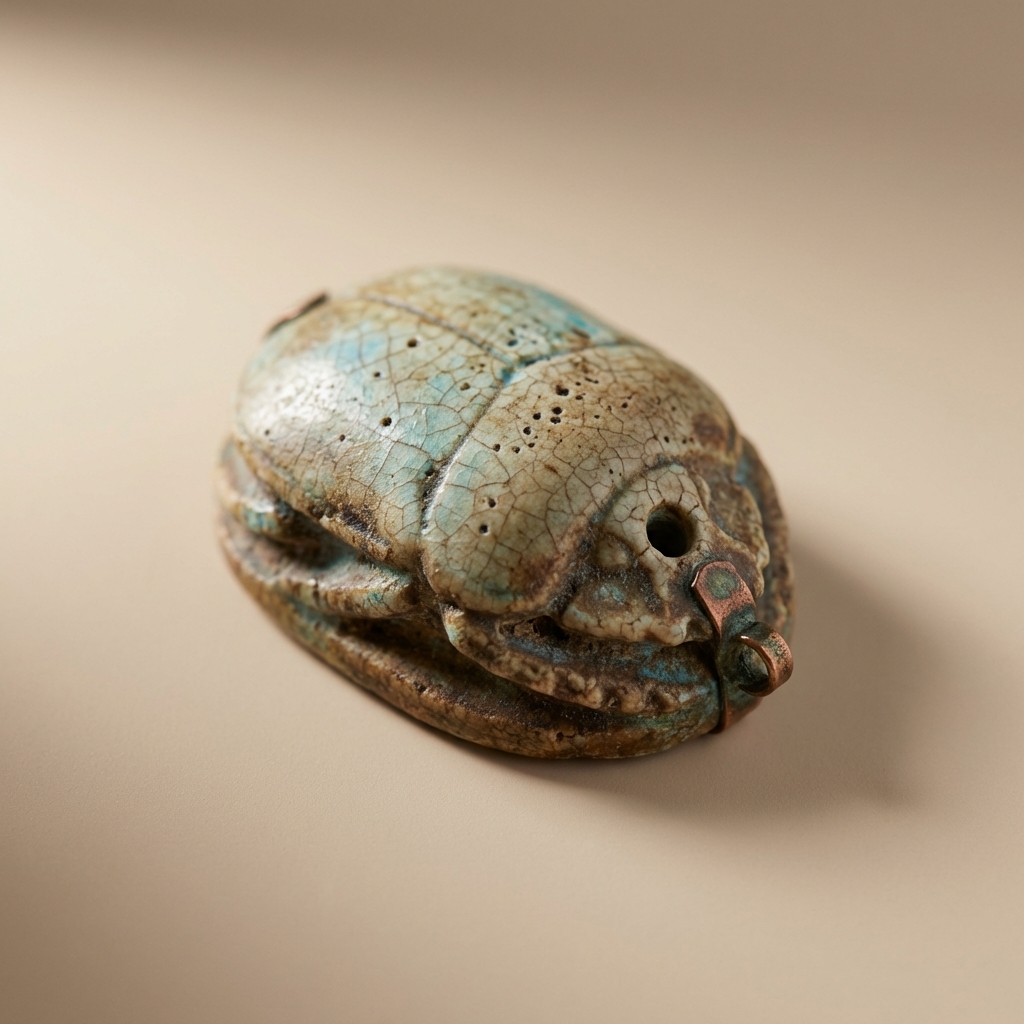
For buyers the practical consequence is straightforward: material, mount and documented context shape both likely use in antiquity and modern market value, so a glazed faience scarab set on a copper alloy hoop should be read differently from a carnelian or gold-mounted example The Metropolitan Museum of Art: scaraboid amulet catalogue entries.
See condition checks and provenance notes on Instagram
Consider materials, condition and provenance together rather than focusing on a single trait when evaluating a scarab ring.
Headline takeaways for collectors: the scarab motif conveys protective and regenerative symbolism, scarab bezels were commonly made in faience, steatite or hardstone like carnelian, and at market level gold-mounted or well-documented pieces generally occupy higher price bands than simple faience mounts, according to recent auction evidence Auction Terminology, Christie's.
Symbolism and historical context of the scarab in ancient Egypt
The visual and religious power of the scarab derives from its association with Khepri, an aspect of the sun god connected to emergence, renewal and the cyclical movement of the sun, which is why scarab amulets frequently carry regenerative meanings in museum descriptions and Egyptological overviews British Museum: scarab collection term and museum catalogues SMB: Amarna catalogue.

Across periods, from the Old Kingdom through the Late Period, the form and use of scarabs evolved in scale, material and inscriptional practice, so a scarab from a New Kingdom context can differ in style and function from an Old Kingdom example and should be interpreted with period sensitivity The Metropolitan Museum of Art: scaraboid amulet catalogue entries.
Scarab rings appear routinely in funerary assemblages as grave goods, where their amuletic role is emphasized, while the same motif also appears in everyday personal adornment where protective or identity-related meanings are possible; the context of discovery therefore matters for reading purpose and social significance Oxford Research Encyclopedias: Khepri and the scarab.
Materials, manufacture and typical forms of scarab rings
Common bezel materials include glazed faience and steatite, which were often used for mass-produced scarab amulets, while carnelian and other hardstones appear in scarabs associated with higher social status; ring mounts range from copper-alloys to silver and gold depending on context The Metropolitan Museum of Art: scaraboid amulet catalogue entries.
Technique matters: faience scarabs rely on a fired paste and glaze process yielding bright colours, whereas hardstone scarabs were shaped and sometimes carved with intaglio designs that could function as seals; metalworking on hoops and bezels shows a range of joining methods and finishing consistent with period metalworking practices Getty Conservation Institute: materials and scientific approaches.
A scarab ring is primarily a symbol linked to Khepri and renewal; its material, mount and find context inform whether it functioned as an amulet, seal or grave good, and those same attributes strongly influence authentication efforts and market value.
Because workshop attribution is frequently uncertain, stylistic traits such as bezel proportions, the style of incised motifs and wear patterns are often used cautiously to suggest period and production group rather than to make definitive attributions, which typically require close comparative study and, where possible, scientific analysis The Metropolitan Museum of Art: scaraboid amulet catalogue entries.
When assessing condition, look for original glazing on faience, signs of surface wear that match expected use, and any evidence of modern adhesives or reassembly; these physical cues, alongside material identification, help distinguish genuinely ancient manufacture from later alterations Getty Conservation Institute: materials and scientific approaches.
Functions: amulet, seal and funerary object - what the evidence shows
Archaeological records show scarab rings commonly used as personal amulets and regularly deposited as grave goods, a pattern that supports the reading of scarabs as protective and regenerative objects in both life and death The Metropolitan Museum of Art: scaraboid amulet catalogue entries.
Some scarabs are clearly designed to leave impressions and were therefore used in sealing or signet-like functions, but whether a scarab served administrative sealing purposes depends on period, inscriptional content and archaeological context, so each object needs object-level evaluation Journal of Egyptian Archaeology: scarab seals and personal adornment.
Practical signs that a scarab functioned as a seal include deep, deliberate intaglio carving, consistent impression wear and matching impressions known from sealed contexts; absence of these traits weakens the case for administrative use and shifts interpretation toward amuletic or decorative functions Journal of Egyptian Archaeology: scarab seals and personal adornment.
How authenticity, condition and restoration affect value
Clear provenance and collection history are central to reducing risk around attribution and legal ownership, and listings that include detailed prior ownership notes or documentation materially decrease uncertainty for buyers Getty Conservation Institute: materials and scientific approaches.

Scientific tools commonly used in authentication and condition assessment include microscopy to examine surface tool marks and wear, XRF for non-destructive compositional screening and Raman spectroscopy for mineral identification; these methods help distinguish ancient manufacture from modern alteration when combined with good provenance Getty Conservation Institute: materials and scientific approaches.
Restoration or conservation treatments can change an object’s appearance and market reception; transparent restoration notes that describe what was stabilised, repaired or left untouched allow buyers and conservators to judge how intervention affects attribution and value Getty Conservation Institute: materials and scientific approaches.
ancient egyptian scarab ring price
Price bands and market signals for scarab rings
Market evidence from recent sales shows broad price ranges: small faience bezels on simple mounts frequently appear in lower price bands, while carnelian or gold-mounted scarab rings and pieces with robust provenance reach higher market positions, reflecting material and documentation as decisive variables Antiquity market trends in Cycladic figurines, 2000 to 2019, International Journal of Cultural Property.
What typically drives low versus high price points are material quality, the presence of a hardstone bezel like carnelian, the metal of the mount and the completeness of provenance documentation; a well-documented carnelian on a gold hoop will usually command a premium compared with an undated faience bezel on a base metal mount Auction Terminology, Christie's.
Auction catalogues and specialist sale notes illustrate how documentation can move a lot between bands: a comparable object with clear collection history and a modern laboratory report will typically attract more competitive bidding than a visually similar object lacking such records The Past Polluted: A Pigovian Approach to the Black Market in Antiquities, International Journal of Cultural.
Catalogue description quality matters: detailed condition notes, clear photography of the bezel and mount, and any available third party reports are market signals that a seller has invested in transparent representation and that prospective buyers should treat these as positive indicators About us, International Association of Dealers in Ancient Art.
A responsible buying checklist for scarab rings
Before bidding or purchasing, assemble a short dossier for each listing: high-resolution photos, clear measurements, written condition and restoration notes, provenance or collection history, and any third party or scientific reports; these items create the basis for an informed decision (see our highlights highlights) Getty Conservation Institute: materials and scientific approaches.
quick pre-purchase evaluation of scarab ring listings
Use as a starter checklist
Short practical steps: ask for unedited macro photos of bezel and hoop, request the listing’s written provenance language, and ask whether any compositional testing has been done; if answers are vague, consider asking for a dated condition report or declining a high-risk purchase Informations for the art trade, Federal Office of Culture (FOC), Switzerland.
When to request scientific tests: if the material identification is contested, recommend non-destructive XRF for metal screening and Raman or visual mineralogy checks for stone identification, keeping in mind that laboratory work requires consent and sometimes expense Getty Conservation Institute: materials and scientific approaches.
Common mistakes, red flags and conservation ethics
Patina and wear can be misread; superficial surface colour or encrustation is not always proof of antiquity and may result from later burial or modern artificial aging, so microscopic inspection and provenance checks are vital to avoid misinterpretation Getty Conservation Institute: materials and scientific approaches.
Over-restoration, particularly 19th and 20th century interventions, can obscure original form or add modern repairs that complicate attribution and market perception; listings should include restoration notes that describe interventions and any stabilisation steps Getty Conservation Institute: materials and scientific approaches.
Legal and ethical red flags include missing documented export history, vague or inconsistent collection history, and objects presented without reliable documentation of find context; such omissions increase legal and ethical risk and should prompt caution Emergency Red List of Egyptian Cultural Objects at Risk, International Council of Museums (ICOM), Paris.
Practical examples and a short decision framework for buyers
Scenario one, lower risk: a faience scarab on a repaired copper-alloy hoop, sold with clear condition notes and photographic detail but limited provenance; a cautious buyer values condition transparency and restricts purchase size or seeks vendor-provided return terms The Metropolitan Museum of Art: scaraboid amulet catalogue entries.
Scenario two, moderate risk: a carnelian scarab set in a silver or gold mount with partial provenance listed and a recent conservator's note; this example benefits from asking for compositional checks and clarifying restoration treatment before committing Getty Conservation Institute: materials and scientific approaches.
Scenario three, higher diligence: a gold-mounted scarab with strong collection history, supporting documentation and a third party report; here a buyer may accept higher premiums because documentation lowers attribution and legal uncertainty, though independent review still improves confidence The Past Polluted: A Pigovian Approach to the Black Market in Antiquities, International Journal of Cultural.
Decision flow in brief: identify material, read condition and restoration notes, confirm provenance language, decide if scientific testing is warranted, then choose based on risk tolerance and documentation; keeping records of correspondence and reports is a prudent final step Object ID, International Council of Museums.
Aurora Antiqua’s role is to present curated ancient rings (see our rings collection rings) with condition notes and collection history where available to help buyers evaluate pieces, while encouraging requests for further documentation or testing when needed.

Closing considerations
Understanding what a scarab ring meant in ancient Egypt helps buyers see beyond surface appearance: the motif carries religious weight linked to renewal, but material, wear and documented context determine how any given object functioned and how it should be valued today Oxford Research Encyclopedias: Khepri and the scarab.
When in doubt, prioritise transparency: photographs, condition notes and provenance reduce risk and support informed judgment, and scientific testing can resolve specific questions about composition or modern intervention when provenance is unclear Getty Conservation Institute: materials and scientific approaches. Visit Aurora Antiqua for listings and information.
Scarab rings commonly served as personal amulets with protective and regenerative symbolism and were often included in funerary contexts; some scarabs also show characteristics of seals but administrative use depends on context.
Typical bezels are made of glazed faience or steatite and sometimes hardstones like carnelian, while mounts range from copper-alloys to precious metals depending on social context and period.
Request tests when material identification or restoration history is unclear; non-destructive methods like XRF and Raman are commonly used to check metals and minerals.
More from Aurora Antiqua
References
- Auction Terminology, Christie's
- Antiquity market trends in Cycladic figurines, 2000 to 2019, International Journal of Cultural Property
- The Past Polluted: A Pigovian Approach to the Black Market in Antiquities, International Journal of Cultural
- About us, International Association of Dealers in Ancient Art
- Informations for the art trade, Federal Office of Culture (FOC), Switzerland
- Emergency Red List of Egyptian Cultural Objects at Risk, International Council of Museums (ICOM), Paris
- Object ID, International Council of Museums
- Scarab. In: UCLA Encyclopedia of Egyptology (Kathlyn M. Cooney), University of California, Los Angeles
- Federal Register, U.S. Customs and Border Protection, Department of Homeland Security
- Client Challenge, JSTOR