


Looking for the real thing? Browse our Medieval ring collection, each piece one of one, individually authenticated, with documented provenance. For the background, see the guide to medieval jewelry.
What we mean by crusader and why the term is broad
Defining the social category (medieval crusader ring)
The word crusader is a wide social label for many people who participated in medieval crusading movements, covering pilgrims, nobles, soldiery, mercenaries and others who took part in campaigns roughly from c.1095 to the late 13th century; this broad meaning matters when evaluating objects such as a medieval crusader ring because the term does not imply a single organised body or uniform status, and dating plus context are essential to any claim about origin The Crusades overview
In many cases participation was episodic rather than institutionalised, meaning people might travel for a campaign or pilgrimage and then return to civilian life, and their possessions often reflect that intermittent presence rather than membership of a standing organisation Metropolitan Museum overview
A short viewing guide to inspect ring photos and notes
Use with high resolution photos
Avoid assuming that a single motif proves membership of a named order; material culture from the crusading period shows widespread Christian motifs that circulated across regions and social ranks, so collectors should treat simple iconographic matches as preliminary until supported by dating and provenance Medieval gold signet ring, Collections Online, Amgueddfa Cymru, Museum Wales, Cardiff
Timeline and geographic scope of medieval crusading campaigns
Main eastern campaigns and roughly dated phases
The main eastern crusading campaigns typically run from the late 11th century through the late 13th century, concentrated around the Levant but with related efforts in the western Mediterranean, the Baltic and the Iberian peninsula; this chronology helps determine whether an object attributed to the crusading period is plausibly dated to that milieu Crusades timeframe
Crusading was episodic and geographically varied, so a ring found in a Mediterranean port might have a different production context than one from northern Europe, and regional workshop styles and materials should be considered in any attribution Regional crusading differences

Beyond the main eastern campaigns there were later or parallel crusading enterprises in other regions, which can complicate dating when an object lacks secure find context; recognising where and when a ring type was produced narrows likely attributions and reduces the risk of mislabelling an object as tied to a particular campaign or house Regional timeline notes
For collectors, the implication is clear: assign a tentative phase and region first, then test iconographic or technical claims against that chronological framework to see if they align plausibly with production practices of the period Finger ring, London Museum (formerly Museum of London)
Who counted as a crusader: roles and social differences
Pilgrims and noncombatants
Pilgrims and other noncombatants travelled for religious reasons and may have worn devotional rings or carried badges that reflect pilgrimage motifs rather than military affiliation; such items often show different wear patterns and domestic repair histories compared with martial equipment Pilgrim participation
Personal items associated with pilgrims can be small and portable, and their iconography commonly emphasises saints, pilgrimage stars or cross forms used for devotion rather than for signalling membership in a military order Museum notes on pilgrimage objects
See curated rings with condition and provenance details on @auroraantiqua
See curated listings that include condition, restoration and provenance notes for rings that appear in the crusader period.
Armed retinues, nobles and mercenaries
Nobles and armed retinues often carried personal insignia or signets that could include heraldic marks or devotional images, while mercenaries and temporary combatants left more varied and less institutionalised material traces; this affects how confidently a collector can read a ring as linked to a named group, and collectors can browse our rings collection Social range among crusaders
Because many participants were temporary campaigners, their rings can lack the consistent administrative or documentary backing that marks membership in a standing order, so provenance and find context are especially important when an attribution claims organisational affiliation Campaign participation patterns
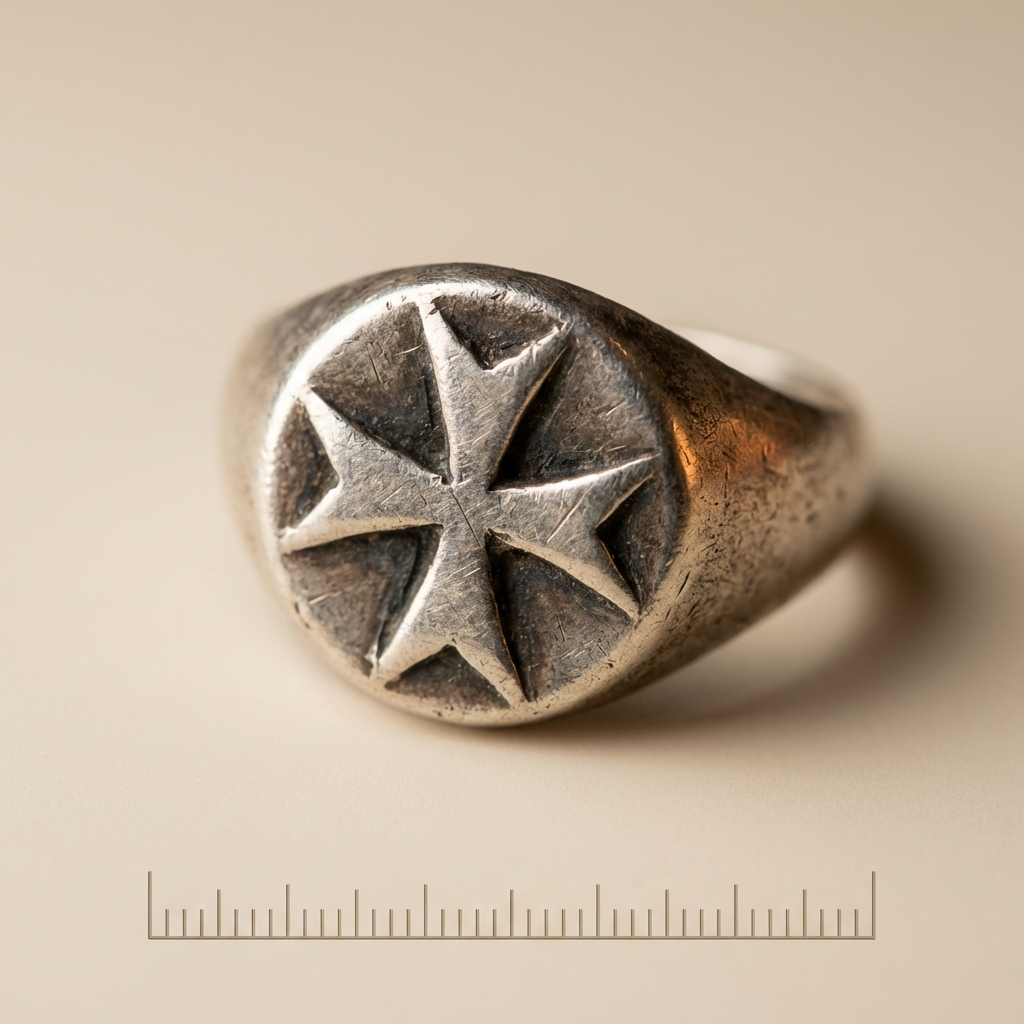
The Knights Templar were a distinct, papally recognised military order founded in the early 12th century with a formal monastic rule and international properties, which differentiates them clearly from the broader category of crusaders who lacked permanent institutional structures Knights Templar overview
This institutional recognition brought legal privileges and a central leadership that administered houses and property across regions, so evidence of sustained institutional presence is a key factor when considering whether an object could be Templar in origin Foundational study of the order
Templar organisation included a Grand Master and a chain of command that handled finances, property and military logistics, a structure that produced documentary traces such as charters and seals rather than uniform daily dress items that survive consistently in the archaeological record Order structure and records
For collectors this means that a ring attributed to the Templars ideally needs supporting documentary evidence or a strong provenance that ties it to the order's institutions rather than relying solely on a motif that appears in many other contexts Documentary basis for Templar identity

The combination of religious vows and military service meant Templar houses supported standing military roles, fortifications and administrative networks, which tends to leave documentary and architectural traces rather than routinised personal insignia that can be unambiguously read from a single ring Order military and administrative structures
The order combined monastic observance with military duties, giving members a distinct social position that often appears in charters, seals and account rolls rather than always producing clear, exclusive emblems on small personal objects Templar identity in records
Collectors should therefore expect that confirming Templar membership for a ring will usually rely on combined evidence such as seal impressions, find context or documentary references rather than a single recurring motif Museum guidance on crusader rings
Templar vows, military role and legal separation from other crusaders
Administrative marks and order signals
Where order membership is visible it tends to be through seals, charter endorsements and central records; such administrative marks are more persuasive evidence for institutional connection than a cross or star motif alone because they can be tied to named houses or accounts Charters and seals
Material marks that can be tied to an order typically come with supporting provenance or find context, so cautious collectors rely on documentation rather than motif-only attributions Order signals in museum records
Material culture overview: common symbols on crusader era rings and small objects
Typical Christian motifs and pilgrimage markers
Rings and small objects from the crusader period commonly show Christian motifs such as various forms of the cross, pilgrimage stars and saints; these images were popular devotional markers and circulated widely among different social groups British Museum object notes
Because these motifs are widespread, a single cross or star should not be taken as proof of membership in a specific military order; provenance and technical data must be combined with iconographic analysis to move from suggestive to persuasive attribution Medieval gold signet ring, Collections Online, Amgueddfa Cymru, Museum Wales, Cardiff. Recent comparative studies support this view Metal Artifacts of the Crusader Kingdom of Jerusalem
What appears frequently versus what is order specific
Many motifs appear frequently across contexts, while order specific signals such as the red cross on a white mantle appear in documentary sources but are less reliably preserved as unique, exclusive signs on small metalwork without other evidence Templar insignia in records
Museum catalogues advise treating common motifs as shared devotional language rather than as conclusive insignia for a named order unless other lines of evidence support the claim Medieval gold signet ring, Collections Online, Amgueddfa Cymru, Museum Wales, Cardiff
How to read a medieval crusader ring: a practical framework
Start with dating and typology
Begin any assessment by fixing the likely date range and typological family of the ring, because a plausible temporal assignment excludes or supports connections to specific campaigns or orders, and comparative typology is the first step in responsible crusader ring identification Ring, Victoria and Albert Museum, London
A crusader is any participant in medieval crusading movements, including pilgrims and temporary combatants, while a Templar was a member of a papally sanctioned military order with monastic vows, central leadership and legal privileges.
Next, examine iconography, manufacture style, condition and any restoration notes in sequence; this stepwise approach helps separate features that are original from later repairs and reveals whether motifs were likely added as part of the original design or are later interventions Condition and iconography assessment
Assess iconography, wear and condition notes
Check how motifs sit within the overall design, observe wear consistent with age, and read restoration notes carefully because stabilisation or repair can obscure original details that are central to an attribution Archaeological materials, Icon, The Institute of Conservation (UK)
When provenance is thin, technical study such as microscopy, metal composition analysis or die comparison can be decisive, and collectors should ask sellers for any available technical reports or permission to have a specialist examine the object in person Technical checks guidance
Identification limits: when an object can and cannot be called Templar
Why a single motif is rarely sufficient
A single motif such as a cross or star is rarely sufficient to call a ring Templar because similar motifs circulated widely and were used by many different social groups; museum curators caution that attribution requires combined evidence Museum caution on single motifs
Popular Templar imagery may have been adopted informally by non members, so attributions that rest only on motif similarity should be treated as provisional and described accordingly in any listing or catalogue entry Iconography and adoption notes
Importance of seals, charters and provenance
The most persuasive evidence for order membership comes from seals, charters or secure find context that can be tied to named houses or accounts rather than from decorative motifs alone Documentary evidence importance
If a ring can be linked to a documented inventory, sealed parcel, or a securely recorded find the attribution gains substantial weight, but absent those links collectors should avoid categorical labels and prefer qualifiers such as attributed to or possibly associated with Prefer cautious attribution language
Dating, provenance and technical study methods collectors should expect
Comparative typology and stylistic dating
Comparative typology matches design features and manufacturing traits with dated examples in museum collections and published catalogues, and it is often the first method used to narrow a production date for an antiquity VII., The Medieval Jewellery from the Fishpool, Nottinghamshire, Hoard, Cambridge University Press
Workshop attribution can remain an open question for many items, so collectors should expect a degree of uncertainty and ask for the specific basis of any claimed workshop or regional attribution Workshop attribution limits
When technical analysis is warranted
Technical tests such as metallurgy, X-ray fluorescence, microscopic wear analysis or die study can help confirm manufacturing techniques and relative chronology, and sellers should disclose any such reports or allow access for independent study when a buyer requests them Technical testing overview. See technical analyses such as this MDPI article on heraldic rings
Ask for exact documentation like collection history, prior ownership notes and verification letters where available, because these items materially change attribution confidence compared with a motif-only claim Research report: export licensing and provenance, GOV.UK, Department for Culture, Media and Sport (DCMS)
Decision criteria for buyers: a concise evaluation checklist
Minimum documentation to look for
Before purchase, insist on clear photographs, measurements, readable condition notes, and any provenance references; these minimum items allow an initial assessment and reduce the chance of misattribution when combined with the workflow above Minimum listing expectations
Where possible, ask for before and after images for any restoration, exact language describing what was stabilised or repaired, and any technical test results that exist for the metal or any set stones E.C.C.O. Professional Guidelines (II): Code of Ethics, European Confederation of Conservator-Restorers'
Condition and restoration considerations
Restoration can stabilise an object without altering its iconography, or it can obscure and complicate reading; condition notes that detail materials and methods used in conservation are therefore essential to evaluate whether motifs are original E.C.C.O. Professional Guidelines (II): Code of Ethics, European Confederation of Conservator-Restorers'
Use conditional language when describing attributions, and prefer phrasing that reflects evidence strength such as possibly, attributed to, or consistent with rather than definitive claims when provenance is incomplete Conservative attribution language
Common attribution mistakes and red flags to avoid
Overreliance on a single motif
Relying on a single motif is a frequent mistake; motifs circulated widely and the same cross or star design can appear on objects from different regions and periods, so a single-feature attribution is weak without corroboration Common attribution errors
Red flags include vague provenance, inconsistent dating statements, and signs of modern tool marks or artificial aging; these cues should prompt caution and further technical enquiries before any purchase Research report: export licensing and provenance, GOV.UK, Department for Culture, Media and Sport (DCMS)
Ignoring poor or missing provenance
Items with missing or vague provenance make confident attributions difficult and increase the risk that a piece is mislabelled; prefer items with transparent collection history and documented prior ownership where possible Provenance importance
When provenance is thin, seek independent technical study or consult published comparanda before accepting claims that a ring belonged to a specific order VII., The Medieval Jewellery from the Fishpool, Nottinghamshire, Hoard, Cambridge University Press
Practical examples and scenario walkthroughs
Scenario: strong provenance and documentary support
A hypothetical ring that comes with a documented collection history, matching inventory mentions and a secure find context allows a confident attribution that would stand up to comparison with museum examples; documentary links such as inventories or sealed parcel notes materially raise attribution confidence Documentary evidence example
In such a case technical checks still add value but are less urgent for establishing order membership because the provenance chain supplies the principal link to institutional records When provenance is strong
Scenario: ambiguous provenance and suggestive iconography
A second scenario has a ring with evocative Templar-like imagery but no collection history; here the correct approach is to treat the piece as possibly associated and to seek typological matches and technical tests before accepting a firm label Ambiguous case approach
Documentary evidence such as a matching seal impression or an archival mention would be decisive in upgrading the attribution from possible to probable, while absence of such links means a conservative listing is the responsible choice Signet Ring, Victoria and Albert Museum, London
Scenario: no provenance and common motifs
A third scenario shows a ring with a common cross motif and no provenance; without find context or technical study the safest description is a crusader period devotional ring or an unattributed medieval ring, and sellers should not label it as Templar without further evidence No provenance guidance
In this situation, collectors can request technical analysis or comparative photography to museum examples, but should expect a conservative attribution unless new evidence appears Conservative handling
Preservation, restoration and what condition notes mean for collectors
Typical conservation treatments and how they are described
Conservators commonly stabilise active corrosion, consolidate fragile joins and record any repairs; good condition notes state exactly what was done and why, which helps assess whether iconography remains legible after treatment E.C.C.O. Professional Guidelines (II): Code of Ethics, European Confederation of Conservator-Restorers'
Request before and after images when conservation has occurred and ask for precise language in restoration notes so you can judge whether a reading of motifs is secure or compromised by intervention Restoration transparency
How condition affects legibility of motifs
Wear, corrosion and previous repairs can obscure or alter design details, so readable motifs are only useful for attribution when condition notes confirm they are original and not the result of later tooling or reconstruction Archaeological materials, Icon, The Institute of Conservation (UK)
When motifs are partially worn, technical imaging can sometimes recover faint details that are otherwise invisible to the naked eye and so change the interpretation of an object for collectors and scholars alike Imaging and detail recovery
Conclusion and a concise buying checklist for collectors
Five quick steps before you consider purchase
1. Fix the likely date and typology through comparative references and ask for the basis of the dating claim HID IN THE EARTH AND SECRET PLACES: A REASSESSMENT OF A HOARD OF LATER MEDIEVAL, Cambridge University Press
2. Review clear photos, measurements and condition notes including any restoration descriptions Condition checklist
3. Seek provenance documentation such as collection history, prior ownership notes or verification letters and treat absence of these as a risk factor Research report: export licensing and provenance, GOV.UK, Department for Culture, Media and Sport (DCMS)
4. Where order attribution is claimed, ask for documentary links such as seals, charters or find context that can be independently checked Order attribution checks
5. When in doubt, request technical study or consult a specialist before accepting a firm label and prefer cautious language in any description Technical study step
Collectors seeking responsibly presented pieces can look for sellers who provide clear documentation, condition and restoration notes, and transparent provenance references; Aurora Antiqua aims to present such context and to help buyers understand the evidential basis for attributions when relevant. Browse our medieval crusader rings collection or see the 'Bethlehem' listing for example listings.

Check typology and stylistic dating against museum comparanda, request clear photographs and measurements, and seek any provenance or find context; technical tests help when provenance is weak.
No. Crosses and stars were widespread devotional symbols; Templar attribution usually needs combined evidence such as seals, charters or secure provenance.
Ask for clear photos, condition and restoration notes, measurements, collection history, prior ownership notes and any verification letters or technical reports.
More from Aurora Antiqua
References
- Medieval gold signet ring, Collections Online, Amgueddfa Cymru, Museum Wales, Cardiff
- Finger ring, London Museum (formerly Museum of London)
- Ring, Victoria and Albert Museum, London
- VII., The Medieval Jewellery from the Fishpool, Nottinghamshire, Hoard, Cambridge University Press
- HID IN THE EARTH AND SECRET PLACES: A REASSESSMENT OF A HOARD OF LATER MEDIEVAL, Cambridge University Press
- Signet Ring, Victoria and Albert Museum, London
- Research report: export licensing and provenance, GOV.UK, Department for Culture, Media and Sport (DCMS)
- Archaeological materials, Icon, The Institute of Conservation (UK)
- E.C.C.O. Professional Guidelines (II): Code of Ethics, European Confederation of Conservator-Restorers'