


Looking for the real thing? Browse genuine ancient artifacts for sale, each piece one of one, individually authenticated, with documented provenance. For the background, see the guide to ancient jewelry.
What we mean by ancient Egyptian engagement rings: definition and scope
Why modern terms can mislead
The phrase ancient egyptian engagement rings is an anachronistic label when applied to objects from Pharaonic and later Egypt, and needs careful definition before it is used in catalogues or popular writing. Researchers and curators typically use more neutral terms such as ancient ring, signet, or finger ring because the archaeological record does not always support a single, uniform ritual equivalent to modern engagement or wedding practice Encyclopaedia Britannica overview on marriage in ancient Egypt
For this article the term is used as a working shorthand to discuss rings found in Egyptian contexts that may have been exchanged, worn as personal markers, or used in amuletic or administrative roles. The goal is to separate the object type from a specific social function unless that function is supported by context or inscription.
Possibly in individual cases, but the evidence is case dependent. Textual, pictorial, and grave-group associations can suggest exchange, yet direct proof of a widespread wedding-ring ritual is limited and requires specific contextual or inscriptional support.
Scope: time periods and social contexts covered
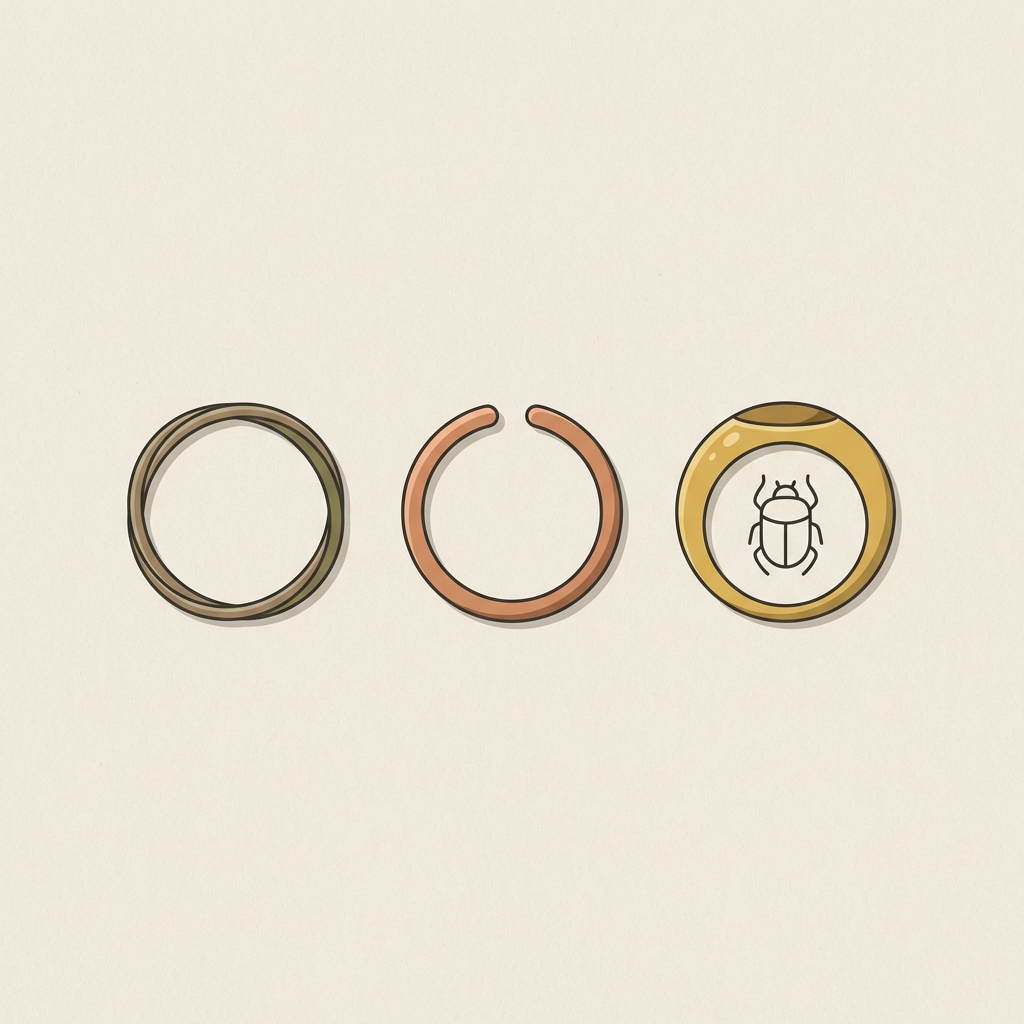
The survey ranges from Predynastic and Early Dynastic reed and braided loops through New Kingdom metal and intaglio rings to Ptolemaic and Roman period adaptations, noting variation by period and social context. Where possible the discussion ties forms to museum catalogue evidence rather than broad generalisations Metropolitan Museum Heilbrunn Timeline on Egyptian jewelry
Because preservation biases favour metal and stone, and because textual and pictorial sources are selective, the article avoids claiming a uniform practice across social strata and emphasizes conditional language where interpretation is uncertain.
Early forms and a short timeline: from reed loops to intaglios
Predynastic and Early Dynastic reed and braided-fiber loops
The earliest ring-forms in Egypt appear as simple loops made from reeds, braided fiber or leather, documented in Predynastic and Early Dynastic contexts; these organic bands served as practical finger loops and may also have held symbolic value in some contexts Metropolitan Museum Heilbrunn Timeline on Egyptian jewelry Discover Magazine overview of ancient ring history
These organic examples seldom survive in common museum displays because plant and leather materials decay, so written catalogues and careful excavation records are the primary evidence for their early use. Their presence in burial assemblages suggests personal value but not a single defined social ritual.

These organic examples seldom survive in common museum displays because plant and leather materials decay, so written catalogues and careful excavation records are the primary evidence for their early use. Their presence in burial assemblages suggests personal value but not a single defined social ritual.
By the New Kingdom copper-alloy, silver and gold rings with more complex mounts and carved stone intaglios become visible in the archaeological record, often catalogued in museum collections and curatorial overviews British Museum collection highlights on Egyptian jewellery
Intaglio stones such as carnelian and steatite were carved and set into bezels; in many cases these rings functioned as personal display, amulet, or signet, and their craftsmanship reflects workshop practices that matured over centuries.

Common materials, stones and manufacturing techniques
Organic materials and their preservation challenges
Organic ring-forms, including reed and leather loops, are among the earliest evidence for finger rings in Egypt but are underrepresented in museum holdings because of preservation bias. Modern collections therefore show a relative abundance of metal and stone examples compared with the earliest organic types Metropolitan Museum Heilbrunn Timeline on Egyptian jewelry
See provenance and restoration notes behind the scenes
When examining listings, always check whether organics are reported as original finds or modern reconstructions, and ask for context and high resolution images of joins or repairs.
Metals, gemstones and carving techniques
Copper-alloy, silver and gold dominate surviving rings, often with stone inlays such as carnelian and occasionally steatite; intaglio carving produced recessed designs that could be used decoratively or as seals, and the choice of stone was often driven by symbolic and material preferences recorded in museum literature Gemstones. In: UCLA Encyclopedia of Egyptology (James A. Harrell), University of California, Los Angeles
An intaglio is a carved or incised design set into a gemstone so the image can leave a raised impression when pressed into soft materials. Surface patina and wear patterns are important condition signals for dating and for assessing whether a stone is ancient, later reused, or a modern replacement.
An intaglio is a carved or incised design set into a gemstone so the image can leave a raised impression when pressed into soft materials. Surface patina and wear patterns are important condition signals for dating and for assessing whether a stone is ancient, later reused, or a modern replacement.
Symbolism and functions: eternity, amulets and signets
Circularity as symbolic form
The circular form of the ring is often read in Egyptian scholarship as resonant with ideas of continuity and eternity, themes commonly expressed in funerary and amuletic materials; such symbolic readings are plausible but should be tied to contextual evidence rather than assumed for every example Metropolitan Museum Heilbrunn Timeline on Egyptian jewelry
Interpretation varies by period and object type; an intaglio bearing a religious motif used in a burial context may carry a different meaning from a plain hoop worn in daily life.
Rings as amulets versus administrative tools
Some rings clearly functioned as amulets, bearing protective imagery, while others served as signets or seals with administrative utility; both roles appear in museum catalogues and curatorial notes, and context determines which reading is stronger for a given piece Overview chapter on the Jewellery of Ancient Egypt
Recognising whether a ring was primarily amuletic or administrative requires looking at associated find context, wear patterns on the bezel, and any surviving impressions or inscriptions.
What the evidence says about rings used in marriage and personal exchange
Textual and pictorial clues
Direct archaeological evidence that rings consistently served as formal marriage tokens in ancient Egypt is limited; textual and pictorial sources plus tomb associations suggest rings could be exchanged, but they do not prove a universal wedding-ring ritual equivalent to modern practice Encyclopaedia Britannica overview on marriage in ancient Egypt. Popular summaries in the gem and jewelry literature offer different origin narratives GIA article on the origin of wedding rings and a brief history of wedding rings.

Grave-group associations and limits of interpretation
Grave-group evidence, such as paired rings or rings found alongside other personal items, can hint at exchange or paired ownership, but such patterns are circumstantial and require careful documentation and provenance to support claims about marriage association British Museum collection highlights on Egyptian jewellery
For writers and collectors the best practice is to present marriage associations as possible interpretations supported by specific contextual evidence rather than as definitive statements.
Regional change and Hellenistic influence in the Ptolemaic and Roman periods
Stylistic shifts and cross-cultural exchange
Ptolemaic and Roman period finds show clear Hellenistic and Roman stylistic influences on Egyptian rings, including portrait intaglios and new mounting styles that reflect workshop exchange and changing tastes in ornamentation British Museum essay on jewellery in Ptolemaic and Roman Egypt. See comparable examples in our ancient Roman rings collection.
Stylistic markers such as naturalistic portraiture on intaglios or certain bezel forms can signal Hellenistic influence, but attribution to a specific workshop or cultural meaning should be made cautiously and with provenance where possible.
Check catalogue and essay sources for Hellenistic features
Compare images and descriptions across sources
Identifying Hellenistic features in Egyptian rings
Concrete features to look for include portraiture carved in the intaglio, refined bezel mounts that match Mediterranean fashions, and workshop markers noted in catalogue entries; these characteristics help place an object within a later Ptolemaic or Roman context Smithsonian Magazine overview of ring history Discover Magazine
Even when Hellenistic elements are present, they do not automatically change local symbolic practices, and each object should be read against its find context and associated documentation.
Dating, attribution and best practices for collectors
Estimating date ranges and stating uncertainty
Collectors should describe dating as an estimate and reference comparable museum catalogue entries or curatorial overviews when available, noting the degree of certainty and what stylistic markers support the attribution British Museum collection highlights on Egyptian jewellery. Compare proposed dates with items in our rings collection when seeking stylistic parallels.
Where possible include measurement data, high resolution photos of the bezel and any marks, and a short statement of what features determine the proposed date range.
Using provenance and catalog references
Provenance and collection history notes often include prior ownership, sale records, or catalogue citations; these details are essential for assessing whether a ring was excavated with secure context or is available only through trade/collection notes Metropolitan Museum Heilbrunn Timeline on Egyptian jewelry
Sellers should be asked to provide any existing documentation and to avoid overstating claims about function or social meaning when context is absent.
Condition notes, restoration and provenance: what to expect in listings
Typical condition descriptions on authentic listings
Common condition language includes patina, stabilized corrosion, repaired mounts, and missing inlays; these descriptors help set expectations about integrity and visible alterations and should be specific about what was observed during examination British Museum collection highlights on Egyptian jewellery
Patina and wear patterns can indicate long term use, but they are not proof of a particular function such as marital exchange without supporting context.
How restoration is recorded and why that matters
Restoration notes should specify what was stabilized, what was repaired, and what was left untouched; transparent description helps buyers judge whether later interventions affect interpretation or display suitability Metropolitan Museum Heilbrunn Timeline on Egyptian jewelry
Well documented restoration and clear provenance references increase confidence in academic phrasing and responsible listing language.
Decision criteria: how to judge a listing that claims a ring has marriage associations
Checklist of documentary and contextual signs to look for
Key items of evidence include explicit inscriptions or dedications, linked provenance indicating paired ownership, contemporaneous textual support for exchange, and secure archaeological context; items lacking these elements should be presented as possible but not proven marriage tokens Encyclopaedia Britannica overview on marriage in ancient Egypt
Request clear photographs of any inscriptions, excavation records, and comparable catalogue entries before accepting claims of marital association.
When to ask for more information or decline
Ask for third party reports, high resolution images, and lineage of ownership when provenance is vague; if a seller cannot provide documentation or the claim rests only on stylistic similarity, exercise caution and consider seeking specialist advice British Museum collection highlights on Egyptian jewellery
Typical mistakes and red flags in listings and research claims
Overstated provenance or vague paperwork
Vague claims such as undocumented old family provenance or unspecified excavation origins are common red flags and should prompt requests for more detailed collection history or paperwork before purchase British Museum collection highlights on Egyptian jewellery
A lack of collection history may mean a piece entered trade without archaeological context, limiting what can be claimed about its social use.
Misreading stylistic similarities as proof of function
Stylistic similarity to a museum piece does not establish identical function; careful reading of context and documentation is necessary to avoid conflating appearance with role in life or ritual Metropolitan Museum Heilbrunn Timeline on Egyptian jewelry
When in doubt, prefer conditional phrasing in descriptions and captions rather than definitive function claims.
How to write accurate catalogue captions and listing copy for ancient rings
Example phrasing that balances context and caution
Use sentences that state observable facts first, then present interpretation as conditional, for example: "Gold finger ring with carnelian intaglio, likely New Kingdom style; catalogues show similar forms used as amulets and seals, and dating is estimated based on bezel form and patina." Such phrasing ties a claim to observable features and to comparative literature Encyclopaedia Britannica overview on marriage in ancient Egypt
Avoid asserting marital use unless there is inscriptional or secure contextual evidence linking the object to a documented ceremony or paired ownership.
How to cite references and provenance
References should be precise: cite museum catalogue entries, publication titles, and any accession numbers or sale records when available. If provenance includes previous collections, list dates and sources rather than vague phrases. This level of detail allows readers to verify claims independently Metropolitan Museum Heilbrunn Timeline on Egyptian jewelry
Include restoration notes directly in the caption and reference any third party reports that support the condition statement.
Practical examples and scenarios: reading three typical listings
Scenario A: a New Kingdom gold ring with intaglio and good provenance
Listing: "Gold ring with carved intaglio, documented in a 19th century collection, comparable to New Kingdom examples in museum catalogues." If supporting paperwork and comparative references are provided, the ring can be described with conditional dating and links to similar catalogue entries Metropolitan Museum Heilbrunn Timeline on Egyptian jewelry
Action: Request excavation or sale documentation, clear photos of the intaglio, and any accession numbers; present marriage association only if the item has inscriptional evidence or paired provenance.
Scenario B: a Ptolemaic-style carnelian ring with uncertain origin
Listing: "Ptolemaic-style carnelian intaglio ring, origin unknown." With uncertain origin and no excavation records, treat dating as a stylistic estimate and avoid asserting social function; compare the piece to documented Ptolemaic examples before accepting period claims British Museum essay on jewellery in Ptolemaic and Roman Egypt
Action: Seek high resolution images and condition notes, and ask whether the stone has been re-set or altered in modern times.
Scenario C: a fiber-loop replica or restored piece
Listing: "Fiber loop ring, presumed antiquity." Reproductions and later restorations of organic loops are common because organics rarely survive intact. If provenance or specialist testing is absent, label the item as reproductions or uncertain and explain the basis for any age estimate Metropolitan Museum Heilbrunn Timeline on Egyptian jewelry
Action: Ask for laboratory reports if organics are claimed to be ancient, and treat surgical or modern stitching and adhesives as indicators of recent repair or reconstruction.
A practical checklist for buyers and writers
Immediate checks before purchase
Before buying, confirm these items: clear photos with scale, measurements, condition notes, provenance statements with dates and sources, and references to comparable museum objects that support dating or attribution Encyclopaedia Britannica overview on marriage in ancient Egypt
If any of these are missing, request them before proceeding and be prepared to decline if documentation cannot be provided.
Documentation to request and retain
Request detailed provenance, any third party or laboratory reports, and close up photos of marks or inscriptions. Retain copies of all communications and documents for future reference and potential resale or study British Museum collection highlights on Egyptian jewellery
When in doubt consult a qualified specialist or a reputable museum curator for a second opinion.
Conclusion and further reading
Key takeaways
Rings are present across Egyptian periods in a variety of materials from organic loops to metal and intaglio rings, but the archaeological record provides limited direct evidence that rings consistently functioned as formal marriage tokens in the way modern engagement rings do; contextual proof and careful provenance remain essential for such claims Metropolitan Museum Heilbrunn Timeline on Egyptian jewelry
Writers and sellers should use conditional language, cite museum catalogues and curatorial overviews when possible, and avoid asserting marital function without concrete supporting evidence.
References and where to read more
Start with major museum overviews and catalogue entries, then consult specialized curatorial essays for Ptolemaic and Roman period changes; these sources provide the necessary comparative material to support responsible descriptions and attributions Encyclopaedia Britannica overview on marriage in ancient Egypt and our Questions and Answers blog.
Further study in museum catalogues and peer reviewed essays will improve certainty in dating and interpretation without overstating the available evidence.
Direct evidence is limited. Textual and pictorial clues, and some grave associations, suggest rings could be exchanged but do not prove a universal wedding‑ring ritual comparable to modern practices.
Early rings could be made from reeds or braided fiber, while surviving examples are often copper alloy, silver, gold, and carved stones such as carnelian or steatite, with organics underrepresented due to preservation.
Use conditional phrasing tied to specific evidence, cite comparable museum catalogues when available, and request provenance or inscriptional proof before making definitive claims.
More from Aurora Antiqua
References
- Ring, Victoria and Albert Museum, London
- Finger Ring with Frog, The Cleveland Museum of Art
- Gemstones. In: UCLA Encyclopedia of Egyptology (James A. Harrell), University of California, Los Angeles
- Faience Technology. In: UCLA Encyclopedia of Egyptology (Paul T. Nicholson), University of California, Los
- Aulus Gellius, Attic Nights, Book X, LacusCurtius, Bill Thayer, University of Chicago (Loeb Classical Library edition)
- Pliny the Elder, The Natural History, BOOK XXXIII, Perseus Digital Library, Tufts University (edition Bostock)
- Scarab. In: UCLA Encyclopedia of Egyptology (Kathlyn M. Cooney), University of California, Los Angeles
- Research report: export licensing and provenance, GOV.UK, Department for Culture, Media and Sport (DCMS)
From Aurora Antiqua
We sell authenticated ancient & medieval pieces, each individually examined before listing and backed by a Lifetime Authenticity Guarantee. One of a kind, sold once, never reproduced.
Browse Ancient Artifacts →