


Looking for the real thing? Browse authenticated ancient artifacts — each piece one-of-one, individually authenticated, with provenance.
What an ankh ring is: a concise definition and why it matters
Quick definition of the ankh symbol
The ankh is the ancient Egyptian hieroglyph most commonly translated as life or breath of life, a short written and visual sign that appears across Egyptian religious texts and art; for a clear reference entry see the Encyclopaedia Britannica Encyclopaedia Britannica.
How the ankh appears in personal adornment and rings
In material culture the ankh shows up both as stand‑alone amulets and as iconographic motifs on objects worn by people, including rings where the sign can be either a mounted bezel or an integral sign‑shaped form; museum collection records demonstrate this variety in practice Metropolitan Museum of Art collection entry and MFA collection entry.
A ring with an ankh motif can therefore mean different things depending on how it was made and used: it may be a direct continuation of Egyptian amulet practice, or a later reuse or revival of the motif in a different cultural context, so the object's context matters as much as its appearance Journal of Egyptian Archaeology article.

Why collectors should care
For collectors and history minded buyers a ring with an ankh motif can be meaningful as wearable heritage, but it also demands careful documentation: a confident attribution to an ancient Egyptian context usually rests on provenance, typological comparison, or laboratory analysis rather than visual appeal alone Journal of Egyptian Archaeology article.
How the ankh functioned in ancient Egyptian belief and material culture
Religious and funerary roles
Egyptological consensus links the ankh to life, life‑force and the concept of the breath of life, and this association appears consistently in religious scenes across long stretches of Pharaonic history, from Old Kingdom monuments through the Ptolemaic period Encyclopaedia Britannica.
Use museum entries and typology guides to compare items
Start with the museum record and condition photos
Because the ankh appears frequently in funerary and temple imagery and is often depicted being held by deities, Egyptologists read it as both a theological symbol and a protective sign; museum objects recorded as ankhs likewise tend to be amuletic in purpose Metropolitan Museum of Art collection entry.
Depictions in art and who holds the ankh
Artwork and reliefs regularly show gods and goddesses presenting or holding ankhs to rulers and deceased individuals, a gesture that supports readings of the sign as communicative of life or divine favor in ritual contexts Encyclopaedia Britannica.
Continuity across dynastic periods
Museum records and object catalogues demonstrate the ankh's continued presence in material culture over many dynastic centuries, which is why typological and contextual evidence is important when interpreting a single wearable object British Museum collection record.
How ankh motifs appear on rings: materials, typologies, and common forms
Full ankh-shaped rings versus mounted ankh bezels
In surviving examples the ankh can be executed as an integral ring form, where the sign itself is the hoop or top, or as a mounted bezel or inlay attached to a conventional ring hoop; museum descriptions note both approaches in practice Metropolitan Museum of Art collection entry.
Typical materials and manufacturing signs
Ankhs and ankh motifs appear in a wide range of materials including gold, faience, bronze and carved stone, and practical typologies record how different materials and techniques tend to leave distinct markers that help with dating and attribution Smithsonian Magazine essay and Art Institute entry.
See behind-the-scenes checks and context on @auroraantiqua
When assessing an ankh motif on a ring, check condition notes and provenance early; clear photos and documented history are essential before concluding age or origin.
When a ring bears an ankh as a mounted bezel, look for how the bezel is fixed to the hoop, the join techniques and any evidence of later soldering or repairs, since these visible manufacturing and conservation details often indicate whether a motif was original or added later Metropolitan Museum of Art collection entry.
What patina, wear and repairs commonly look like
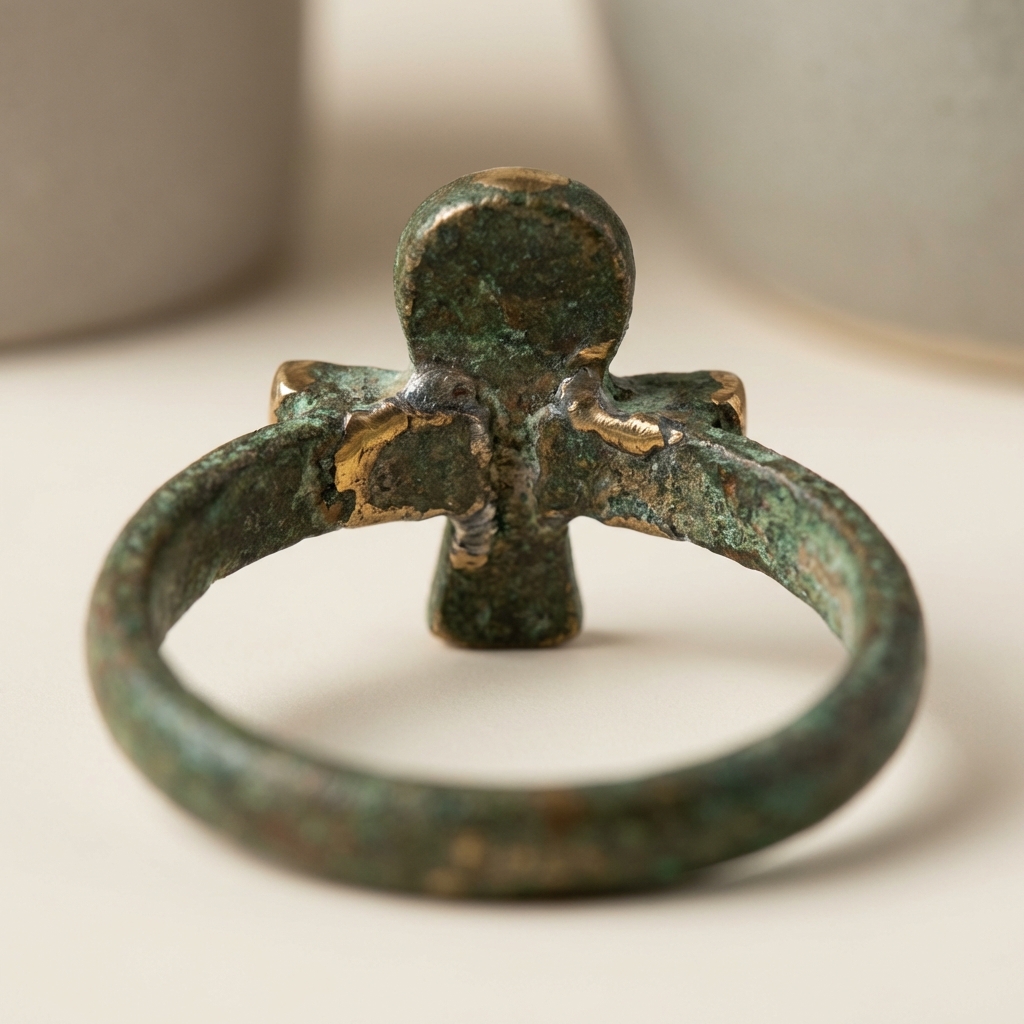
Patina and corrosion patterns vary by material, but consistent surface weathering, wear at contact points and coherent corrosion between a bezel and its hoop can suggest contemporaneous ageing, while inconsistent patina or fresh solder marks can point to later alteration British Museum collection record.
Condition notes from museum and curatorial records are therefore useful models: they describe stabilisation, any conservation work carried out, and visible repairs, which collectors should ask sellers to provide when ankh motifs are present Metropolitan Museum of Art collection entry.
How to evaluate age and provenance: a practical framework
Key documentary and photographic evidence to request
Start by requesting clear, high resolution images from multiple angles, measurements, and explicit condition notes that describe patina, joins and any restoration work; museum practice lists these elements as basic documentation for comparative study Metropolitan Museum of Art collection entry.
Next, prioritise collection history or provenance statements: a documented chain of ownership, prior collection references or catalogue entries greatly improves the reliability of a dating or cultural attribution British Museum collection record.
Typology and comparison with museum examples
Typological comparison with well documented museum objects is a core step: match shape, material, manufacturing marks and decorative details against catalogued ankh examples to see whether a ring fits known patterns from particular periods or workshops Journal of Egyptian Archaeology article. For comparative reference, also consult Aurora Antiqua's Ancient Roman Rings collection for examples of catalogued typologies.
Focus on documented provenance, high-resolution photos showing patina and joins, clear condition and restoration notes, and comparative typology with museum-recorded examples before accepting claims of ancient attribution.
When to seek scientific or specialist reports
If documentary and typological checks leave uncertainty, consider requesting scientific analysis or an independent specialist report; techniques such as metallurgical testing, thermoluminescence for ceramics, or conservation assessments can provide data tied to manufacture and material that visual inspection alone cannot supply Journal of Egyptian Archaeology article.
Bear in mind that precise attribution to a workshop or decade is often not possible without secure provenance or comparative typology backed by scientific data, so any firm dating claim without those supports should be treated cautiously Journal of Egyptian Archaeology article.
Common mistakes and red flags when assessing ankh rings
Over-reliance on style alone
Dating a ring by perceived stylistic similarity alone is a common error; scholarly practice emphasises contextual evidence and typology rather than visual impression as the primary basis for attribution Journal of Egyptian Archaeology article.
Confusion with revival or reproduction examples
Historical reuse and later revivals of the ankh sign, from Victorian era appropriations to Coptic Christian adaptations and modern fashion pieces, mean that similar forms can be found in many periods and contexts, complicating attribution if documentation is missing Smithsonian Magazine essay.
Problematic or missing documentation
Watch for specific red flags: vague or unverifiable provenance statements, photographs that hide joins or the ring interior, inconsistent patina between components, and the absence of conservation notes or prior examination records; museum records show these are legitimate concerns when assessing an object Metropolitan Museum of Art collection entry.
When several red flags appear together, treat the attribution as uncertain and consider asking for more documentation or an independent condition report before a purchase decision Metropolitan Museum of Art collection entry.
Practical examples and scenarios: reading three sample listings
Museum-documented ankh amulet used as a ring bezel
Scenario: a listing includes high resolution images, measurements, a collection entry number and a conservation report describing the amulet and how it was set into a modern hoop. In such cases, comparison with museum records can show whether the amulet matches known types and whether the mounting is recent; museum entries provide models for the level of documentation expected Metropolitan Museum of Art collection entry.
Actionable next step: request copies of the collection entry or catalogue citation and any conservation reports, and ask for close photos of the bezel interior and joins before accepting ancient attribution British Museum collection record.
A 19th century revival-style ankh ring
Scenario: a ring shows a carefully modelled ankh motif but the maker's marks, wear patterns and metalwork techniques align with 19th century manufacture. Historical essays on reuse and revival explain how motifs were repurposed in later tastes, and such context helps reframe meaning away from an ancient Egyptian religious function Smithsonian Magazine essay.
Actionable next step: seek documentation tying the item to 19th century ateliers or exhibition histories, and treat any claimed Pharaonic origin as unlikely without strong provenance or testing Journal of Egyptian Archaeology article.
A modern fashion ankh ring with no documentation
Scenario: an attractive ankh motif offered without measurements, with a modern soldered hoop and no provenance claims. Without documentation or specialist reports, the reasonable conclusion is that the piece is a contemporary or recent reproduction with symbolic use rather than an antiquity Smithsonian Magazine essay.
Actionable next step: either decline if the buyer needs an authentic antiquity, or request a returnable trial and clear condition photos if the buyer accepts a modern piece as a motif-driven accessory.
Conclusion: a buyer checklist and responsible language for describing an ankh ring
Short checklist for safe buying
Checklist essentials: ask for high resolution photos, measurements, clear condition and restoration notes, documented provenance or collection history, and any available conservation or laboratory reports; museum practice recommends these items as minimal documentation Metropolitan Museum of Art collection entry.
How to phrase evidence-based descriptions
Model language for listings and enquiries: date material as an estimate, describe materials as listed or as they appear, and note that attribution is based on available documentation; avoid absolute claims without supporting provenance or scientific reports Journal of Egyptian Archaeology article.
Where to find further trustworthy references
Begin with major collection entries and scholarly typology as starting points for comparison; the Encyclopaedia Britannica and curated museum records are useful reference anchors for basic definitions and catalogued examples Encyclopaedia Britannica.
For collectors seeking curated pieces and careful context, Aurora Antiqua presents curated pieces with condition notes, provenance style references and restoration explanations to help make informed choices.
Look for secure provenance, high-resolution photos showing joins and interior marks, coherent patina across components, and any conservation or laboratory reports; without these, treat the piece as uncertain.
Request clear images, measurements, condition and restoration notes, collection history or prior catalogue references, and any conservation or lab reports available.
Historically the ankh is linked to life and protective functions, but on rings its meaning depends on context and period; later revivals and modern fashion use the motif with different intentions.
References
- https://www.britannica.com/topic/ankh
- https://auroraantiqua.com/collections/rings
- https://collections.mfa.org/objects/102/ankh
- https://www.jstor.org/stable/3822097
- https://auroraantiqua.com/products/roman-silver-ring-auriga-red-jasper-intaglio-of-cock-drawing-a-chariot-driven-by-a-mouse-1st-3rd-century-ad-eu-57-us-7-5
- https://www.britishmuseum.org/collection/object/Y_EA66448
- https://www.metmuseum.org/art/collection/search/544367
- https://www.metmuseum.org/art/collection/search/548476
- https://www.smithsonianmag.com/history/egyptian-symbols-ankh-reuse-2024-10/
- https://www.artic.edu/artworks/136258/amulet-of-an-ankh
- https://auroraantiqua.com/collections/ancient-roman-rings
- https://auroraantiqua.com/
- https://auroraantiqua.com/collections/artifacts