


Looking for the real thing? Browse our ancient artifact collection, each piece one of one, individually authenticated, with documented provenance. For the background, see the guide to ancient jewelry.
Intro: why the question matters for collectors and curious readers
For collectors and history minded buyers the question Which god has an ankh? is not merely academic but directly relevant when interpreting images, assessing authenticity and deciding whether an object fits a collection. An ankh ring or similar small item can carry iconographic meaning that affects dating, attribution and the kinds of provenance one should seek.
Museum catalogues and standard reference works provide a shared baseline for reading the sign, so collectors benefit from comparing listing claims to those records rather than relying on sweeping assertions in a sales description. In many cases, clear provenance and careful condition notes are what reliably separate an informed purchase from a risky one, and that perspective informs the guidance below.

Aurora Antiqua presents curated ancient rings with contextual notes so buyers can see condition, documented repairs and collection history when available. This article aims to add that curator perspective without making provenance claims about any single unsourced item. See our rings collection for related examples.
What is the ankh: definition and historical context
The ankh is an ancient Egyptian hieroglyphic and iconographic sign most commonly interpreted as representing life, both earthly and eternal, a reading reflected in encyclopedias and museum glossaries; this definition helps explain why the sign appears in a broad set of ritual and funerary contexts Encyclopaedia Britannica ankh entry.
In temple, tomb and ritual imagery the ankh typically appears in scenes of bestowal, protection and resurrection, where gods, pharaohs or ritual agents hold, offer or receive the sign. Museum object records and department summaries make clear that the sign functions as both a written hieroglyph and a visual motif in many media Encyclopaedia Britannica ankh entry.
Which god has an ankh? A short overview of associations
Short answer: multiple figures can appear with the ankh, but two deities are the clearest and most consistently attested in temple and funerary imagery. Understanding which god is shown depends on iconographic context, the accompanying attributes, and where the scene was used in ritual or tomb decoration Encyclopaedia Britannica ankh entry.
Isis and Osiris are the principal deities most often pictured with the ankh, yet the sign also appears with other gods and with pharaohs in scenes that emphasize life, kingship and ritual bestowal. For collectors this means a single depiction does not always carry a single interpretation; the wider scene matters.
Reading these scenes requires attention to clothing, accompanying symbols and the overall pose of the figure. Where museum records or catalogue descriptions are available they give comparative examples that help avoid overstating a piece s meaning British Museum ankh collection term.
@auroraantiqua curator notes and behind the scenes
When examining listings, consult condition notes and provenance statements alongside iconographic descriptions so the visual interpretation is supported by documentary context rather than taken alone.
Isis and the ankh: why she is so often shown with it
Isis is one of the principal deities frequently shown holding or receiving the ankh in temple and funerary imagery, a pattern that reflects her roles in protection, rebirth and magical acts on behalf of the living and the dead Encyclopaedia Britannica Isis entry.
Scenes of Isis offering or holding the sign commonly occur in funerary contexts where she acts as a protective and restorative figure, and historians read these gestures in light of her broader mythic functions. This association does not by itself date an object precisely, but it gives a reason for careful comparison with published parallels.
Osiris and the ankh: life, resurrection and rulership
Osiris is likewise regularly shown with the ankh, often in contexts that emphasize resurrection or the restoration of life to the deceased or to a ruler. Standard Egyptological references note this recurring depiction in funerary and kingly bestowal scenes Encyclopaedia Britannica Osiris entry.
These representations connect the ankh to ideas of afterlife and legitimate kingship, which is why Osiris holding the sign often appears in compositions tied to funerary theology and royal ideology.
Isis and Osiris are the deities most consistently shown with the ankh in Egyptian temple and funerary imagery, but the sign appears with other gods and pharaohs and must be read in context with provenance and supporting documentation.
For a buyer, the critical question is whether the depiction and documentation together support the claimed date and provenance, because iconography alone can suggest function without proving age or origin.
Other deities, kings and the ankh: broader uses
Beyond Isis and Osiris, gods such as Anubis or Horus and pharaohs themselves appear with the ankh in ritual scenes where the sign serves a general function related to life, power or divinely conferred status. Museum glossaries and object records show examples across periods where the ankh functions in these broader roles Encyclopaedia Britannica ankh entry.
The frequency and nuance of these appearances can change by period and by the specific ritual context; for collectors this underlines the need to compare a ring motif to dated, published parallels before leaning on an iconographic label as proof of period.
Ankh on ancient rings and jewellery
On ancient jewellery the ankh appears both as an incised or cast motif and occasionally as a suspended charm or adapted bezel motif on rings, with museum departments documenting these variants in collection pages and curatorial overviews The Metropolitan Museum of Art Egyptian Art department. See a comparative example at an Egyptian ring listing.
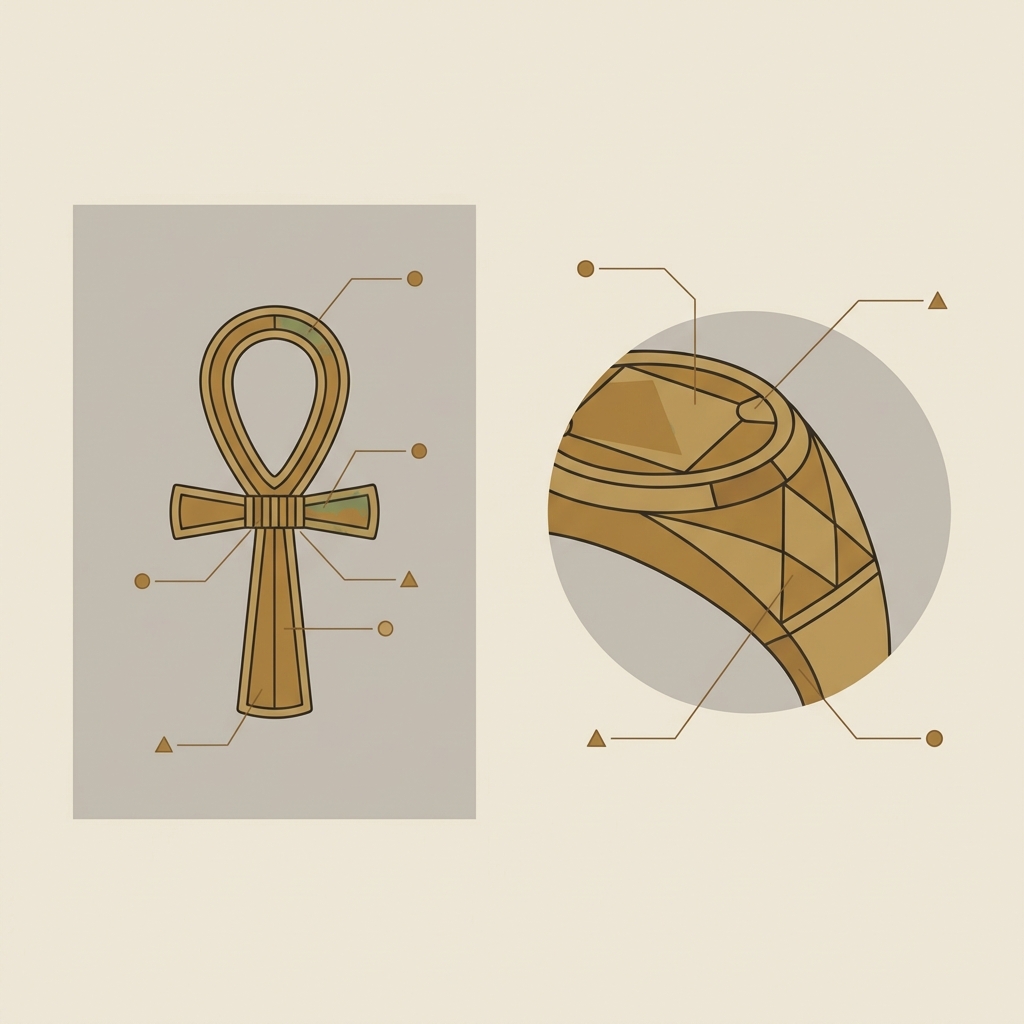
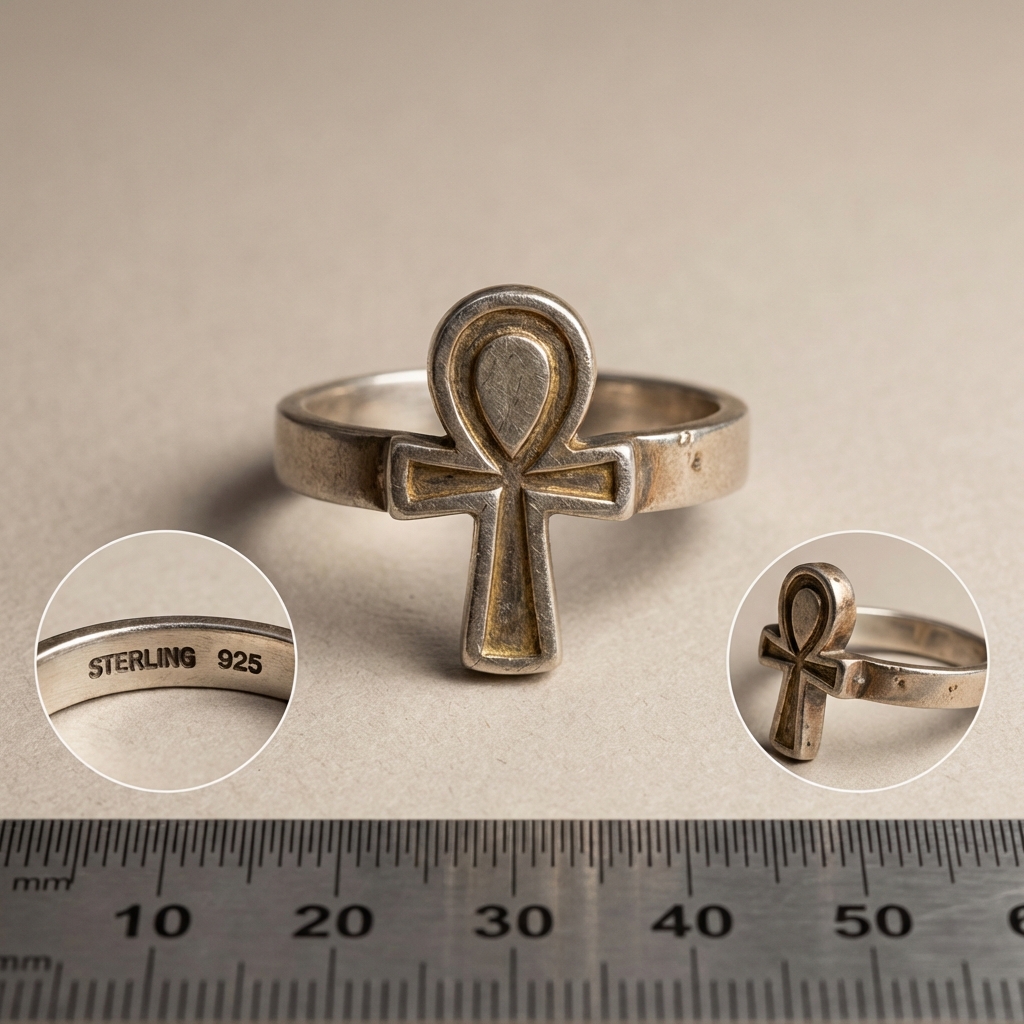
When the ankh is adapted to a ring bezel it is often stylised so that the loop and arms fit the available space, and the motif can show wear consistent with handling and contact. Close examination of bezel proportions, intaglio lines and patina helps determine whether the motif and the mounting share the same age or whether later alteration is possible.
short provenance and photo checklist for ring bezels
Use for preliminary seller evaluation
Collecting photos that show the bezel from multiple angles, a clear scale and any maker s marks is essential. Museum entries that record similar bezel adaptations provide useful comparison points, so use those references when a listing lacks detailed provenance.
How to evaluate an ankh ring: provenance, condition and testing
When assessing an ankh ring start with provenance documentation: look for collection history, prior ownership notes, verification letters and catalogue references where available. Provenance records are central to a trustworthy attribution and are frequently cited by museums and responsible dealers as part of an object s documentation UNESCO 1970 Convention. For practical advice on verifying a seller s story see a guide on evaluating provenance.
Next, examine condition notes and restoration records in the listing. A consistent patina across the bezel and hoop, documented repairs and clear restoration notes that describe what was stabilised or left untouched are important. Where such notes are absent, request them and compare images to known examples from museum collections The Metropolitan Museum of Art Egyptian Art department.
If provenance is incomplete or raises questions, specialist reporting and material testing are recommended. Tests such as XRF for metal composition or petrographic analysis for stones can clarify whether materials match expected ancient alloys or gem choices, and these methods are typical components of expert assessments rather than automatic proof of age.
Practical checklist for initial due diligence includes verifying provenance entries, asking for high resolution images of bezel details and hallmarks, and requesting written restoration notes. If a seller cannot or will not provide these items, treat the absence as a red flag rather than a minor omission.
Legal and ethical buying: UNESCO 1970 and best practice
Museums and reputable dealers commonly reference this framework when discussing legal acquisition, so when provenance notes mention legal export documentation or prior cataloguing by a recognised institution those claims merit careful verification through original paperwork or third party checks.
When documentation cannot be established, many experienced buyers and advisors recommend declining a purchase rather than accepting uncertain provenance, because legal and ethical risks can include loss of the object or long term reputational harm for a collection.
Dating and attribution: limits and open questions
Precise dating for small jewellery items can be difficult because workshop practices, recycling of metal and later remounting can obscure original manufacture. Museum and curatorial literature note that some small types require close comparison with published parallels and sometimes material testing to narrow a date range The Metropolitan Museum of Art Egyptian Art department.
Where museum publication is lacking, conservative attributions are appropriate; seek catalogue comparisons, specialist opinions and, if justified, targeted scientific analysis before accepting a narrow date or provenance claim for a ring.
Common mistakes and red flags when buying ankh rings
Common listing signals that require caution include missing or vague provenance, images that lack bezel detail or scale, and condition descriptions that omit restoration notes. Such gaps are frequent reasons to ask follow up questions before bidding or buying The Metropolitan Museum of Art Egyptian Art department. For tips on spotting hallmarks and authenticity see a guide on authentic vintage jewellery.
Other red flags are confident authenticity claims without documentation, modern additions to mounts that do not match patina, or hallmarks inconsistent with claimed period metallurgy. Document questions in writing and request further photographs or test reports when a listing raises doubts.
Practical scenarios: short case studies for collectors
Scenario A, guarded purchase: a ring with ankh bezel is offered with clear collection history, dated exhibition records and detailed restoration notes. In such a case a buyer might proceed after confirming documents, obtaining high resolution images and, if needed, a short specialist report confirming material consistency. Museum comparison points and catalogue references can help corroborate the timeline The Metropolitan Museum of Art Egyptian Art department.
Scenario B, pause and verify: a visually convincing ankh motif appears in photos but the seller provides no provenance, only brief condition remarks and no hallmarks. Here the prudent path is to request full imagery, a written restoration statement and, if uncertainty remains, a third party opinion or refusal to buy until testing and documentation are available. The legal framework and best practice guidance argue for caution when provenance is unclear UNESCO 1970 Convention.
Conclusion and next steps for interested collectors
Key takeaways: Isis and Osiris are the most commonly associated deities with the ankh in temple and funerary scenes, but the symbol appears with other gods and pharaohs and must be read in context. For collectors the highest priorities are provenance, condition notes and appropriate testing before purchase Encyclopaedia Britannica Isis entry.
Next steps include comparing a candidate ankh ring to published museum records, asking sellers for full provenance and restoration notes, and seeking specialist reports when documentation is incomplete. Following these steps helps align collecting practice with ethical and legal expectations and with curatorial standards. For further reading and community Q&A see our questions and answers hub.
Look for clear provenance, consistent patina across bezel and hoop, detailed restoration notes and, when needed, specialist material testing; if documentation is lacking, seek expert advice before purchase.
No; deity imagery indicates iconographic meaning but does not by itself prove a specific date. Use catalogue comparisons, provenance and testing to support dating.
Expect collection history, prior ownership notes, any export or import paperwork, written restoration notes and, where available, verification letters or catalogue references.
More from Aurora Antiqua
References
- Amulet of an Ankh, inv. no. 1894.103, Art Institute of Chicago
- A Newly Discovered “Bull Head Amulet” from Tell El-Farkha, Egypt, Ksiegarnia Akademicka
- scarabée ; amulette, Louvre site des collections, Musee du Louvre, Departement des Antiquites egyptiennes, Paris
- The Fitzwilliam Museum, Amulet: E.281.1896, University of Cambridge
- Emergency Red List of Egyptian Cultural Objects at Risk, International Council of Museums (ICOM), Paris
- Red Lists Database, International Council of Museums (ICOM)
- Federal Register, U.S. Customs and Border Protection, Department of Homeland Security
- Research report: export licensing and provenance, GOV.UK, Department for Culture, Media and Sport (DCMS)