


Looking for the real thing? Browse genuine Roman coins for sale — each piece one-of-one, individually authenticated, with provenance.
What is an ancient Roman coin necklace? Definition and historical scope
Clear definition and what counts as a coin necklace
An ancient roman coin necklace is, in practical terms, a struck Roman coin that has been modified so it can be worn suspended as jewellery or an amulet, often by piercing, bezel mounting or by adding a suspension loop, and presented as an object of personal display or protection. Evidence from major collection and interpretive essays shows that converting coins into wearable items is attested across the Roman world and into later, Byzantine contexts, where many coins were repurposed as personal ornaments, not only as currency, which helps define the scope of what collectors call a coin necklace Metropolitan Museum of Art essay on Roman jewellery.
For clarity, this definition covers pierced coins, coins set into bezels, and coins with later attached loops that were clearly intended for suspension; it excludes modern reproductions and recent costume conversions unless the seller explicitly describes them as modern work or replicas. In museum and find records the distinction between ancient conversion and modern alteration is important for interpretation and for value, so where possible look for documentation that explains when a coin was modified Portable Antiquities Scheme guidance on coin pendants.

Time range and geographic spread (Republic to Late Antiquity and beyond)
The practice of adapting coins for wear is not limited to a single century or province; archaeological and museum records indicate conversions occur from the Roman Republic through the Imperial period, into Late Antiquity and, in many cases, continue into Byzantine contexts where coinage remained an element of personal display. This geographic and chronological breadth means that items described broadly as coin necklaces may date to very different periods and regions, and a careful description should note the likely period or provide reasoned dating where possible British Museum overview of Roman jewellery.
How Roman coins were converted into necklaces: common techniques
Piercing and drilling
Piercing and careful drilling through the coin field or behind the portrait is one of the simplest and most common ways coins were made wearable; archaeological finds and Portable Antiquities Scheme records show drilled coins across many regions and periods, often with holes sized to accept a cord or wire suspension, and with wear around the hole consistent with long use Portable Antiquities Scheme guidance on coin pendants.
Bezel-mounting and suspension loops
Bezel-mounting, where a thin metal rim is formed to hold the coin edge and a loop is soldered or formed into the rim, is another frequent solution; suspension loops can also be added by folding the coin edge or by attaching a separate mount, and these methods are recorded in both museum collections and archaeological reports which note stylistic variation by region and period Cambridge Core article on coin pendants and reuse.
See behind-the-scenes on @auroraantiqua
When evaluating a listing or image, consult clear condition and mounting photos and ask the seller for close-up images of drill holes, bezel joins, and the coin's edge to help judge whether the conversion appears contemporary to the coin or the result of later tooling.
Signs of contemporary mounting versus later alteration
Practical signs that a mount may be contemporary to the coin include consistent corrosion or patina across the join, tool marks that match ancient tooling practice, and wear patterns indicating long use rather than fresh cutting or filing; researchers and conservators often use these visual cues, alongside technical tests, to distinguish ancient mounting from recent alteration Cambridge Core article on coin pendants and reuse.
What did wearing a Roman coin necklace mean? Symbolism and social uses
Imperial portraiture, deities and common motifs
Coins commonly show imperial portraits, gods and goddesses, and widely recognised symbols; when worn as pendants these motifs could communicate political allegiance, show closeness to a ruler or dynasty, or serve as an expression of personal identity, and curatorial essays make clear these readings are part of how museums interpret coin jewellery Metropolitan Museum of Art essay on Roman jewellery.
Social messages: allegiance, status, protection and amuletic uses
Across many find records and numismatic case studies, coin pendants appear to have operated on multiple levels: as status markers or badges of allegiance, as visible signs of connections to imperial authority, and sometimes as protective amulets where iconography was read for its protective or religious connotations, a range of social meanings well attested in numismatic and museum literature American Numismatic Society discussion on coins as jewellery.
Interpretation depends on iconography, find context and technical evidence; coins could signal allegiance, status or serve as amulets, but dating and meaning are provisional without provenance or specialist analysis.
Regional and chronological variations in meaning
Meaning varied by region, date and social context; a coin used as a pendant in a provincial market town may have been read differently from one carried by a soldier on campaign, and the same motif could be reinterpreted across time, which is why many specialists caution against single, definitive readings without context Metropolitan Museum of Art essay on Roman jewellery.
Why iconography can mislead: reuse, long use-lives and dating limits
Coins worn long after minting and implications for dating
Coins were often worn and reused long after their minting, sometimes centuries later, so an iconographic date does not always indicate when the coin was converted to jewellery; archaeological recording and museum notes emphasise that long use-lives make single-datum dating unreliable without supporting context Portable Antiquities Scheme guidance on coin pendants.
Why iconography alone is insufficient
Because coins circulated widely and could be altered at different times, iconography should be treated as provisional evidence for dating unless supported by find context, metallurgical testing or die-matching; specialist numismatic methods are often needed to refine an estimate and avoid a misleading attribution British Museum overview of Roman jewellery.
Technical indicators experts use: metal, patina, edges and mounting clues
Metal composition and patina cues
Analysts use metal composition and patina as basic indicators: different alloys and surface chemistry can suggest a likely period and circulation history, while a consistent patina across coin and mount may point to an earlier, contemporaneous conversion rather than a recent addition Cambridge Core article on coin pendants and reuse.
Quick inspection worksheet to record visible features
Use as a starting checklist for documentation
Edge, strike and wear patterns
Edges and strike characteristics can help: struck edges, clipping patterns, and die flaws are numismatic clues that can be compared against catalogued specimens, and consistent wear across the flan, portrait and fields may indicate extended use before conversion; specialists sometimes use die-matching as part of this process to narrow attribution Cambridge Core article on coin pendants and reuse.
Indicators of contemporary mounting versus later repairs
Evidence that a mount is contemporary includes solder and join methods visible under magnification and corrosion patterns that cross the join between coin and mount; conservation research notes recommend combining visual inspection with XRF or metallurgical testing when available to reduce uncertainty about timing of alteration British Museum research notes on authentication and conservation.
Authentication and careful buying: provenance, condition and conservation notes
What good provenance and documentation look like
Provenance and collection history are primary risk-reduction tools for buyers: clear documentation, previous collection references, or museum accession details materially improve confidence in an item's history, and reputable sellers will provide the chain of custody or references to prior catalogues when available British Museum research notes on authentication and conservation.
How restoration and conservation notes affect interpretation
Condition and restoration notes should be transparent about what was stabilised, cleaned or repaired; an honest description that notes in situ consolidations, removed encrustation or modern soldering helps buyers understand whether a coin necklace is substantially original or has been significantly reworked American Numismatic Society discussion on coins as jewellery.
When to seek third-party specialist assessment
When provenance is incomplete or the mounting looks suspicious, seek independent numismatic assessment or conservation reporting; a third-party report can include XRF composition analysis, die-matching, and a condition survey that separates original features from later interventions and reduces the risk of buying an example with modern alterations British Museum research notes on authentication and conservation.
Museums examples and documentation
Museums often present coin pendants with detailed interpretive notes that explain the conversion technique, likely date range, and conservation history; these entries are useful models for what good documentation looks like and illustrate how curators balance iconographic interpretation with technical evidence Metropolitan Museum of Art essay on Roman jewellery. For additional context and recent institutional reporting, see the British Museum press materials British Museum press release.
Portable Antiquities Scheme find examples and what they reveal
Find reports recorded by the Portable Antiquities Scheme complement museum examples by showing a range of local practices and a high incidence of pierced coins in some regions, which informs how scholars understand local conversion habits versus market-driven remounting Portable Antiquities Scheme guidance on coin pendants. See the Portable Antiquities Scheme annual reviews for broader reporting and summaries of finds PAS Vision and reviews, and recent reporting on county-level treasure finds provides supplementary context recent media coverage.
How to read a listing: walk-through of a good documentation set
A well-documented listing should include high-resolution obverse and reverse photos, edge detail, close-ups of any mount joins or holes, weight and measurements, clear condition and restoration notes, and any collection history; when those elements are present, the listing becomes a practical tool for roman coin jewelry identification and reasoned assessment American Numismatic Society discussion on coins as jewellery.
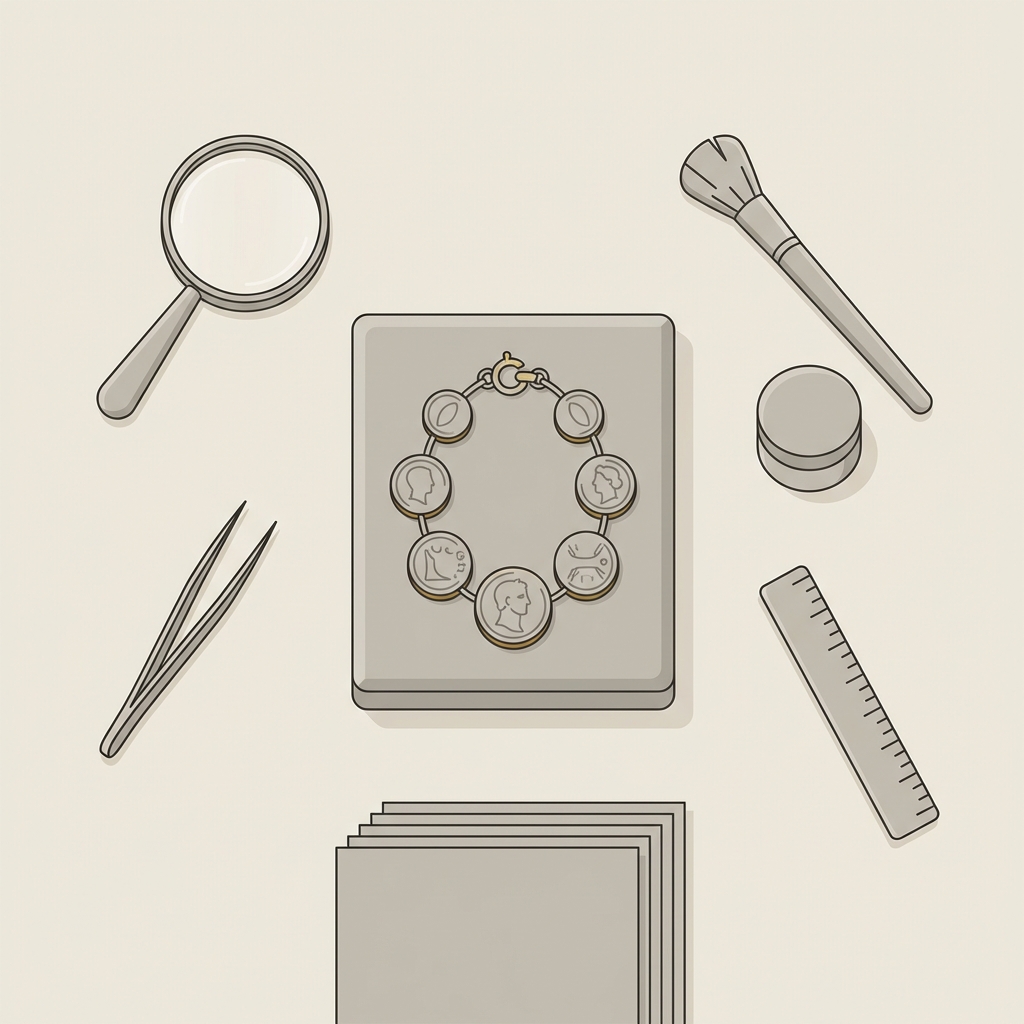
In many cases, curated sellers such as specialist antiquities dealers will add provenance notes or reference past auctions and catalogues; these references are not guarantees, but they do help reconstruct a collection history that can be compared with public records.
A practical checklist for collectors: documenting and recording a purchase
Minimum photos and measurements to request
Ask for clear obverse and reverse photos, a detailed edge shot, measurements (diameter and thickness) and the weight; these basic data points allow preliminary comparison with catalogued types and help flag unusual conservation or later alteration British Museum research notes on authentication and conservation.
Documentation and questions to ask sellers
Request provenance or collection history, restoration and conservation notes, and any third-party reports; ask directly whether drilling, soldering or other modification occurred before or after the coin left circulation, and whether any testing such as XRF has been performed British Museum research notes on authentication and conservation.
How to store and care for an ancient coin necklace
For storage, keep the pendant in a stable, dry environment away from rapid temperature or humidity change, use inert materials such as acid-free tissue or museum-grade boxes, and avoid aggressive cleaning; if conservation is needed, seek a trained conservator rather than attempting home restoration American Numismatic Society discussion on coins as jewellery.
Conclusion: reading meaning responsibly and buying with care
Summary of main points
Roman coin necklaces often carry layered meanings, from political allegiance to personal protection, and were produced by a variety of simple modification techniques across many centuries; however, interpreting a single piece requires care, because coins were reused and remounted long after minting and iconography alone is rarely decisive Metropolitan Museum of Art essay on Roman jewellery.
Final guidance for collectors
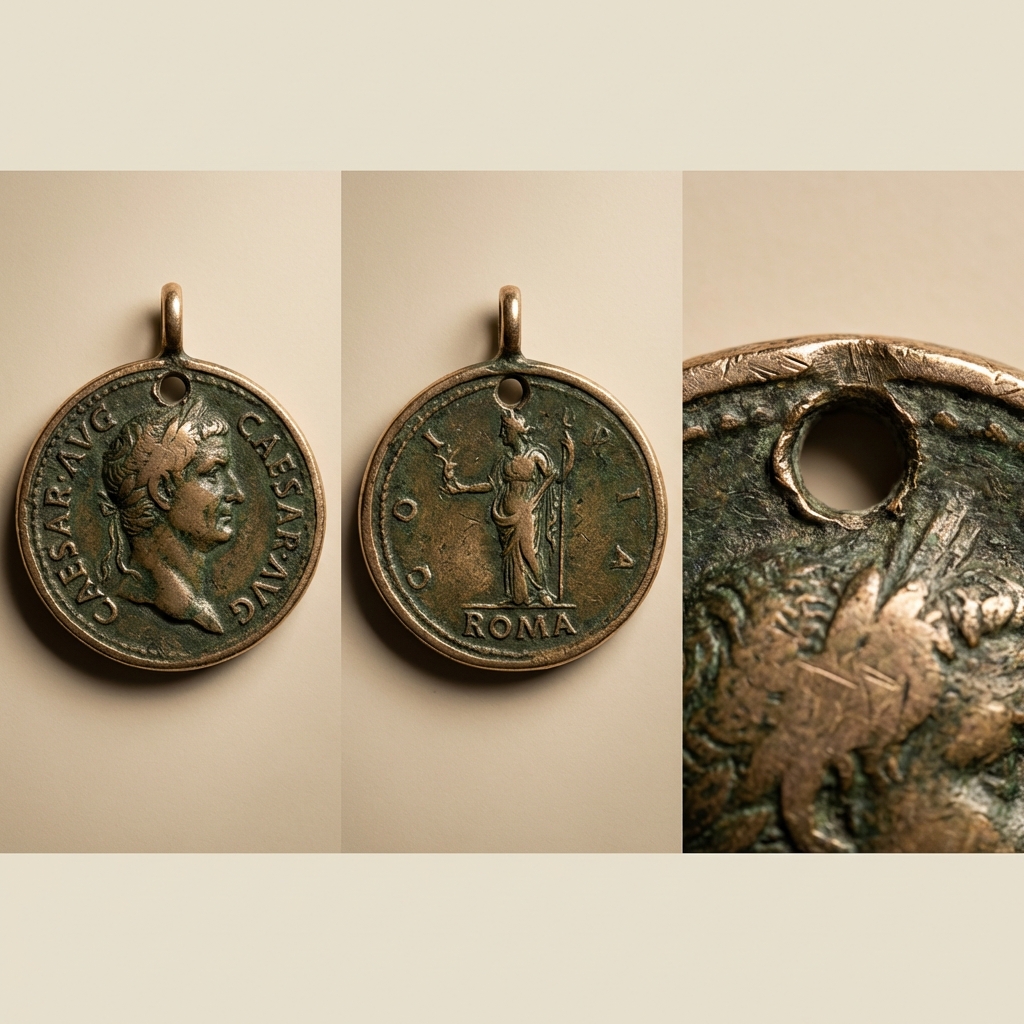
Aurora Antiqua presents condition notes and documented context for curated pieces to help buyers understand an item's history and condition, and buyers should expect similar transparency from other reputable sources when evaluating acquisitions.
Common mistakes and red flags: fakes, modern alterations and over-reliance on images
Signs of modern tooling and unreliable photographs
Common red flags include fresh tool marks, uneven or mismatched patina between coin and mount, crude soldering, or obvious modern drill holes; images that crop edges or fail to show obverse, reverse and edge views make it hard to judge these signs, so request additional photos if a listing is unclear British Museum research notes on authentication and conservation.
Misinterpreting modern repairs as ancient
Modern repairs can be presented or photographed in ways that mimic age; look for sharp filing marks, unfinished joins, or recent tool scratches that cut into original surfaces, and treat unattributed claims about antiquity with caution until supported by documentation or specialist assessment Cambridge Core article on coin pendants and reuse.
Overconfidence in unattributed claims
If a seller or listing makes strong claims about age, ritual use, or provenance without paperwork, slow down and ask for the underlying evidence; clear provenance, conservation notes, and independent assessments reduce the reliance on images alone and help separate authentic ancient conversion from modern fabrication American Numismatic Society discussion on coins as jewellery.
Practical examples and case scenarios from museums and PAS records
Museum examples: curated coin pendants with documentation
Museums often present coin pendants with detailed interpretive notes that explain the conversion technique, likely date range, and conservation history; these entries are useful models for what good documentation looks like and illustrate how curators balance iconographic interpretation with technical evidence Metropolitan Museum of Art essay on Roman jewellery.
Portable Antiquities Scheme find examples and what they reveal
Find reports recorded by the Portable Antiquities Scheme complement museum examples by showing a range of local practices and a high incidence of pierced coins in some regions, which informs how scholars understand local conversion habits versus market-driven remounting Portable Antiquities Scheme guidance on coin pendants.
How to read a listing: walk-through of a good documentation set
A well-documented listing should include high-resolution obverse and reverse photos, edge detail, close-ups of any mount joins or holes, weight and measurements, clear condition and restoration notes, and any collection history; when those elements are present, the listing becomes a practical tool for roman coin jewelry identification and reasoned assessment American Numismatic Society discussion on coins as jewellery.
A practical checklist for collectors: documenting and recording a purchase
Minimum photos and measurements to request
Ask for clear obverse and reverse photos, a detailed edge shot, measurements (diameter and thickness) and the weight; these basic data points allow preliminary comparison with catalogued types and help flag unusual conservation or later alteration British Museum research notes on authentication and conservation.
Documentation and questions to ask sellers
Request provenance or collection history, restoration and conservation notes, and any third-party reports; ask directly whether drilling, soldering or other modification occurred before or after the coin left circulation, and whether any testing such as XRF has been performed British Museum research notes on authentication and conservation.
How to store and care for an ancient coin necklace
For storage, keep the pendant in a stable, dry environment away from rapid temperature or humidity change, use inert materials such as acid-free tissue or museum-grade boxes, and avoid aggressive cleaning; if conservation is needed, seek a trained conservator rather than attempting home restoration American Numismatic Society discussion on coins as jewellery.
Conclusion: reading meaning responsibly and buying with care
Summary of main points
Roman coin necklaces often carry layered meanings, from political allegiance to personal protection, and were produced by a variety of simple modification techniques across many centuries; however, interpreting a single piece requires care, because coins were reused and remounted long after minting and iconography alone is rarely decisive Metropolitan Museum of Art essay on Roman jewellery.
Final guidance for collectors
Prioritise provenance, clear condition and restoration notes, and specialist assessment where documentation is incomplete; use the checklist and example documentation practices discussed in this article when evaluating a potential purchase and treat claims about meaning as plausible interpretations rather than certainties American Numismatic Society discussion on coins as jewellery.
Look for consistent patina across coin and mount, wear around holes or joins, clear condition notes, and supporting provenance; when in doubt, request a conservation or numismatic report.
Not necessarily; portraits could signal allegiance, status, or be used as personal emblems or amulets, and interpretation depends on context and supporting evidence.
Request collection history or provenance notes, detailed condition and restoration descriptions, measurements and weights, and any existing conservation or laboratory reports.
References
- https://www.metmuseum.org/toah/hd/jwl/hd_jwl.htm
- https://finds.org.uk/news/2024/coin-pendants-and-personal-adornment
- https://auroraantiqua.com/products/roman-silver-ring-auriga-red-jasper-intaglio-of-cock-drawing-a-chariot-driven-by-a-mouse-1st-3rd-century-ad-eu-57-us-7-5
- https://www.britishmuseum.org/collection/galleries/roman-britain-jewellery
- https://www.cambridge.org/core/journals/antiquity/article/coin-pendants-reuse-and-identification-2024
- https://auroraantiqua.com/
- https://auroraantiqua.com/blogs/questions-and-answers
- https://auroraantiqua.com/collections/ancient-roman-rings
- https://numismatics.org/pocketchange/2024/03/12/coins-as-jewellery/
- https://www.britishmuseum.org/research/publications/research-notes/coin-pendant-authentication-conservation-2025
- https://www.britishmuseum.org/about-us/press/press-releases/british-museum-save-exquisite-henry-viii-pendant-nation
- https://finds.org.uk/publications/reviews/2025
- https://www.bbc.co.uk/news/articles/cm2yerrqel7o