


Looking for the real thing? Browse genuine ancient rings for sale, each piece one of one, individually authenticated, with documented provenance. For the background, see the guide to ancient jewelry.
What is an ancient amethyst ring? Definition and context
An ancient amethyst ring is, for collecting purposes, an antiquity in which a natural amethyst gemstone is set within a historical metal mounting whose date and style correspond to past periods such as Roman, Byzantine or medieval, and the piece is offered with some combination of condition notes, provenance and documentation. For buyers, the phrase "ancient amethyst ring" signals both an artifact and a wearable object, and it invites careful attention to how the stone's colour and the mount's history are recorded by the seller, because those records influence how likely the stone is to retain its original appearance. For context on how museums and collections present amethyst in archaeological jewellery, consult the British Museum discussion on ancient jewellery and amethyst use British Museum guide to ancient jewellery
Collectors value set amethyst in historical rings for a mix of material, iconographic and historical reasons: the stone's colour and cutting can indicate taste and workshop practices, while wear consistent with age, a readable bezel and documented provenance can help place the piece in a collecting history. Listings usually describe "condition notes" and may highlight whether the stone shows zoning, surface wear, or documented interventions; these notes are essential because apparent colour alone does not prove that a stone preserves its original hue. For how amethyst appears and is described in collection catalogues, see the British Museum guidance cited above British Museum guide to ancient jewellery
Why collectors value set amethyst in historical rings
Within collecting circles, amethyst's historical popularity and its range of purple tones make it a sought-after material for wearable history, but buyers should expect condition notes that explain any repairs, soldering or conservation that might have exposed the stone to heat or chemical cleaning. Sellers and curators often annotate a listing with provenance, restoration notes and any lab reports available; these documents help separate natural preservation from later alteration and are highly relevant when assessing whether a mounted stone reflects its original colour. For practical guidance on handling such gemstones in collections and reading condition statements, see conservation resources on gemstones and collection care CCI guidance on gemstones and collection care

How listings typically present colour, condition and provenance
Listings commonly include controlled-lighting photos, a short condition summary, and any provenance highlights such as prior collection history or documentation letters; buyers should treat these as the first line of evidence and follow up with specific requests for lab reports or additional images before purchase. When documentation is present it should be read carefully and used together with photo evidence to decide if an amethyst likely retains its natural tone or if recorded interventions could have changed its colour. Readers can learn more about the role of documentation and up-to-date lab reports from museum and gemological practice notes British Museum guide to ancient jewellery
How amethyst gets its original purple color
The purple hues we call amethyst are produced primarily by trace iron atoms incorporated into the quartz lattice together with radiation-induced colour centres; these combined mechanisms explain why tones vary from pale lilac to deep red-violet and why some crystals show flashes of red in certain light. This gemological consensus is summarized in modern reference material on amethyst colour mechanisms and remains the foundation for why collectors look for specific tones and zoning in mounted stones. For a concise technical overview of the chemistry and optics behind amethyst colour, see the GIA entry on amethyst GIA amethyst overview
In practice, the precise shade and saturation depend on how iron is distributed during crystal growth and on subsequent exposure to natural radiation; growth-related zoning often records those changes physically, so a single amethyst can contain bands of different tone. Because these internal zoning patterns are part of how the colour forms naturally, they are valuable visual clues for assessing whether a stone's hue is primary or the result of later treatment. For more on iron oxidation states and spectral evidence that explain purple versus yellow quartz, see the mineralogical literature Study on the effect of heat treatment on amethyst color and the cause, Springer Nature and a color mechanism study on color mechanisms
Suggest basic non-destructive tests to request
Request recent reports when possible
Trace iron and radiation-induced colour centres: the gemological mechanism
Trace amounts of iron incorporated into quartz occupy sites in the crystal lattice and, when combined with natural radiation, form colour centres that absorb specific wavelengths and produce the purple we recognise as amethyst. This explanation accounts for both the general presence of purple tones and the variability collectors observe, and it underpins why spectroscopy and careful visual inspection are recommended tools for assessing an ancient amethyst ring. For a modern review of colour mechanisms in amethyst and their diagnostic features, consult the Gems & Gemology review on amethyst and citrine Gems & Gemology review and comparative mineralogical studies on amethyst characteristics
How growth zoning and iron distribution control tone and saturation
During crystal growth, fluctuations in the availability of iron and in the local chemical and thermal environment create zones with different trace-element concentrations; where iron is slightly more concentrated or where the radiation history favours formation of stronger colour centres, tones become deeper and may show red-violet flashes. These internal growth patterns are often visible in controlled-light photos as banding or uneven saturation and are practical markers for collectors trying to identify original colour rather than uniform, treated colour. For a general discussion tying spectral evidence to iron distribution, see the American Mineralogist paper referenced above American Mineralogist discussion of iron and quartz colour
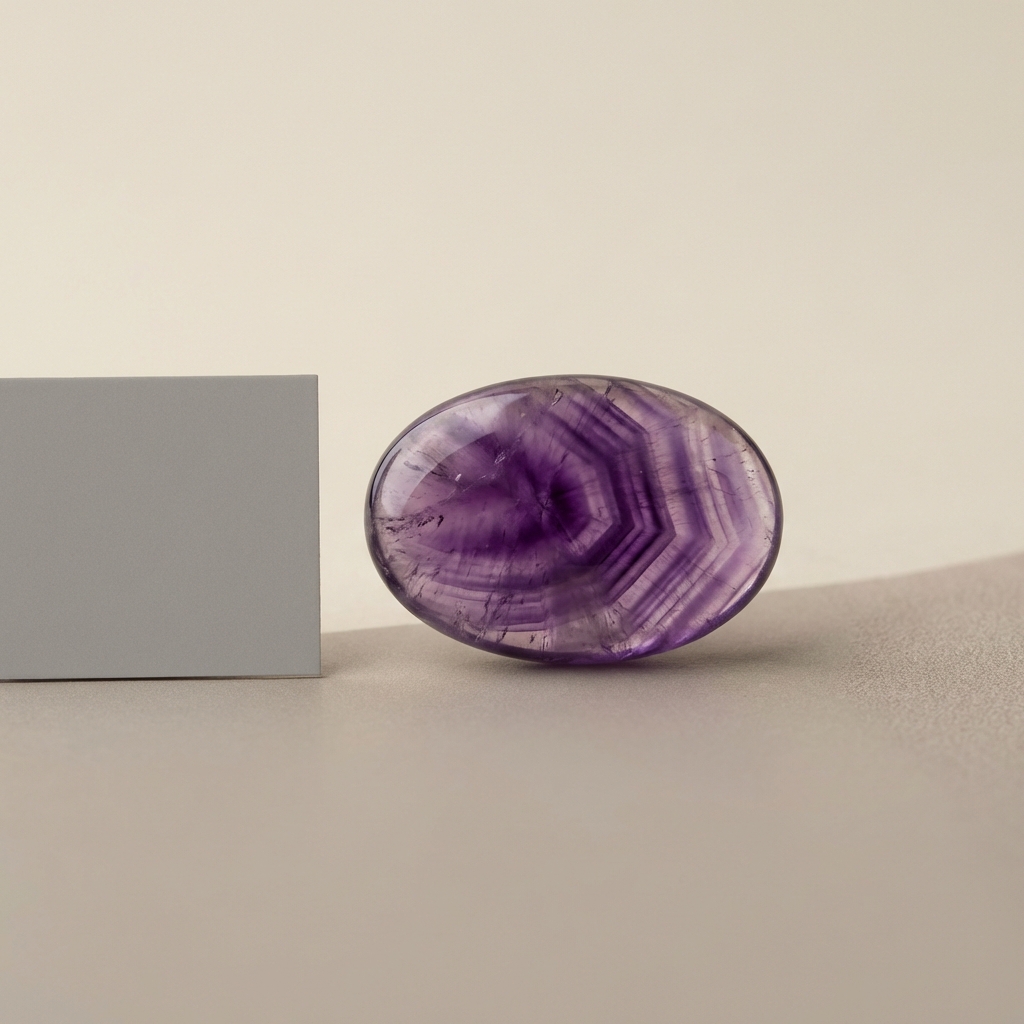
Natural amethyst colour can range from very pale lilac through medium purple to deep saturated purple with red-violet flashes, and many stones show growth-related zoning that creates visible bands or patches of differing tone; this natural variability is why the term "original colour" is best used carefully, as it may describe a range rather than a single, uniform hue. Looking at set stones, what a collector sees as the original colour should be judged against this natural variability and with awareness that some variance is expected even in untreated amethysts. For an accessible summary of how colour varies naturally in amethyst, see the GIA amethyst page GIA amethyst overview
Visual assessment alone can be misleading for set stones, because the bezel, metal reflections and surface wear influence perceived tone; controlled-lighting photography and angled views are better at revealing zoning and true saturation. Close-up photos that use neutral background and standard light sources make zoning easier to interpret and provide a reproducible record for later comparison if a conservator or gemologist is asked to test the stone. For guidance on photographic protocols and interpreting colour in mounted gemstones, consult collection care resources on gemstone stability CCI guidance on gemstones and collection care
Examples of colour range and zoning visible in set stones
Practical examples include a Roman intaglio ring where the amethyst shows a darker central band and paler edges due to growth zoning, or a medieval signet with a uniformly pale lilac cabochon that reflects low saturation; neither pattern by itself proves treatment, but knowing typical natural patterns helps separate likely natural variation from uniform colours that may suggest heating or irradiation. When a ring shows clear banding, that pattern often indicates original growth zoning rather than a uniform treatment-induced colour, although lab tests remain the only reliable way to be certain. For more on how to interpret these visual clues, see the GIA and Gems & Gemology discussions on colour mechanisms Gems & Gemology review
Limits of visual assessment become especially clear when stones are deeply set or when mounts have dark interiors: viewing angles and metal foil backs can mute perceived saturation and hide zoning. That is why collectors are advised to request controlled-lighting images and, when possible, a report from a gemological lab that includes spectroscopy or an inclusion study before relying on photos alone. The practical checklist below repeats these recommendations because they are the most consistent ways to approach the question of original colour. For general lab testing recommendations, see the Gems & Gemology review and GIA guidance Gems & Gemology review
Common treatments and processes that change amethyst color
Two human-directed treatments most commonly alter amethyst colour: controlled heating and artificial irradiation; heating often converts purple to yellow tones that are called citrine, while specific heating paths or irradiation can produce green prasiolite in some quartz. Because these treatments change the chemical state of iron or the stability of colour centres, they can produce colours that differ substantially from the stone's original purple. For a practical overview of these treatment mechanisms and their results, see the International Gem Society overview on amethyst treatments IGS article on amethyst treatments and a study of heat treatment effects on heat treatment.
Heating and artificial irradiation: what they do and how colour shifts
Heating tends to remove or reconfigure the colour centres responsible for purple hues, moving spectra toward yellow-brown ranges, while irradiation can either deepen or alter tones depending on the iron state and the heat history; the visible outcome may be citrine-like yellow or, under some conditions, green prasiolite. These treatment pathways are relatively well understood in gemology and are explicitly testable by spectroscopic methods that detect the fingerprints left behind by heat or irradiation. For a concise explanation of how heat and irradiation affect amethyst, see the International Gem Society treatment guide IGS article on amethyst treatments
See condition photos and lab discussions on @auroraantiqua
Please request condition photos and any available lab reports when a listing mentions heating, cleaning or restoration; these documents are the most direct way to check whether a mounted colour is likely original
Signs treatments leave and which tests detect them
Treatment indicators include unusually uniform colour where zoning would be expected, atypical spectral absorption features, or documented reports of heating or irradiation in a listing's restoration notes; gemological spectroscopy and inclusion studies are the standard tests for detecting these signals in a mounted stone. Laboratory reports that include spectroscopy can identify treatment signatures, and up-to-date lab work is the reliable source for differentiating natural conservation of colour from deliberate treatment. For details on treatment detection and what to ask labs for, consult the Gems & Gemology review and the IGS treatment overview Gems & Gemology review
How mountings, conservation and environment affect the apparent colour
In many ancient mounted stones, apparent colour change is more often linked to heat events, cleaning, or reactions with the metal mount than to prolonged daylight fading; conservation literature notes that long-term light exposure rarely causes strong bleaching compared with thermal or chemical events. This means that condition notes which record past repairs, soldering, or aggressive cleaning are highly relevant when judging whether a stone's present hue is original. For conservation guidance about gemstone stability in collections, see the Canadian Conservation Institute resource CCI guidance on gemstones and collection care
Corrosion products from mountings and historical cleaning materials can affect the immediate visual environment of the stone and sometimes change its apparent tone by depositing films or altering internal reflections; in other instances, a past repair may have included heat exposure that altered colour centres. That is why restoration notes and condition records are central to any assessment, and why conservators recommend non-destructive testing for stones still in their original mounts. For discussion on how mountings affect gemstones in historical jewellery, see the British Museum materials on ancient jewellery British Museum guide to ancient jewellery
In many ancient mounted stones, apparent colour change is more often linked to heat events, cleaning, or reactions with the metal mount than to prolonged daylight fading; conservation literature notes that long-term light exposure rarely causes strong bleaching compared with thermal or chemical events. This means that condition notes which record past repairs, soldering, or aggressive cleaning are highly relevant when judging whether a stone's present hue is original. For conservation guidance about gemstone stability in collections, see the Canadian Conservation Institute resource CCI guidance on gemstones and collection care

A practical checklist to assess the original color of an ancient amethyst ring
Step 1, request controlled-lighting photos: ask for neutral, high-resolution images from multiple angles, including transmitted and reflected light where possible, and a photograph of the ring removed from the hand to show true colour against a neutral background. Controlled-light photos make zoning and saturation differences more visible and provide a reproducible record you can share with an expert or lab. For why controlled images matter and how they reveal zoning, consult the GIA guidance on amethyst colour GIA amethyst overview

Step 2, look for zoning and visual clues: examine images for growth-related banding, uneven saturation or internal features visible at high magnification; obvious banding often indicates natural variation, while overly uniform colour can be a sign of treatment. Step 3, ask explicitly about documented heat or cleaning events and check restoration notes for any recorded interventions that might have exposed the stone to heat or chemicals. Inclusion study and spectral data are the next steps if the listing suggests ambiguity. For recommended lab approaches and evidence hierarchy, see the Gems & Gemology review and IGS treatment overview Gems & Gemology review
Step 4, request spectroscopy or a recent lab report where possible: spectroscopy can show absorption features and fingerprints of heat or irradiation, while an inclusion study can distinguish growth features from treatment effects. If a stone remains in its mount, ask for non-destructive spectroscopy results or for a qualified laboratory to examine the stone in situ. Step 5, combine lab findings with provenance and restoration documentation to form a reasoned judgement about whether the stone likely preserves its original colour. For guidance on which tests detect common treatment pathways, see the IGS treatments overview IGS article on amethyst treatments
Typical mistakes collectors make and how to avoid them
A common error is over-reliance on a single, poorly lit photo or on a simple seller statement such as "untreated" without documentation; photos with warm or cool lighting can dramatically change perceived tone and hide zoning, so always request controlled-lighting images before forming a view about original colour. Many listing descriptions use conditional language and buyers should read those phrases carefully; if a seller does not provide provenance or lab data, treat claims about original colour as provisional and request more evidence. For information on light and stability issues that affect viewing, see the CCI notes on gemstone care CCI guidance on gemstones and collection care
Another frequent mistake is misreading restoration records or confusing natural variation with treatment: a uniformly coloured cabochon is not automatically treated, and banded stones are not automatically original, so lab reports remain the arbiter when visual evidence is ambiguous. Corrective actions include asking for multiple photos, requesting explicit restoration histories, and insisting on recent spectroscopy where available. For practical notes on reading restoration and condition statements in museum and collecting contexts, see British Museum materials on ancient jewellery British Museum guide to ancient jewellery
Practical scenarios and concluding guidance for buyers
Scenario 1: Well-documented ring with a recent lab report. If a listing includes controlled-light images, detailed provenance and a lab report noting natural zoning and no signs of heating, the combined evidence supports the conclusion that the visible purple likely reflects the stone's original colour; proceed with normal due diligence and keep the documentation for your collection records. For how museum and collection practices tie provenance to material analysis, see British Museum notes on ancient jewellery British Museum guide to ancient jewellery
Scenario 2: Good photos but no lab report. When images are clear and show pronounced zoning, you can use the photos as provisional evidence but should still request spectroscopy or a lab inspection if the asking price or the piece's importance justifies it. Photos help but cannot replace spectral fingerprints that distinguish heat or irradiation, so consider an independent lab report when uncertainty remains. For background on why lab reports are decisive, consult the Gems & Gemology review Gems & Gemology review
Amethyst's colour is primarily produced by trace iron and radiation-induced colour centres; natural zoning and iron distribution control tone, while heating, irradiation or conservation interventions can change colour. Buyers should request controlled-light images, restoration notes and spectroscopy or lab reports to assess whether a mounted stone likely retains its original colour.
Scenario 3: A listing notes past repairs, cleaning or an unclear restoration history. Treat these as potential red flags for altered colour and insist on condition details and any conservation reports before purchase; if the ring is especially desirable, request recent non-destructive spectroscopy or plan for a post-purchase lab evaluation. Restoration notes that mention heat or aggressive cleaning can be the decisive factor in a conservative buying decision. For conservation guidance on interventions and gemstone stability, see the CCI collection care resource CCI guidance on gemstones and collection care
Summary and next steps: the scientific basis for amethyst colour, the common causes of change, and the practical checklist together suggest a document-led, conservative approach to buying ancient amethyst rings. Ask for controlled-light photos, review condition and restoration notes closely, and request spectroscopy or an inclusion study when the piece's importance justifies it. Aurora Antiqua presents curated ancient rings with condition notes and provenance-style documentation where available to help buyers make informed choices while keeping expectations clear and conditional
Look for unusually uniform colour, request spectroscopy or a lab report, and ask about any recorded heat or restoration events; lab tests are the reliable way to detect treatment.
Conservation guidance indicates that long-term sunlight rarely causes strong bleaching compared with heat or chemical interventions, though local factors can matter.
Request controlled-light photos, condition and restoration notes, provenance documentation, and any recent spectroscopy or gemological reports.
More from Aurora Antiqua
References
- Study on the effect of heat treatment on amethyst color and the cause, Springer Nature
- 16 CFR Part 23, Guides for the Jewelry, Precious Metals, and Pewter Industries, Federal Trade Commission, eCFR
- The Gemstone Book, CIBJO Blue Book, Coloured Stone Commission, CIBJO, The World Jewellery Confederation
- How to Care For Your Jewellery: The Ultimate Guide by the National Association
- Amethyst Gemstone, Gemological Institute of America
- International Gem Society, gemsociety.org
- Client Challenge, Springer