


Looking for the real thing? Browse authenticated ancient artifacts, each piece one of one, individually authenticated, with documented provenance. For the background, see the guide to ancient jewelry.
Quick answer: Did Cleopatra wear rings and what would they have looked like?
Elite Ptolemaic women commonly wore crowns or diadems, multi strand collars, bracelets and armlets, earrings and finger rings made in gold and precious materials, with common inlays such as carnelian, faience and glass, as recorded in museum catalogues and collection overviews The Metropolitan Museum of Art highlights on ancient Egyptian jewellery.
When we picture Cleopatra in modern media we often see a set of idealised regalia derived from both Egyptian and Hellenistic conventions, but the surviving numismatic and sculptural portraits show headgear and portrait conventions rather than an itemised inventory of personal pieces British Museum studies of Cleopatra portraiture and coinage and detailed studies of Ptolemaic finger rings such as WRAP-ptolemaic-finger-ring (Gkikaki).
Follow @auroraantiqua for behind the scenes looks at curated ancient rings
Read on for concrete ways to recognise Ptolemaic ring types, what motifs mean, and the practical checks collectors use to evaluate provenance and condition.
It is important to be clear that securely provenanced personal jewellery traceable to Cleopatra VII herself is essentially absent from the published record, so attributions to her are usually typological statements of Ptolemaic style rather than documented ownership Oxford Research Encyclopedias entry on Cleopatra VII.
At a glance: popular motifs include the uraeus, Hathoric horns and sun disk elements carried over from earlier Egyptian royal visual language, while Hellenistic elements such as diadems and portraiture influence appear in Ptolemaic pieces, producing a blended aesthetic typical of the 1st century BCE world British Museum collection overview on Egyptian jewellery.

At a glance
Collectors looking for egyptian rings for women should expect to see the same classes of jewellery that appear across museum catalogues for elite Ptolemaic women: diadems and crowns, broad beaded necklaces and collars, bracelets and armlets, earrings and rings. These categories are the typological baseline used by curators and cataloguers when assigning objects to the Ptolemaic period The Metropolitan Museum of Art highlights on ancient Egyptian jewellery. For related items see our rings collection.
What this article will cover
This guide describes typical forms and materials for Ptolemaic rings, the motifs you will commonly see and how numismatic and sculptural evidence informs but also limits attribution to a named owner. It then gives practical checklists for evaluating listings and examples that show how to apply them in real-world buying decisions.
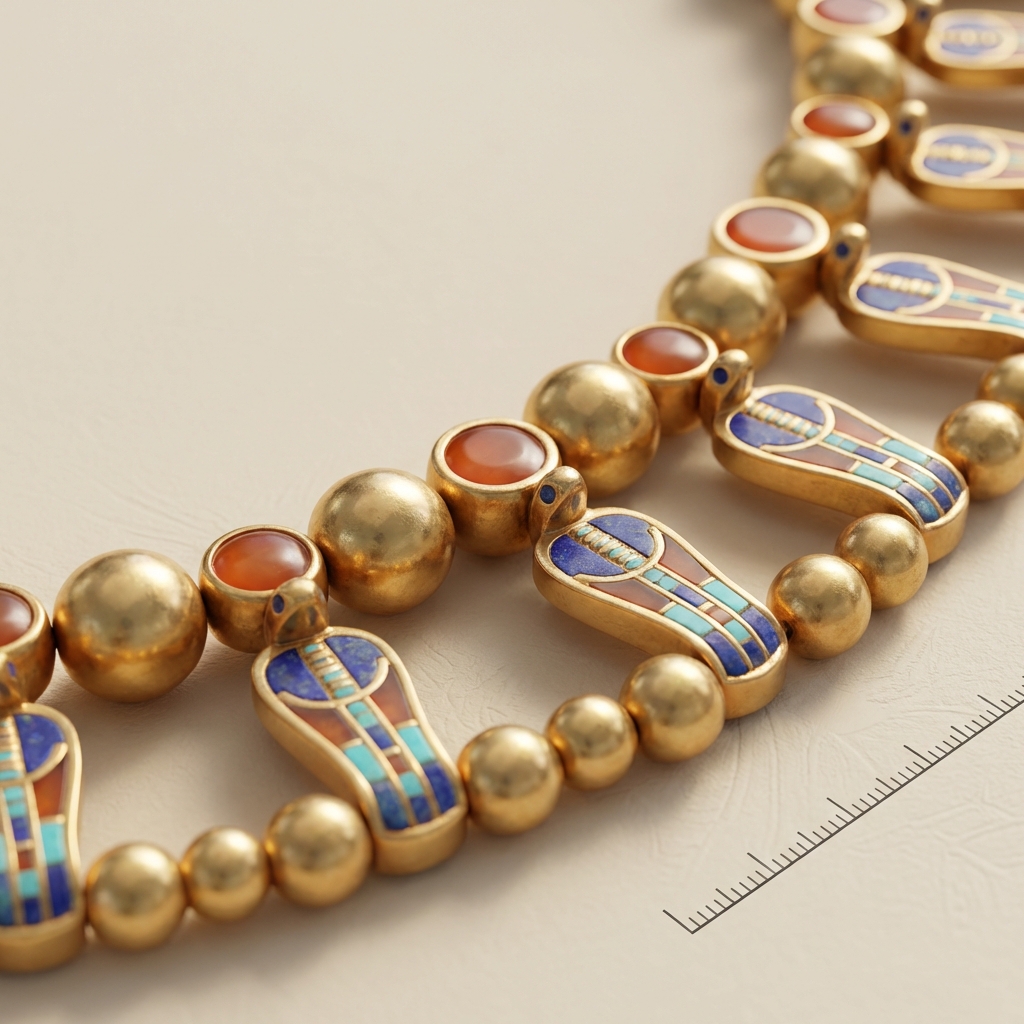
Ptolemaic and Hellenistic rings in Egypt were most commonly made in gold and silver and often set with engraved gemstones such as carnelian or agate, as well as glass paste in imitative use, according to museum object records and catalogues The Metropolitan Museum of Art highlights on ancient Egyptian jewellery. These materials were widespread among elite jewellery and appear repeatedly in collection summaries.
Common materials and stones
Gold was the preferred metal for elite jewellery, frequently combined with intaglio stones such as carnelian and agate; glass and glazed faience were also used where hard stones were less available or to echo particular colours and motifs The Metropolitan Museum of Art highlights on ancient Egyptian jewellery. If a listing claims a modern gem identification, seek independent confirmation because stone appearance can be deceptive in photographs. For technical studies of gems and finger rings see the Getty catalogue Ancient gems and finger rings - Getty Museum.
Ring types and settings (bezel, intaglio, hoop)
Bezel settings often hold a cut or engraved stone that may be carved in intaglio to form a portrait, deity, symbol or geometric device; such intaglios can function as seals when pressed into wax or clay. Simple hoop bands without decoration are common as everyday jewellery. Museum object descriptions emphasise these recurring forms across Ptolemaic contexts Oxford Research Encyclopedias on material culture in the Ptolemaic period.
Iconography and motifs: identifying Egyptian and Hellenistic symbols on rings
Ptolemaic jewellery often combines Egyptian royal motifs and Hellenistic decorative elements; recognising which visual language a motif belongs to helps place a ring in context. Catalogue summaries note the regular presence of uraeus forms, Hathor elements and sun disk iconography alongside Greek-style portraiture and diadem motifs British Museum collection overview on Egyptian jewellery.
Elite Ptolemaic women wore crowns or diadems, collars, bracelets, earrings and rings often made in gold and set with carnelian, agate or glass; numismatic and sculptural portraiture shows the visual language of regalia but does not by itself prove named ownership. To recognise period-appropriate egyptian rings for women, examine material and construction, compare motifs with museum catalogues, request provenance and condition documentation, and seek independent specialist reports when needed.
Egyptian royal motifs: uraeus, Hathoric forms, sun disk
The uraeus, a rearing cobra symbol, can appear as a full figure in larger pieces or as a reduced decorative device in intaglio scenes; similarly, Hathor attributes such as the cow horns and sun disk can appear compressed into small carved seals or as relief ornament on bezels. Recognising how these motifs are adapted to small-scale settings helps collectors interpret iconography without overstating ownership claims The Metropolitan Museum of Art highlights on ancient Egyptian jewellery.
Hellenistic portraiture and Greek motifs
Hellenistic visual language appears in Ptolemaic jewellery through diadems, portrait heads rendered in intaglio and Greek decorative borders. Coin and sculptural portraiture influenced small personal items, but those media are often idealised, so a portrait intaglio on a ring indicates stylistic influence rather than proof that a named person owned the ring British Museum studies of Cleopatra portraiture and coinage. You can also compare Hellenistic parallels in our ancient Greek rings collection.
Rings as signets: intaglios, seals and social function
Many rings in the Ptolemaic world served as both personal ornament and functional seal. Deeply carved intaglios on a flat bezel are a strong cue that a ring could have been used for sealing documents or possessions, a practice recorded in object-level studies and museum descriptions The Metropolitan Museum of Art highlights on ancient Egyptian jewellery.
Design cues that suggest signet use include a broad, flattened bezel, concentrated wear on the carved surface and signs of repeated contact on the mounting. Museum entries discuss this overlap between jewellery and sigillographic practice for Hellenistic Egypt Oxford Research Encyclopedias on Ptolemaic material culture.
How intaglios were used
Intaglios carved into carnelian or agate could carry portraits, deity images or personal devices. When used as seals they were practical identifiers; when worn as jewellery they communicated affiliation, status or religious sentiment. Photographs that show the depth and profile of the carving give important clues to function.
Design cues that indicate a signet vs purely decorative ring
Look for a flat or slightly bevelled surface, deep undercut carving, and a bezel form designed to contact a soft surface. Decorative rings may show shallower engraving, raised cameo forms or more elaborate external ornament that would be impractical for sealing.
Why we usually cannot say a ring belonged to Cleopatra: attribution limits
Attribution of a named ownership to Cleopatra VII requires direct provenance or excavation context, which is essentially absent for personal jewellery claimed to belong to her; therefore most pieces linked to her in trade are typological Ptolemaic attributions rather than documented ownership Oxford Research Encyclopedias on Cleopatra VII. Specific provenance case studies are discussed in museum literature and specialist journals a Ptolemaic queen in the Museum of Fine Arts, Boston.

Numismatic and sculptural portraits are invaluable for understanding royal dress and headgear, but they are idealised and propagandistic, so coinage can show us the visual language of regalia without proving that a specific ring or piece belonged to the person portrayed British Museum studies of Cleopatra portraiture and coinage.
When a seller or catalogue frames a ring as 'Cleopatra style' or 'Ptolemaic type' the safe reading is that the object shares period-appropriate forms and motifs, not that it can be assigned to a named queen without archaeology or contemporaneous documentation supporting that link Oxford Research Encyclopedias on Cleopatra VII.
How museums, catalogues and coins help researchers identify period features
Museum catalogues and collection overviews remain foundational resources for material types, manufacturing techniques and motifs; curators use these published comparanda to date and attribute objects by typology and technical parallels The Metropolitan Museum of Art highlights on ancient Egyptian jewellery.
Numismatic and sculptural evidence reliably shows the headgear and portrait styles associated with royal image, and these sources are especially useful for identifying diadem types and portrait attributes that reappear in small personal jewellery. Researchers caution, however, that portraits are stylised and do not list wearable possessions British Museum studies of Cleopatra portraiture and coinage.
Key museum resources and object records
The Metropolitan Museum of Art and the British Museum publish catalogues and online object records that present typological sequences, images and descriptions researchers rely on when assigning date ranges and cultural context. Consulting object-level records gives you a clearer sense of comparable forms and documented variants The Metropolitan Museum of Art highlights on ancient Egyptian jewellery.
What coin and sculpture evidence reliably shows
Coins and sculptures indicate the visual language of royal regalia such as diadems, uraeus placement and portrait styles. These media are strong evidence for appearance and symbolism but weaker evidence for personal possession of a named piece.
Practical buying checklist for egyptian rings for women
When evaluating listings for egyptian rings for women, follow a short checklist: request provenance documentation or collection history, review detailed condition and restoration notes, ask for high-resolution images showing joins and patina, and seek independent specialist reporting for stone identification when it matters ICOM Code of Ethics for Museums.
Also check cultural-property guidance such as the UNESCO convention and be cautious if provenance is incomplete or the seller cannot provide verifiable prior ownership notes UNESCO convention on cultural property.
- Request documented provenance or collection history where available
- Ask for explicit condition notes and restoration details
- Require close photographs of bezels, solder points and patina
- Seek an independent specialist report for stone identifications
- Check whether the item has published comparanda in museum records
Provenance and condition checklist for evaluating listings
Use this checklist to request documentation from a seller
Provenance and documentation to request
Good provenance details include collection history, previous ownership notes, old catalog numbers or references to published catalogues. If a listing cites a museum catalogue entry, ask for the specific object record or citation so you can verify the comparison The Metropolitan Museum of Art highlights on ancient Egyptian jewellery.
Condition, restoration and third-party reports
Condition notes should describe what was stabilised, what was repaired and what was left untouched. Independent specialist reports for stone identification and a conservator's note on restoration work add meaningful verification for higher-value purchases ICOM Code of Ethics for Museums.
Assessing condition and restoration notes on listings
Photos and measurements are the first line of inspection. Look for clear shots of the bezel profile, the interior band, the mountings and any solder joins. Precise measurements help you assess whether a modern repair has altered proportions; museum object records often include these same measurements for comparison The Metropolitan Museum of Art highlights on ancient Egyptian jewellery.
Restoration notes that say what was stabilised, repaired or left untouched are most useful. Vague language such as 'minor restoration' without specifics is a red flag; a good note will say which joins were soldered or whether loose stones were re-mounted and why ICOM Code of Ethics for Museums.
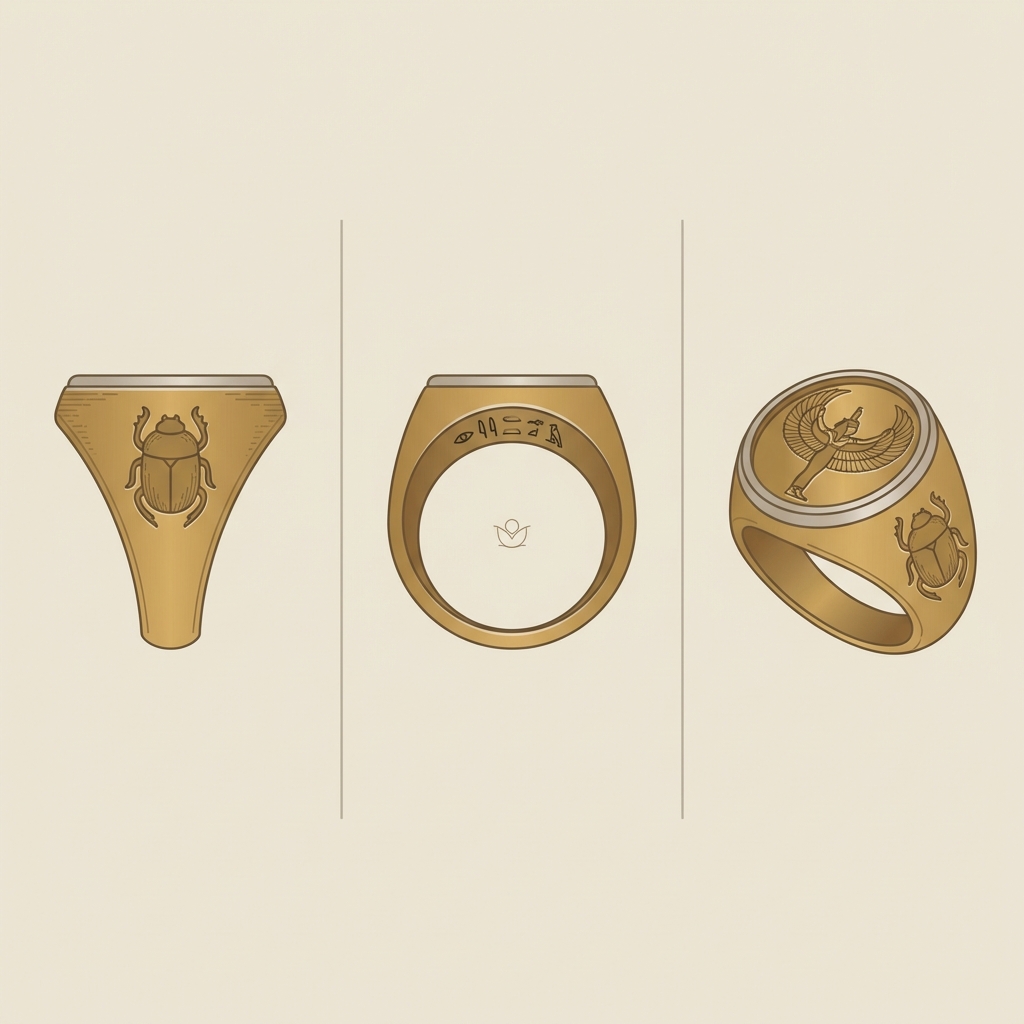
What to look for in photos and measurements
Request high resolution images with scale, detail shots of the bezel and inner band stamp if present, and angled photos that reveal the depth of any intaglio. If solder seams look recent, ask for a conservator's description of what was done and why.
How restoration is typically reported and what stable conservation looks like
Responsible reports distinguish between conservation that stabilises an object and intrusive restoration that alters original material. Stable conservation is described in factual terms and notes any reversible interventions and materials used.
Recognising Ptolemaic versus earlier Pharaonic styles on rings
Ptolemaic jewellery frequently blends Hellenistic portraiture influences with older Egyptian royal motifs, so look for diadem forms and portrait heads together with uraeus or Hathoric signs. These blended cues are typical of the Ptolemaic era and serve as useful dating indicators in typological comparisons British Museum collection overview on Egyptian jewellery.
Continuities with earlier Egyptian royal motifs persist in many pieces, so a single motif does not guarantee an earlier Pharaonic date. Comparing the technical execution, alloy composition where available, and stylistic details against museum comparanda helps narrow dating decisions The Metropolitan Museum of Art highlights on ancient Egyptian jewellery.
Stylistic cues that point to Hellenistic influence
Portrait heads in intaglio, Greek ornamental borders and the presence of diadem motifs are useful cues for Hellenistic influence. When these features combine with Egyptian symbols, the result is often a Ptolemaic profile rather than a purely Pharaonic or purely Greek object.
Continuities with earlier Egyptian royal motifs
Symbols such as the uraeus and Hathor attributes continue in Ptolemaic contexts, sometimes simplified for small-scale mounting. Catalogue comparisons make these continuities clear and are the recommended resource when making fine distinctions.
Common listing mistakes and red flags (what to be skeptical of)
Claims that an object 'belonged to Cleopatra' without archaeological context or written provenance should be treated skeptically. Such attributions are often market language based on typological similarity rather than evidence of named ownership Oxford Research Encyclopedias on Cleopatra VII.
Other red flags include missing collection history, inconsistent dates across different parts of a listing, generic stock photos, vague restoration notes and lack of independent reporting. If several of these appear together, request more documentation or an independent assessment before proceeding ICOM Code of Ethics for Museums.
Over-claiming personal ownership by famous figures
Attributions to famous figures are usually marketing shorthand. The responsible phrasing is to describe stylistic and typological parallels and to make clear that named ownership is not proven without supporting documentation.
Vague provenance or inconsistent condition descriptions
If provenance is reduced to a short phrase such as 'from a private collection' without further detail, ask for collection history dates, prior catalogue references or any documents that substantiate the statement.
Three short example scenarios: reading a ring listing
Example A: A Ptolemaic-style gold ring with a carnelian intaglio, clear collection notes dating to the 19th century, photos of the bezel showing wear consistent with age and a conservator's note on a discreet solder repair. This listing passes basic checks because it supplies comparanda and documentation for the ring's chain of ownership and condition The Metropolitan Museum of Art highlights on ancient Egyptian jewellery.
Example B: An attractive gold bezel ring described as 'Cleopatra era' with stylistic similarities to Ptolemaic rings but no provenance beyond 'private collection'. No detail photos are provided. In this case the ring may be Ptolemaic in style but the absence of documentation makes named attributions and confident dating speculative Oxford Research Encyclopedias on Cleopatra VII.
Example C: A ring with obvious modern solder seams and a re-polished bezel that obscures an intaglio. Heavy restoration can alter the object's appearance and complicate dating; ask for a conservator's report and weigh how restoration affects your interest in the piece.
How a curator or seller should present an ancient ring (what good documentation looks like)
Essential listing elements include high resolution photographs from multiple angles, precise measurements, explicit condition notes, clear restoration documentation and any provenance or collection-history notes available. These elements allow a buyer to assess both authenticity and condition with more confidence ICOM Code of Ethics for Museums.
Recommended phrasing avoids asserting named ownership without evidence. Phrase attributions as typological comparisons or period-style parallels when direct provenance is absent, and cite specific museum comparanda rather than general statements.
Essential listing elements: photos, measurements, condition and provenance notes
Supply scale bars in images, a clear view of the bezel and inner band, and a short paragraph on restoration interventions. If a ring has associated paperwork, scans of prior catalogues or an owner letter should be available to serious buyers.
How to phrase attribution responsibly
Model phrasing: 'Ptolemaic-style gold ring, likely 1st century BCE based on bezel form and iconography; provenance: private collection, acquired 19xx, documentation available on request.' This frames the attribution as probable and invites verification rather than asserting a named owner.
How Aurora Antiqua frames provenance, documentation and condition in our listings
Aurora Antiqua presents curated ancient rings spanning Roman, Greek, Byzantine, Islamic, Celtic, medieval and post medieval periods with condition notes, restoration notes and provenance references when available. Our editorial aim is to explain cultural context and collection history to help buyers understand what they are seeing without asserting ownership claims we cannot document The Metropolitan Museum of Art highlights on ancient Egyptian jewellery.
We emphasise clear photographs, explicit measurements and transparent restoration notes. When documentation exists we reference it to help buyers verify claims; when it does not we use typological language and provide comparanda to museum records so readers can judge the evidence for themselves.
Further reading and museum resources to consult
Start with museum overviews and catalogues for typological grounding. The Metropolitan Museum of Art and the British Museum provide accessible summaries and object records that are essential comparanda for collectors and researchers alike The Metropolitan Museum of Art highlights on ancient Egyptian jewellery.
Numismatic catalogues and published object-level descriptions are especially useful for portrait comparisons and diadem types. Where possible, consult object entries in museum databases rather than relying solely on secondary summaries British Museum collection overview on Egyptian jewellery.
Conclusion: How to buy egyptian rings for women with confidence
Key takeaways: Ptolemaic-style rings and related jewellery are well documented as typologies, but named attribution to Cleopatra is usually unsupported without clear provenance. Use museum comparanda, numismatic studies and object-level records when assessing claims about origin or ownership Oxford Research Encyclopedias on Cleopatra VII.
Final checklist: request provenance and condition documentation, insist on detailed photos and measurements, seek independent specialist reports for gemstones when needed and consult cultural-property guidance if provenance is incomplete. Collect with curiosity and care to respect heritage while building a considered collection ICOM Code of Ethics for Museums.
Look for a combination of Hellenistic portrait cues and Egyptian motifs such as the uraeus, check alloy and workmanship against museum comparanda, and ask for provenance and independent specialist reports if the claim matters to you.
No, an uraeus signals royal symbolism but not personal ownership; without clear provenance or excavation context it indicates stylistic affiliation rather than named ownership.
Request collection history or provenance notes, condition and restoration reports, high resolution photographs with measurements, and any prior catalogue or publication references.
More from Aurora Antiqua
References
- Amulet with the wedjateye of the god Horus, Victoria and Albert Museum, London
- Eye of Horus (Wedjat) Amulet, Egypt, Ptolemaic Period, Art Institute of Chicago
- Gemstones. In: UCLA Encyclopedia of Egyptology (James A. Harrell), University of California, Los Angeles
- Finger Ring with Frog, The Cleveland Museum of Art
- Ring, Victoria and Albert Museum, London
- How to Care For Your Jewellery: The Ultimate Guide by the National Association
- Archaeological materials, Icon, The Institute of Conservation (UK)
- Emergency Red List of Egyptian Cultural Objects at Risk, International Council of Museums (ICOM), Paris
- wrap.warwick.ac.uk
- Ancient Gems and Finger Rings: Catalogue of the Collections, The Getty