


Looking for the real thing? Browse our Greek ring collection, each piece one of one, individually authenticated, with documented provenance. For the background, see the guide to ancient jewelry.
What jewelry is unique to Greece? A concise overview
Greek material culture spans classical, Hellenistic, Byzantine and later island traditions, and that range is what people commonly mean when they ask what jewelry is unique to Greece. For collectors the term covers a spectrum of forms and techniques rather than a single look, and it helps to think in periods and local workshops when assessing a piece.
Several visual categories recur across that spectrum and will appear often in museum collections and specialist literature: coin-set rings, engraved bezels with animals or gods, Byzantine filigree and granulation, and folk motifs such as the evil-eye or laurel wreath. These categories are useful starting points for identifying objects and for setting realistic expectations about condition and documentation The Met Museum overview on Greek jewellery.
See behind the scenes at @auroraantiqua
Read the buying checklist and the case study below to learn how to evaluate condition, provenance and listing details before you consider a purchase.
When viewing listings, bear in mind that genuine antiquities commonly show wear consistent with age: patina, softened tool marks, and occasional losses where thin elements have broken. For confident attribution, documented provenance or catalog references are central; absent those, proceed with extra caution.
Key historical periods and what they left behind
Classical and Hellenistic rings often appear in bronze and gold with engraved bezels that show animals, deities or hybrid creatures, and those motifs are helpful dating clues for collectors and cataloguers The Met Museum overview on Greek jewellery.
From the Hellenistic centuries onward, coin mounting and reuse becomes visible in personal adornment, and that practice carries into Roman and later Byzantine contexts where continuity and adaptation coexist American Numismatic Society discussion of coin jewelry.
Byzantine technical developments, notably precise filigree and granulation, produce a distinctive construction vocabulary that many regional workshops later echoed; these techniques create a recognisable texture and soldering logic that specialists look for when attributing a piece Museum of Cycladic Art notes on Byzantine jewellery. For museum comparisons of coins and gems, see the Getty Villa entry on Greek coins and gems Getty Villa, Greek Coins and Gems, and consult Byzantine catalogues and collection pages such as our Byzantine Rings collection for comparative listings.
Regional continuities matter: island and mainland workshops sometimes preserved older forms or combined them with local materials, so a piece described only as "Mediterranean" loses important comparative context that you can recover by consulting specific museum entries.

Greek coin rings: what they are and why they appear across periods
Types: ancient coins mounted vs struck ring coins
The term greek coin rings covers two related practices: mounting an ancient coin as a bezel on a finger ring, and producing rings struck or cast with coin-like portraits or emblems. In many museum and numismatic records the former appears as a reuse of an existing coin, while the latter is sometimes a bespoke struck or cast object.
Coin mounting is documented in archaeological and numismatic literature as a repeated practice from the Hellenistic period into Roman and later contexts, so finding a coin in a ring does not alone fix a single date; cross-checking the coin type and the mounting method is essential American Numismatic Society discussion of coin jewelry. For a focused discussion of wearing coins in late antiquity see the Met Museum perspective on coin use Wearing Coins in Late Antiquity.
A combination of materials, techniques and clear documentation distinguishes Greek rings: characteristic motifs and mounting styles, Byzantine filigree or granulation where present, consistent ancient patina and tool marks, and corroborating provenance or catalog references.
Collectors should ask whether the coin shows wear consistent with long circulation or whether the coin appears freshly re-cut or adapted for mounting; the mounting style and soldering can indicate whether the mounting is ancient or a later novelty.
Context matters: museum examples show coin rings used for display, portability of portrait imagery, or simply the reuse of a familiar object as personal ornament; numismatic catalogues and museum entries are central references for interpretation and comparison The Met Museum overview on Greek jewellery.
Contexts where coin rings are documented in museum and numismatic literature
Archaeological finds and museum collections record coin-mounted rings across Hellenistic and Roman contexts, and numismatic outreach materials provide useful overviews of mounting techniques and their social meanings American Numismatic Society discussion of coin jewelry. Recent outreach on recovered hoards and coin finds provides useful context for circulation and reuse Money Makes the World Go 'Round: Ancient Greek Coin.
When a listing claims a coin ring is Hellenistic, compare the coin type and die characteristics to established numismatic catalogues and then examine the mounting technique; mismatches between coin date and mounting style are a common sign that further enquiry is needed.
Materials, techniques, and signature motifs in Greek rings
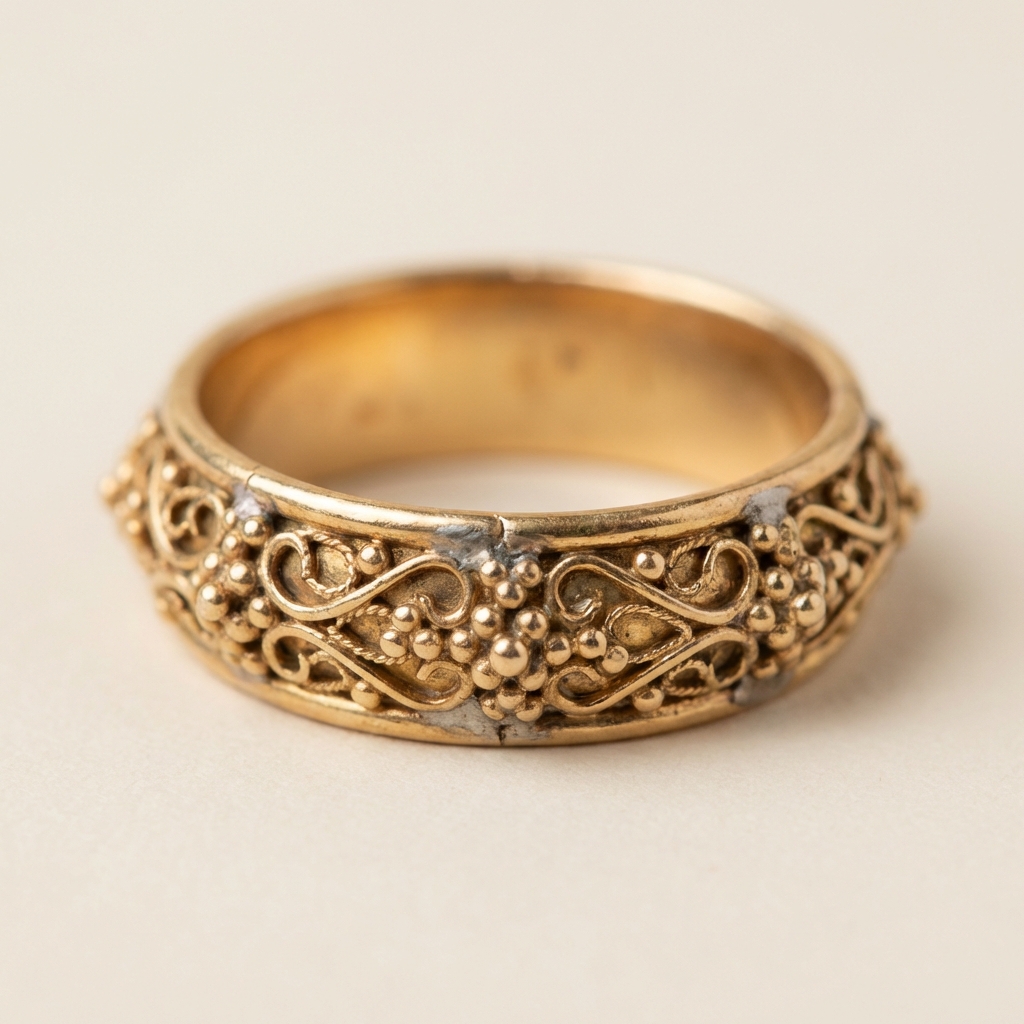
Bronze and gold are the principal metals that appear in classical and Hellenistic Greek rings, often combined with semi-precious stones such as carnelian or agate when an intaglio is present; descriptions that state metal content without testing should be read as seller claims unless a technical report is provided Oxford Research Encyclopedia entry on ancient Greek jewellery.
Byzantine filigree and granulation are technical signatures: fine twisted wire and soldered granules form patterns that are recognisable under magnification and are often noted in museum catalogues as characteristic of Byzantine-era goldsmithing Museum of Cycladic Art notes on Byzantine jewellery.
Iconography is another axis for attribution. Laurel wreaths, animal intaglios and the evil-eye motif appear in continuities from antiquity into popular tradition; when these motifs combine with local mounting types they can point toward regional workshops or island practices Benaki Museum jewelry highlights.
Be cautious with material descriptions in listings. Metal identification by sight can be misleading; responsible sellers disclose testing or the absence of it, and they provide clear restoration and condition notes rather than sweeping claims about purity.
How to identify authentic greek coin rings and ancient Greek rings
Visual cues are the first layer of assessment: consistent ancient patina, tool marks, and wear patterns that align with the purported period can indicate age and truthful handling history, while modern tool evidence or incongruent soldering patterns suggest later work British Museum gallery notes on ancient Greek objects.
Documentation is often more decisive than visual inspection alone. Seek provenance statements, collection history, and catalog references; when a seller cites a museum or a published catalogue number, follow up by checking that entry directly in the museum record or bibliography The Met Museum overview on Greek jewellery.

Scientific testing is appropriate when a seller asserts precious-metal content or when the metal composition affects value or conservation choices. Tests such as XRF can establish metal composition but do not by themselves date an object; combine testing with documentary proof and condition analysis Oxford Research Encyclopedia entry on ancient Greek jewellery.
When assessing a listing, prioritise documentation: clear photos, detailed condition and restoration notes, and any third-party reports. If those are missing, ask for close-ups of junctions, bezels and solder lines, and for magnified images of any claimed intaglio or coin faces.
Common mislabels, red flags, and typical errors in online listings
Generic geographic labels such as "Mediterranean" or "Ancient style" obscure workshop-specific details that matter for attribution; museum comparisons usually require region-specific matches rather than broad labels British Museum gallery notes on ancient Greek objects.
Missing condition notes, vague restoration disclosures, and photographs that hide edges or junctions are concrete red flags. Sellers who rely on emotive copy rather than documentation should be asked for specifics before any commitment.
Also be wary of images that show an object only in flattering light or from a single angle; request measurements, scale references, and close views of solder lines and punch marks so you or an expert can evaluate construction and wear.
Practical examples: reading a listing and a case study from Aurora Antiqua
Start a listing read with these fields: measurements with units, multiple close-up photos, an explicit condition statement, any restoration notes, and any provenance or catalog references; ask sellers for third-party reports when metal content or unusual repairs are asserted Oxford Research Encyclopedia entry on ancient Greek jewellery. Compare to museum entries and numismatic descriptions and to our Ancient Greek Rings collection when possible.
In practice, a well-documented listing will note what was stabilised, what was repaired and what was left untouched in restoration notes, and will provide measurements and clear photos that include the bezel, hoop and shoulders. The Aurora Antiqua example below is presented as a model of that approach.
Compact buyer checklist for reading listings and comparing to museum entries
Use as a preparatory checklist
Using the checklist: match each field to the listing, and when possible compare the coin or motif to a museum catalog entry. If a coin is present, consult numismatic resources to determine die types and circulation wear before accepting a dating claim American Numismatic Society discussion of coin jewelry. In the Aurora Antiqua case study see the Chimaron listing Chimaron product page for the provided documentation and photos.
Case study: the representative Greek bronze ring offered by Aurora Antiqua is described with measurements, condition and restoration notes and a suggested dating to the 4th century BCE; readers should treat that dating as a professional estimate supported by stylistic comparison and documentation, and then follow up on any catalog references or images provided to corroborate the attribution The Met Museum overview on Greek jewellery.
Regional styles and island traditions
Museum collections document island-specific and mainland workshop differences in motifs and mounting, and those regional signatures help specialists narrow attributions; comparing a listing to region-specific museum entries is often more informative than generic comparisons Benaki Museum jewelry highlights.
Some island traditions preserved Byzantine techniques such as fine filigree or continued to use particular bead types and local metals in popular pieces; these continuities explain why similar motifs appear across centuries in local craft contexts Benaki Museum jewelry highlights.
Because workshop practices vary, a collector should ask sellers for references to comparable museum objects from the same island or mainland region rather than accepting broad geographic labels.
Care, preservation, and handling of ancient rings
Handle bronze and gold rings with clean hands and avoid exposure to acidic surfaces or prolonged moisture; store pieces in stable, low-humidity conditions and use inert padding to prevent abrasion to thin elements or intaglios.
Restoration notes typically describe whether an object was stabilised, whether structural repairs were made, or whether fragile elements were left untouched; treat those notes as condition information rather than promises about longevity and consult a conservator for active corrosion or structural instability British Museum gallery notes on ancient Greek objects.
Buying checklist: what to ask and request before purchase
Essential requests include: multiple high-resolution photos with scale, full measurements, a detailed condition statement, explicit restoration notes, and any provenance or catalog references; ask sellers for third-party reports when metal content or unusual repairs are asserted Oxford Research Encyclopedia entry on ancient Greek jewellery.
Sample questions to ask sellers: What is the object measured ring size and weight? Were any stabilisations or repairs performed and can you show pre-restoration images? Is there a documented collection history or a published catalogue reference? If the seller cites a test, can they provide the full report?
Reasonable seller responses include detailed photos, clear condition and restoration notes, and reproduction of any catalog references. If a seller cannot provide basic documentation for an antiquity claim, it is usually prudent to walk away.
How museums and numismatics document coin jewelry
Museum catalog records typically list dating, material, collection history and bibliography; these catalog fields are precisely what a buyer should request or check when a seller cites an institutional comparison The Met Museum overview on Greek jewellery.
Numismatic resources help with coin identification and die studies, and outreach materials often explain mounting practices and circulation wear that differentiate an ancient reuse from a modern adaptation American Numismatic Society discussion of coin jewelry.
When to seek scientific testing or third-party reports
Common tests include XRF for metal composition and assays for precious-metal fineness; these tests are useful for confirming metal content but do not on their own prove age or provenance, so interpret them alongside documentary evidence Oxford Research Encyclopedia entry on ancient Greek jewellery.
Request third-party reports when a listing asserts metal purity or when the piece has ambiguous construction that affects attribution; a reputable laboratory report or a specialist statement adds weight to a claim but should still be read in the context of provenance and condition notes.
Summary: what makes jewelry uniquely Greek and why collectors value it
Key takeaways: visual cues such as engraved bezels, coin mounts and Byzantine filigree, combined with consistent patina and documented provenance, are the strongest indicators of Greek origins for rings and small jewelry The Met Museum overview on Greek jewellery.
Compare listings to museum examples, prioritise clear condition and restoration notes, and use the buying checklist to request the necessary photos and documentation before purchase.
Further reading and museum resources
Recommended institutional resources to consult include the Met Museum collection and overview on Greek jewellery for technique and typology, the British Museum galleries for object cataloguing and condition guidance, the American Numismatic Society material on coin mounting, and the Oxford Research Encyclopedia for survey-level context The Met Museum overview on Greek jewellery. For additional museum comparisons consult the Getty Villa and collection pages Getty Villa, Greek Coins and Gems.
Use museum catalog numbers and published catalogue entries when asking sellers for corroboration, and treat online listings cautiously until you have direct documentary or laboratory evidence to support historical claims.
Greek coin rings are rings that incorporate ancient coins as bezels or are struck with coin-like imagery; their presence must be evaluated with coin identification and mounting technique to assess age.
Common indicators include engraved animal or deity bezels, laurel wreath motifs, and Byzantine filigree or granulation, though motifs often persist regionally and require contextual comparison.
Request a third-party report when a seller claims precious-metal purity, when construction is ambiguous, or when provenance is incomplete and the metal composition affects attribution.
More from Aurora Antiqua
References
- boucle d'oreille, Louvre site des collections, Musée du Louvre, Département des Antiquités grecques
- Ganymede jewelry (Gold, rock crystal, emerald), Greek, Hellenistic, ca, The Metropolitan Museum of Art, New York
- Earring, Victoria and Albert Museum, London
- Gold bracelets with enamel decoration, Museum of Byzantine Culture Thessaloniki
- Gold earring, Museum of Byzantine Culture Thessaloniki
- The techniques of Byzantine gold jewelry, Paul and Alexandra Canellopoulos Museum, Athens
- Octagonal Pendant, The Cleveland Museum of Art, Ohio
- Gold necklace with coin pendants, Inv. 17.190.1655, The Metropolitan Museum of Art
- Online Coins of the Roman Empire, American Numismatic Society and Institute for the Study of the Ancient World
- Getty Villa, Gallery 101D, Greek Coins and Gems