


Looking for the real thing? Browse genuine Greek rings for sale, each piece one of one, individually authenticated, with documented provenance. For the background, see the guide to ancient jewelry.
What are Greek rings and coin rings? (greek coin rings)
In museum and curatorial use, an ancient ring is a small wearable metal or stone object made to be worn on a finger, often carrying an image or device that could serve decorative, sealing, or protective roles. Collections surveys treat rings as a category that includes simple hoops, signet or intaglio rings, and more complex mounts where a disc or gem is set into a bezel, with materials ranging from gold and silver to bronze and engraved stones, and patina that helps indicate age The Metropolitan Museum of Art
Within that category, coin rings are best understood as an adaptive reuse or deliberate mounting of coinage or coin-like stamped discs into wearable form. In many documented examples a coin face was pierced, trimmed, or set into a bezel so it could be worn as an ornament or used as a device, and the practice appears in a range of contexts and periods in the Greek world Gold necklace with coin pendants, Inv. 17.190.1655, The Metropolitan Museum of Art
Dating for Greek rings typically spans the Archaic through Hellenistic periods, roughly the 7th to 1st centuries BCE in broad typological discussion, but specific attributions often remain estimates based on style, find context, and comparative typology rather than absolute certainties The Metropolitan Museum of Art
Guidance for taking clear photos and basic ring measurements to aid identification
Use natural light and include a ruler for scale
Because the category covers several practices, it helps to keep three terms in mind: bezel for the frame that holds a disc or gem, intaglio for an engraved image used for sealing, and coin-mounted to denote coins or discs adapted for wear. These distinctions guide how curators describe objects and how collectors should read listings Oxford Research Encyclopedia of Classics
Roles and functions: ornament, seal, amulet, and social signal
Museum essays and object entries present Greek rings as multifunctional artifacts that could be personal ornament, a sealing device, an amulet, or a status marker depending on design and how the piece was used in life The Metropolitan Museum of Art
An intaglio face, for example, points toward use as a signet or seal because the carved image would produce an impression in wax or clay; conversely, a boldly modeled coin face without cutting for impression is more likely an ornament or amulet rather than a practical seal Oxford Research Encyclopedia of Classics
Motifs themselves could shift an object's likely function. A deity or divine symbol might indicate personal devotion or protective intent for the wearer, whereas civic emblems could communicate belonging or status within a city or polis. These readings depend heavily on context, so comparable motifs can imply different meanings in different places and times The Metropolitan Museum of Art
To make these ideas concrete, here are three short case-style descriptions: a gold intaglio with a small carved head and a flat hoop fits a sealing function; a bronze ring with a large pierced coin mounted into a high bezel reads as wearable display likely emphasizing the coin image; a ring showing repairs consistent with long wear and localized polishing suggests repeated personal use rather than a modern novelty Oxford Research Encyclopedia of Classics
How coin rings were made: adaptive reuse, mounting, and workshop practices
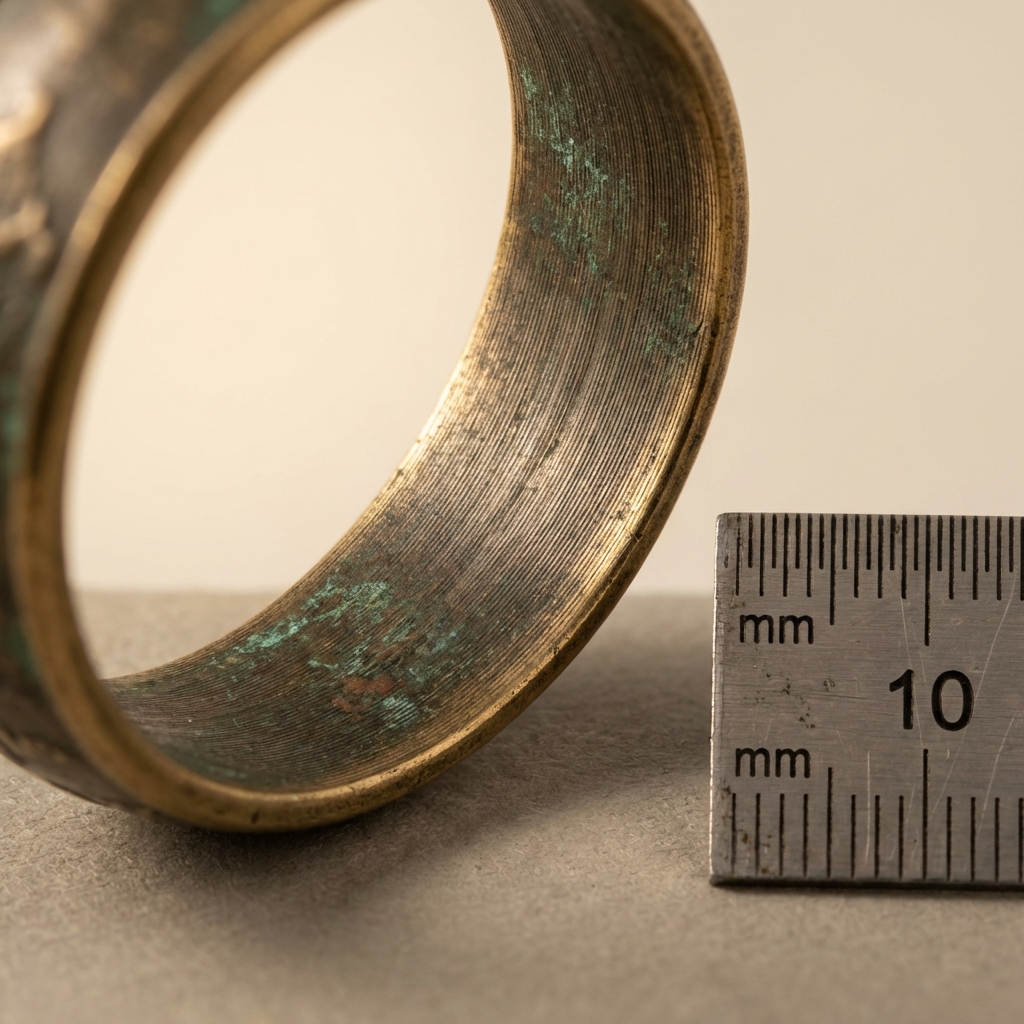
Typical techniques include piercing a coin to accept a rivet, trimming the coin edge to sit cleanly in a bezel, and securing with solder or a folded edge in bronze examples. Workshop practices vary by metal and period, and tool marks consistent with hand files or lathe work can help specialists identify periods of mounting Numismatic Chronicle report
Collectors should look for physical signs of ancient mounting, such as wear that follows the metal join, consistent corrosion patterns across the join, and period-appropriate tool marks rather than sharp modern files or recent solder that sits atop older metal. When the join is unclear, provenance and photographic sequences can be decisive in assessing age of the mount Numismatic Chronicle report

Because some mounts may be modern additions rather than ancient reworkings, curatorial reports recommend close photographic documentation and, where necessary, targeted scientific analyses to determine whether mounting joins and solder are contemporary or antique Application of multi-modal 2D and 3D imaging and analytical techniques, npj Heritage Science (Springer Nature)
Common motifs and their likely meanings
Common images on Greek rings and coin faces include gods and goddesses, animals, and heroic figures. These motifs can carry multiple, overlapping meanings such as protection, civic allegiance, or personal devotion depending on the owner and context The Metropolitan Museum of Art
For example, Athena often appears with martial or civic iconography and can indicate association with a polis that revered her, while the owl associated with Athena might also signal practical associations such as wisdom or a civic emblem; similar animal motifs like lions could indicate protection or royal associations in different regions Oxford Research Encyclopedia of Classics
Because motifs carry layered meanings, avoid single, definitive readings; instead, consider motif, findspot, and context together rather than relying on a single feature The Metropolitan Museum of Art
To visualize an example without an image: imagine a bronze ring with a worn owl in high relief on a trimmed coin face set in a low bezel. The owl could reasonably be read as an Athena emblem and civic sign, but concurrent wear patterns, mounting style, and provenance would be needed to prefer a civic interpretation over a personal devotional one Oxford Research Encyclopedia of Classics
How to identify and assess greek coin rings before you buy
When assessing a listing, start with a visual checklist: patina and wear consistent with age, uniform corrosion patterns across joins, period-appropriate tool marks, and an image that matches documented types in museum publications. These visual cues are the first line of evidence collectors use British Museum
Next, request clear provenance and condition notes; reliable listings will offer a collection history or prior ownership notes and describe any restoration or stabilization that was done British Museum
They can indicate personal adornment, sealing practice, protective or religious meaning, or civic belonging; interpretation depends on motif, wear, mounting technique, and provenance rather than any single visible feature.
If the object is important to your collection or the attribution is uncertain, ask for targeted scientific testing such as elemental analysis, which can help identify alloy composition, or isotopic work when available. Keep in mind that such studies remain limited in scope across collections and do not always produce a simple yes or no for authenticity Application of multi-modal 2D and 3D imaging and analytical techniques, npj Heritage Science (Springer Nature)
Practical phrasing for buyers to use when contacting a seller: request high-resolution images of the bezel join, an inside-hoop shot showing any marks or repairs, and a statement of any restoration or consolidation performed. Also ask whether the seller has any documented collection history or prior catalog references British Museum
Condition, restoration notes, and documentation to demand
Common restoration terms you may see include stabilized (a treatment to halt active corrosion), consolidated (a material applied to strengthen fragile areas), filled (losses filled with a conservation material), or left untouched. Each term has implications for appearance and future care British Museum
Good documentation will state exactly what was done, when, and by whom, and provide before and after images if possible. Vague language such as some "cleaning" without specifics is a red flag and should prompt further questions About us, International Association of Dealers in Ancient Art
Ask for close-ups of the bezel, the mounting join, and any solder or rivet areas. If restorations are described as reversible conservation treatments, that detail is helpful; if work was invasive or used modern fillers, ask how that affects surface appearance and measurement British Museum
Practical examples: reading a listing and spotting red flags
Imagine a listing that provides multiple high-resolution views, a paragraph of condition notes describing a stabilized hooped break and small filled loss on the bezel, and a stated collection history with a previous dealer invoice. That combination gives more confidence than images alone and models the documentation collectors should expect British Museum
Top red flags include missing provenance, overly smooth or artificially uniform patina inconsistent with handling, clearly modern solder over old joins, and vague restoration language with no images. Any of these should prompt further inquiry or a conservative decision to pass American Numismatic Society
Get the buyer checklist and photo guide
If you want a short, optional checklist to save, request a downloadable buyer checklist that lists photos, provenance points, and key restoration questions
A short buyer checklist to paste into a message to a seller: request high-resolution front and back photos, close-ups of the bezel and mounting join, a description of any restoration or stabilization, a statement of prior ownership or catalog references, and whether any scientific testing has been performed British Museum
Saving message templates helps keep questions consistent across listings and allows you to compare seller responses directly. If answers are evasive or missing, treat that as a meaningful factor in your decision American Numismatic Society
Open research gaps and what they mean for collectors
Scholars continue to call for systematic metallurgical and isotopic studies across museum and private collections to help distinguish ancient mounting practices from modern additions and to trace metal sources; such studies can change attribution discussions but are still not widely available for most rings Journal of Archaeological Science
Numismatic reports also note uncertainty about how often coin mounts are ancient reworkings versus modern additions, a question that affects how confidently a collector can accept a coin ring as wholly ancient or as a later assemblage Numismatic reports
Practical implication for collectors: where scholarship is limited, prioritize documentation and conservative buying. When a listing includes laboratory results or a catalog entry tying the piece to a collection history, that information meaningfully improves the basis for attribution Research report: export licensing and provenance, GOV.UK, Department for Culture, Media and Sport (DCMS)
Summary and responsible next steps for collectors
Greek rings served multiple roles in antiquity and coin-mounted examples are often adaptive reuses of coin faces set for wear. Read motif, mounting, and wear together rather than relying on a single visible feature The Metropolitan Museum of Art
Final buyer checklist: request high-resolution photos, clear condition and restoration notes, provenance or collection history, and consider scientific testing for high-value or uncertain attributions. Use conservators or numismatic specialists for difficult cases British Museum
Aurora Antiqua presents ring listings with condition notes, restoration details, and provenance references when available, to help collectors make better informed decisions without implying absolute authentication
A coin-mounted ring is a ring where a coin or coin-like disc has been pierced, trimmed, or set into a bezel for wear; such mounts can be ancient reworkings or later additions and require careful assessment.
Look for consistent patina across the join, period-appropriate tool marks, documented provenance, and clear restoration notes; when uncertain, request specialist evaluation or targeted scientific analysis.
Not for every purchase; testing is most useful when attribution is critical or a piece is high value. Many collectors rely on documentation, condition notes, and expert photographs for routine decisions.
More from Aurora Antiqua
References
- Gold necklace with coin pendants, Inv. 17.190.1655, The Metropolitan Museum of Art
- Octagonal Pendant, The Cleveland Museum of Art, Ohio
- boucle d'oreille, Louvre site des collections, Musée du Louvre, Département des Antiquités grecques
- Application of multi-modal 2D and 3D imaging and analytical techniques, npj Heritage Science (Springer Nature)
- About us, International Association of Dealers in Ancient Art
- International Association of Professional Numismatists (IAPN), IBSCC
- Archaeological materials, Icon, The Institute of Conservation (UK)
- Research report: export licensing and provenance, GOV.UK, Department for Culture, Media and Sport (DCMS)