


Looking for the real thing? Browse genuine ancient rings for sale, each piece one of one, individually authenticated, with documented provenance. For the background, see the guide to ancient jewelry.
What is an ancient Roman coin pendant?
An ancient roman coin pendant is a coin that has been adapted or used as personal ornament or amulet, typically by adding a suspension point or mount, and it can range from a simple pierced denarius to a coin set in a bezel for long term wear. Museums and numismatic overviews record this reuse as a common method of turning currency into wearable objects, and understanding the basic forms helps separate deliberate reuse from coins left as currency or in hoards Metropolitan Museum of Art overview on coin reuse.
A short checklist to spot suspension and mount indicators
Use as a first pass observation guide
Working definitions help non specialists: a coin pendant is not simply any coin found near a neck chain, but a coin deliberately modified or mounted so it could be worn. Typical physical signs of adaptation include a suspension hole, solder marks where a hoop or bezel was attached, or evidence of a fitted mount that alters the coin edge or reverse. The long chronological span of reuse means objects described this way can date from the Roman imperial period through medieval reuse and into later collecting practice, so dating often rests on multiple lines of evidence.
Broadly speaking, pendants fall into three practical categories: pierced coins with original metal left intact, coins holed and suspended on wire or thread, and coins set into later metal mounts such as bezels. Each form leaves different traces on the coin that specialists look for when distinguishing jewellery from coins that remained in circulation or were found in hoards.
How common was coin reuse as jewellery in the Roman world?
Evidence from museum collections and numismatic literature shows that reuse of coins as personal adornment was well attested across the Roman world, appearing in curated collections and scholarly overviews that document coins used as jewellery and amulets British Museum coin collection research.
The practice was not uniform: frequency, form and local meanings varied by region and period. In some areas pierced antoniniani or denarii appear more often in domestic contexts, while in others later reworking and medieval reuse are predominant. Catalogues and finds reports provide the comparative material that supports these regional and chronological patterns.

Because so many institutions hold examples, public collections offer a reliable starting point for collectors wanting to see illustrated parallels and documented cases. Looking to institutional records can give a sense of how frequently certain motifs or mount styles occur and how scholars interpret those patterns.
How to tell if a Roman coin was actually worn as a pendant
Practical identification relies on visible wear and tooling marks that indicate deliberate adaptation, including suspension holes, solder or mount traces, flattened edges where a bezel sat, and localized polish consistent with rubbing against skin or fabric. Wear patterns are best assessed alongside context, because isolated features can be ambiguous Journal of Roman Archaeology research on coins as amulets and pendants.
Follow @auroraantiqua for behind the scenes looks
Download a one page checklist to help note suspension holes, mount traces and patina before you ask for more technical reports.
Start with suspension hole identification: the hole should usually show signs of age, such as deformation around the edge and patina continuity through the breach, rather than crisp, bright metal that suggests recent drilling. Look for tooling marks at the mouth of a hole and for a consistent surface patina that continues uninterrupted from the face to the pierced edge.
Solder and mount traces often appear as very localized skillful additions: thin joins on the coin edge, small areas of differing corrosion where a bezel once touched the metal, or flattened rims where a mount was fitted. If multiple indicators are present together, they form a stronger case that the coin functioned as ornament rather than remaining currency.
Scientific and documentary methods for authentication
Non destructive metal analysis can show whether an alloy matches expected compositions for a proposed date or whether modern solder alloys are present on a mount. Such analysis does not by itself establish use as a pendant, but it helps separate modern alterations from ancient or medieval work when interpreted with stylistic and die study comparisons. Relevant technical literature includes an XRF methodology study and work combining advanced techniques such as synchrotron radiation techniques for alloy and surface analysis.
Documented provenance and photographic documentation of the reverse side, as well as clear restoration notes when mounts were stabilized, are a crucial companion to science. A lack of testing or incomplete provenance means attribution should remain provisional and treated with appropriate caution in buying decisions. Further accessible studies of non destructive elemental analysis are available in open literature.
Common images on Roman coin pendants and what they could mean
Certain motifs recur on Roman coins that were later worn as pendants, and these images often carried layered meanings. Imperial portraits, Fortuna, Sol and goddesses such as Minerva or Diana, plus personifications, could signal status, imperial loyalty or protective associations depending on date and locality British Museum coin iconography research.

Interpreting iconography requires care. A portrait may indicate the wearer wanted to display allegiance or social connection to an emperor, but the same image could later be worn for reasons unrelated to politics. A figure of Fortuna or a solar emblem could be a sign of luck or protection to the original owner or to later wearers who repurposed the object in a different cultural setting.
Because meaning can shift across time and place, identify motifs but avoid single line interpretations. Consider the coin type, where it was found or first recorded, and whether the image was commonly used in local jewellery traditions during a later period of reuse.
Archaeological clues: wear patterns, mounts and find context
Mounts and soldering practices alter the coin edge and these alterations can often be dated or at least compared with known mounting styles; archaeological reports and finds records are essential for tying a specific piece to a clear context Journal of Roman Archaeology on reuse evidence.
Findspot information matters. A coin recovered in a domestic context with associated jewellery finds is more plausibly a worn pendant than a similar coin found within a hoard, where coins are more likely to represent stored wealth or savings. Excavation notes that record position, association and stratigraphy strengthen arguments about use.
Bear in mind some mounting practices can be modern. Fresh tool marks, modern solder alloys visible under analysis, or a mismatch between patina on the mount and patina on the coin are reasons to question ancient reuse and to request further documentation or testing before drawing conclusions.
Conservation and care: what not to do with an ancient coin pendant
Have you ever tried to clean a family coin with household products?
Household cleaning and abrasive methods can remove patina and obscure traces that are crucial for dating and identification, and museum find care guidance recommends avoiding such treatments and following professional advice for stabilisation Portable Antiquities Scheme guidance on caring for finds.
If a coin pendant requires intervention, consult a conservator or follow finds office guidance rather than using acids, metal polishes or mechanical scrubbing. Conservators can stabilise mounts, consolidate loose elements and document any work done so the object's record remains intact for future study.
Minor stabilisation such as securing a loose bezel or consolidating fragile joins is best performed with reversible methods and clearly recorded restoration notes. Inappropriate repairs can obscure evidence and complicate later authentication work, so transparent restoration notes matter for both care and attribution.
How later mounts and repairs affect attribution and value
Modern remounting is visible to a careful eye: newer solder, post medieval metalwork styles, or machine cut bezels will look different from hand formed ancient mounts. Identification of these features helps distinguish a coin that was adapted in antiquity from one retrofitted for display or sale in recent centuries American Numismatic Society guidance.
When restoration notes and condition notes are provided they should explain what was stabilised, repaired, or left untouched. Such transparency helps buyers and researchers assess how much of the current appearance reflects original reuse and how much is later alteration.
Ask sellers for clear photos of the reverse side and of the join between coin and mount. These views often reveal whether a mount was attached in antiquity or added more recently, and whether conservation work has been properly recorded.
A practical buying checklist for ancient Roman coin pendants
Request documentation before you buy: provenance notes, collection history, clear images of obverse and reverse, detailed restoration and condition notes, and any available testing reports such as XRF or specialist opinions ANS on documentation and testing.
Ask direct questions: when and where was the coin found, who conducted any testing, what exactly was stabilised, and can you see the reverse and the mount join under magnification. If answers are vague or absent, treat attribution as provisional and consider seeking independent advice.
Use a simple decision framework: if physical indicators of wear and mounts align with documented find context and scientific reports, confidence grows; if any of these elements are missing, pause and request more information. Clear condition notes, restoration notes and provenance materially increase buyer confidence even when testing is limited.
Red flags and common mistakes buyers make
Relying solely on attractive images is a common error. Photos can hide modern drilling, fresh solder, or areas where cleaning has removed informative residues, so always request high resolution images of both faces and the mount join before deciding Portable Antiquities Scheme care guidance.
Other red flags include vague provenance language, claims of certainty without supporting documentation, or visible signs of aggressive cleaning such as uniform bright surfaces and loss of original corrosion. If a listing omits restoration notes or reverse views, that is a reasonable cautionary signal.
Independent testing can resolve some issues, and asking for third party reports or for access to specialists who regularly work with numismatic material can reduce mistakes that result from overreliance on images or seller claims.
Illustrative scenarios: reading three typical coin pendant cases
A denarius with a suspension hole
Imagine a denarius with a rounded suspension hole near its rim that shows matched patina through the pierced metal and a smoothed area where rubbing occurred. These combined signs strongly indicate ancient or medieval wear as an ornament rather than a recent hole drilled for display, and such use is well documented in museum overviews Metropolitan Museum overview.
In such a case, request provenance and any finds reporting that accompanied the coin. Matching archaeological context or older collection records improves interpretation and buyer confidence.
A coin remounted in a modern bezel
A coin set in a neat machine cut bezel with fresh solder and a different patina on the bezel metal is more likely a modern remount. That does not make the coin itself inauthentic, but it complicates arguments about ancient use as jewellery; clear restoration notes and metal analysis can help determine when the mount was added ANS discussion on remounting and testing.
When confronted with modern remounting, ask for documentation of any conservation, and for close images of the join and the coin reverse. Such documentation helps separate the coin's original production and dating from later display choices.
A medieval reuse of a Roman coin
Roman coins repurposed in medieval contexts can show different mounting habits and may have been worn for new symbolic reasons. For example, an emperor portrait on a Roman coin could be reinterpreted in medieval Christian contexts as a protective or vestigial emblem, and examples of medieval reuse are referenced in numismatic and archaeological literature Journal of Roman Archaeology article.
Here, ask whether any archaeological context or collection history ties the object to a medieval layer or assemblage. Documentation that traces the object's collection history through earlier ownership can greatly clarify periods of reuse.
How Aurora Antiqua approaches listing ancient Roman coin pendants
Aurora Antiqua acts as an expert curation reference and trust layer for buying ancient jewelry online, presenting pieces with historical context, condition notes and provenance and documentation references when available to help readers understand what they are seeing. Our role is to explain context and set expectations rather than to promise absolute certainty about attribution.
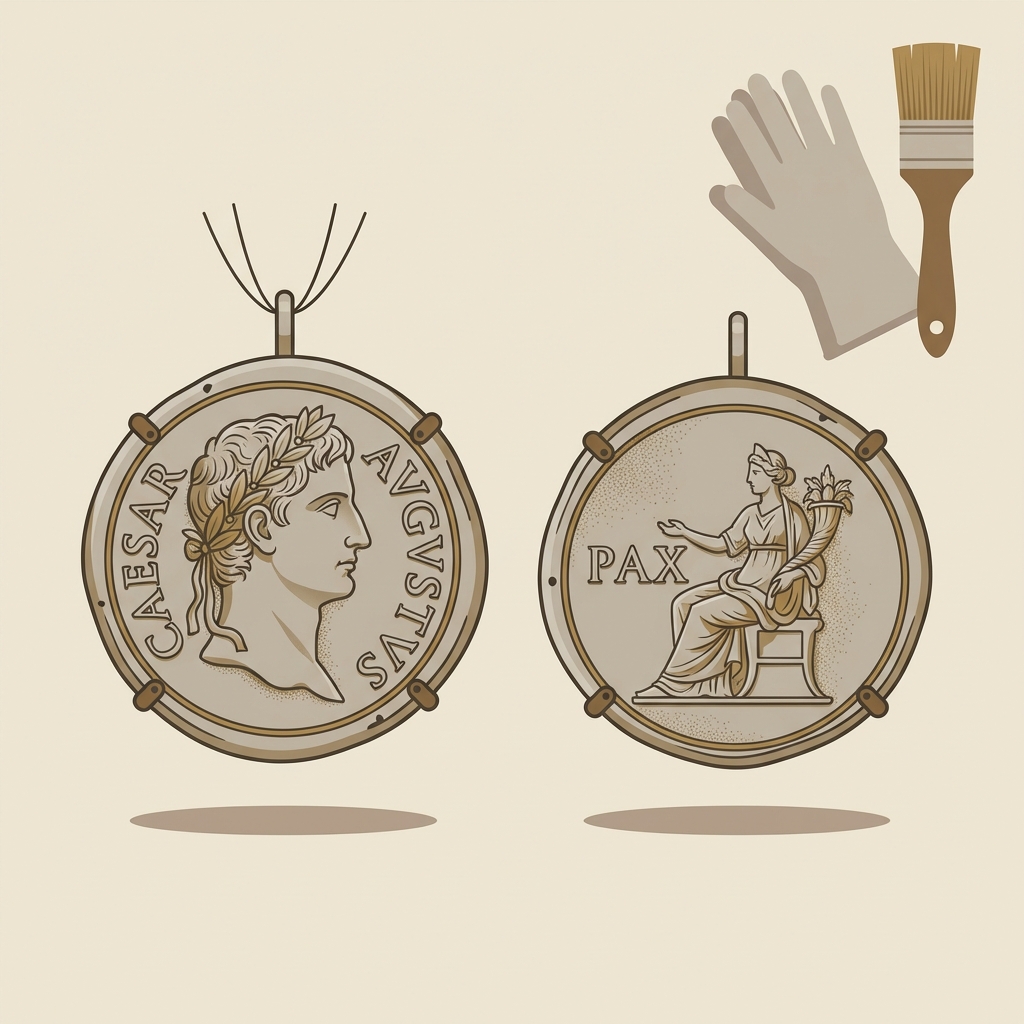
Listings typically include restoration and preservation notes that describe what was stabilised, repaired, or left untouched, and may reference curated ancient rings and select small artifacts alongside an object. Where available, provenance and documentation references such as collection history or verification letters are shown to improve buyer confidence, while clear condition notes highlight wear consistent with age and any interventions.
Remember that presence of notes or documentation increases confidence but does not constitute an absolute guarantee; lack of testing or incomplete provenance is a common reason to treat attribution as provisional and to ask for additional information.
Legal and ethical considerations for collectors
Legal obligations and export rules vary by country, and reporting finds to the appropriate authority matters for lawful collecting. National heritage regulations can restrict export or sale, and responsible collecting practices emphasize clear provenance and respect for find reporting systems Portable Antiquities Scheme guidance.
Ethical collecting values documented find history and careful sourcing. When provenance is incomplete, consider whether purchasing aligns with local laws and best practice, and seek further documentation or advice from specialists to avoid unintended legal or ethical risks.
Collectors should be mindful that some countries have strict cultural property rules and that reputable sellers will aim to provide clear provenance and collection history when available.
Summary: what an ancient Roman coin pendant can mean for a collector
Coin pendants can signal a range of meanings for collectors: personal status or allegiance when worn in antiquity, protective or lucky associations when used as an amulet, or later reinterpretation in medieval contexts. Interpretation depends on combined evidence of iconography, physical wear and documentation ANS guidance on combined methods.
For buyers the practical next steps are straightforward: ask for provenance and collection history, request clear photos of both faces and the mount join, avoid household cleaning that could erase informative patina, and where possible seek non destructive testing and third party opinions. These actions help you move from curiosity to a reasoned judgement about a piece.
Look for physical signs such as a suspension hole with matched patina, solder or bezel traces, and localized polish from wear; corroborate these with find context, provenance and, where possible, non destructive testing.
No, household cleaning can remove patina and diagnostic residues; consult finds guidance or a professional conservator for stabilisation and cleaning advice.
Ask for provenance and collection history, high resolution images of obverse and reverse, detailed restoration and condition notes, and any available testing or specialist reports.
More from Aurora Antiqua
References
- Gold necklace with coin pendants, Inv. 17.190.1655, The Metropolitan Museum of Art
- Octagonal Pendant, The Cleveland Museum of Art, Ohio
- Application of multi-modal 2D and 3D imaging and analytical techniques, npj Heritage Science (Springer Nature)
- Coin Hoards of the Roman Empire, University of Oxford
- Online Coins of the Roman Empire, American Numismatic Society and Institute for the Study of the Ancient World
- About us, International Association of Dealers in Ancient Art
- Microstructure and chemical composition of Roman orichalcum coins emitted after, Scientific Reports, Springer
- The Past Polluted: A Pigovian Approach to the Black Market in Antiquities, International Journal of Cultural
- Combining synchrotron radiation techniques for the analysis of gold coins from, Nature
- Unveiling origins, composition, and appearance of ancient Islamic gold coins, PubMed Central