


Looking for the real thing? Browse our Roman coin collection, each piece one of one, individually authenticated, with documented provenance. For the background, see the guide to buying ancient artifacts.
What is roman coin jewelry and why authentication matters
Definitions and common forms: mounted coins, intaglios, repurposed coins, roman coin jewelry
Roman coin jewelry describes ancient coin flans or intaglios that have been set into modern or historic mounts to be worn as rings, pendants or brooches. Collectors and buyers commonly encounter coins set in bezels, soldered to hoops or adapted with a bezel ring to make an ancient artifact wearable rather than left as a loose numismatic specimen.
Authentication matters because it clarifies condition, provenance and likely period rather than promising financial outcomes. Knowing whether a coin is genuine can explain why a surface looks worn, where restoration notes are relevant, and how an ancient ring or other artifact should be described for sale or conservation. For practical identification steps, start with careful visual comparison and reference resources to set realistic expectations for what tests can and cannot confirm British Museum guidance.
See behind the scenes at @auroraantiqua
Save or download the DIY checklist in this article so you can record photos, measurements and condition notes before you consult an expert.
When a coin has visible mounts, repairs or later modifications, some tests will be limited or need specialist handling. Mounting can obscure edge details, and solder used in a bezel can affect non invasive composition readings. Keep condition notes that describe the bezel, any solder, and whether an intaglio or gemstone was added as part of the setting.
A concise DIY checklist for assessing roman coin jewelry
Order of checks: visual, measurements, simple tests, provenance
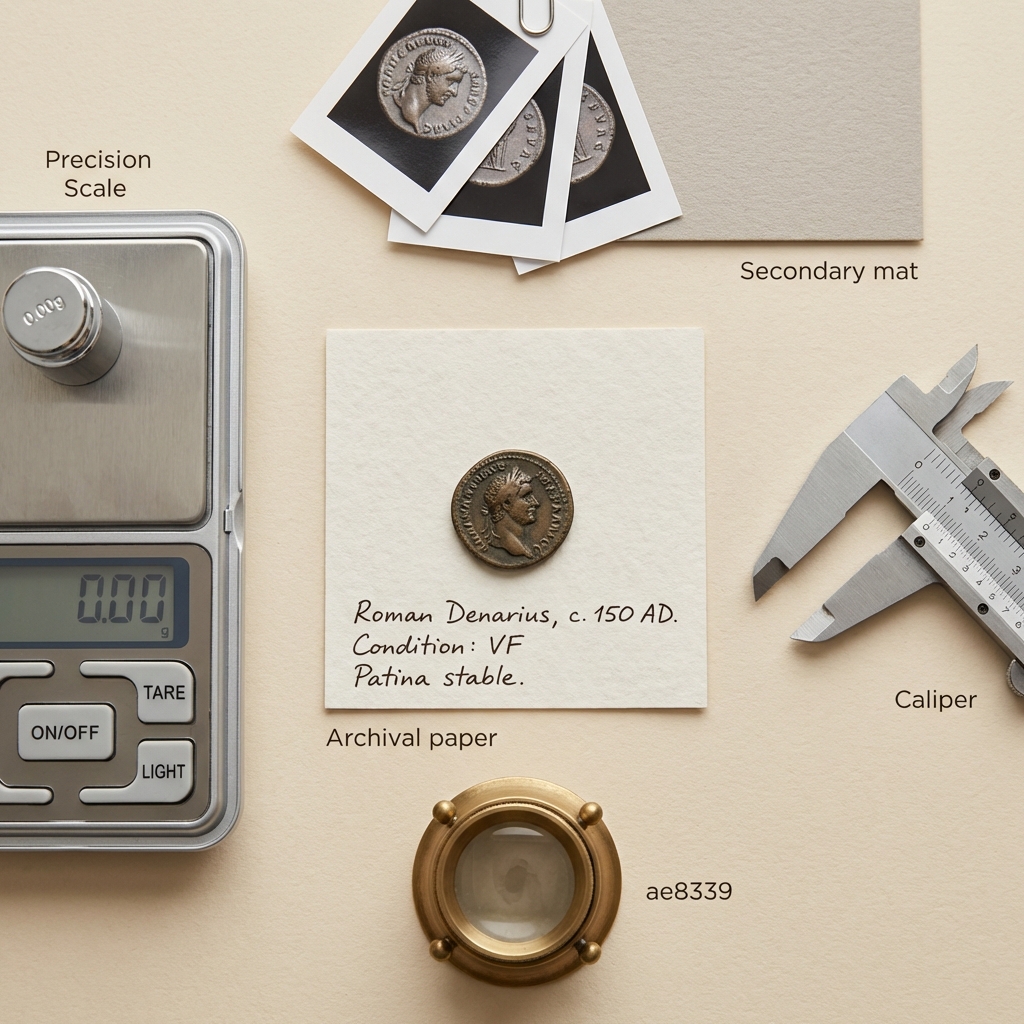
Before you start, prepare bright, diffuse light, a camera with macro capability, a scale accurate to 0.1 gram and a calliper for diameter and thickness. Take high resolution photos of both faces, the edge and the mounted setting, and make written notes of any visible repair, solder or modern additions. Recording clear images and a description of the mount creates essential condition notes to share with experts later.
Follow an ordered checklist: 1) photograph and label each view, 2) note visible mounting or restoration, 3) measure weight, diameter and thickness, 4) run simple non technical tests if available, and 5) check provenance and public records. Start comparisons with museum catalogues and reputable online corpora to place basic style and legend features before calling a lab or specialist Online Coins of the Roman Empire, American Numismatic Society and Institute for the Study of the Ancient World.
When you record measurements, write units and any instrument tolerances alongside the values. If you plan to share results with a consultant, include photos of the measurement process and describe how the coin sits in the bezel so an expert knows whether measurements were taken on the coin or include part of a mount.
Visual comparison: style, legends and iconography
What to compare: portrait style, lettering, reverse types
Museums and numismatic catalogues provide curated images and descriptions that help place designs and lettering within probable date ranges British Museum guidance.
Compare lettering carefully: modern forgeries often show inconsistent letter spacing or shapes that differ from period examples. Iconographic devices such as deity types, military trophies or animal motifs should be compared to examples in online corpora and reference catalogues to check for stylistic alignment with a likely period Online Coins of the Roman Empire: Search, American Numismatic Society.
Note edge features and how the coin meets its mounting. An original flan edge with irregular thickness is typical for many ancient issues, while a perfect round edge or a visible casting seam can indicate a modern reproduction. Record every observation in your condition notes so you can present them clearly to a numismatic reviewer.
Measure and compare: weight, diameter and thickness
How to take repeatable measurements at home
Objective measurements help flag obvious mismatches with accepted standards or recent auction records. Use a scale with 0.1 gram accuracy and callipers for diameter and thickness, and repeat each measurement twice to confirm consistency. Note whether your measurements include part of the bezel when coins remain mounted, as that will affect direct comparison with catalogued loose-coin standards American Numismatic Society: Silver Quinarius of Augustus, Emerita, 25 BCE.
Record your numbers in a simple table: weight in grams, diameter in millimetres, thickness in millimetres, and any observational notes about solder, rim damage or mounting. Keep unit labels and instrument tolerances next to the value so an expert can interpret your result quickly.
Begin with detailed photographs and condition notes, record weight and dimensions, compare style and legends with museum catalogues, perform simple non invasive tests, and consult provenance records; escalate to accredited numismatic organisations or conservation labs if doubts remain.
Compare your figures to published standards and recent auction entries for the same type. Large deviations can indicate a later cast, an altered flan or a different alloy. When measurements diverge from expected ranges, those mismatches become useful evidence to report to a specialist rather than definitive proof by themselves AN UNKNOWN COIN DIE OF AUGUSTUS (27 BC, 14 AD), Journal of Ancient History and Archaeology, DOI.
Simple non technical tests and portable analytical tools
Magnet, specific gravity and what they can show
Start with simple non technical checks such as magnet testing and specific gravity where feasible. A magnet can quickly flag magnetic modern steels or iron cores that are inconsistent with typical Roman silver or bronze, while a specific gravity test can indicate unexpected alloy proportions. These checks are screening tools and are not definitive on their own Identifying Counterfeits Using XRF.
Portable XRF has become a widely used non destructive tool that provides surface compositional readings and can flag unexpected elements or modern additives. For published notes on analyzer accuracy see an industry discussion of XRF analyzer accuracy XRF analyzer accuracy. However, pXRF cannot by itself prove ancient circulation or burial history because it measures near surface composition and does not capture manufacturing or provenance context. Treat pXRF as an informative but incomplete line of evidence and seek expert interpretation for any surprising results Investigating Ancient “Bronzes”, J. Paul Getty Museum and Getty Conservation Institute, Los Angeles.
When you describe pXRF results to an expert, include how the coin was mounted and whether measurements were taken on a visible coin surface or over solder. Mounting and later repairs can introduce contaminants that affect readings, so clear restoration notes help specialists interpret analytic outputs.
When you describe pXRF results to an expert, include how the coin was mounted and whether measurements were taken on a visible coin surface or over solder. Mounting and later repairs can introduce contaminants that affect readings, so clear restoration notes help specialists interpret analytic outputs. See also Thermo Fisher guidance on XRF testing through holders Thermo Fisher discussion.
Provenance, recording and documentation to strengthen attribution
What to look for in provenance notes and cataloguing
Provenance documentation and public recording materially strengthen attribution because they provide collection history, findspot information and any prior verification letters. Where available, consult public recording systems to see if the coin or type has a recorded findspot or catalogue entry that aligns with your object Portable Antiquities Scheme guidance.
Typical provenance elements are prior ownership notes, findspot or excavation context, and any verification letters or cataloguing records. Keep a clear record of this documentation, and include it with the condition notes you prepared earlier when asking a conservator or numismatic body to review the piece.

As an example of transparent presentation, a curated seller will list restoration notes and collection history when available, describe what was stabilised or left untouched and provide clear photographs. Aurora Antiqua aims to present condition notes and provenance context to help readers and potential buyers understand what they are seeing without implying absolute authentication.
Common forgery signs and typical pitfalls collectors miss
Surface and tool mark indicators
Common forgery indicators include modern tool marks on legends and devices, mismatched patina or wear patterns, visible casting seams and recent solder repairs. Under low magnification, modern tool marks often appear as sharp scratch patterns or inconsistent engraving that differs from period die work Forgery detection guide.
Inconsistent wear or patina that seems localized to recesses or artificially darkened areas can be a sign of surface treatment. Some modern forgeries intentionally mimic burial corrosion, so apparent ageing should be cross checked with stylistic comparison, measurements and, when available, laboratory analysis to avoid misreading surface appearance as proof of antiquity Reproducing bronze archaeological patinas through intentional burial, Heliyon (Elsevier, Open Access).
When to seek expert verification, labs and accredited services
Which institutions and services to consider
Seek expert verification if tests conflict, if the piece is potentially valuable, or if mounting obscures critical diagnostic features. Appropriate resources include accredited numismatic organisations, conservation laboratories and established auction house specialists who can provide cataloguing opinions or non invasive technical analysis International Association of Professional Numismatists (IAPN), IBSCC.
list of expert resources and report elements to request
Request non invasive analysis first
Expect a staged expert workflow: an initial visual and documentary review, followed by non destructive methods such as microscopy and pXRF, and only then invasive or destructive sampling if absolutely necessary and justified. A conservator or numismatic laboratory report should explain how pXRF results match visual and contextual evidence, and whether further testing is recommended Application of multi-modal 2D and 3D imaging and analytical techniques, npj Heritage Science (Springer Nature).
How authentication differs when coins are set as jewelry
Mounting, solder and how secondary work affects tests
Mounting and solder can hide legends, edge features and flan characteristics, and they may introduce modern metals that affect surface composition checks. That means some tests should be interpreted with caution for mounted pieces and conservator input is often needed to assess whether the coin can be tested in situ British Museum guidance.
Before any testing, photograph and note the exact nature of the bezel and solder. If a mount must be removed for definitive analysis, a conservator should document restoration notes that explain what was stabilised, repaired or left untouched so the coin’s condition and any later interventions remain clear.
A decision checklist to buy, sell or display roman coin jewelry
Questions to answer before you buy or sell
Use a short buyer checklist: do you have clear condition notes and photos, are weight and dimensions recorded, is there any provenance documentation, and are there simple test results such as a pXRF reading or specific gravity? If the answer to any of these is no and the piece is of potential significance, seek a written numismatic opinion before purchase or sale International Association of Professional Numismatists (IAPN), IBSCC.
When presenting items to buyers or auctioneers, include condition notes, measurements and any provenance documentation. See the Ancient Roman Rings collection for examples of transparent presentation. For higher value items or when test results are mixed, obtain a short verification letter from an accredited numismatic body or specialist to avoid disputes and to make the object’s history transparent to future owners.
Typical mistakes and how to avoid them
Overreliance on a single test
A frequent error is relying on one method alone. For example, a single pXRF reading or an attractive patina is not conclusive. Use a multi method approach that combines visual comparison, measurements and at least one independent line of technical evidence before reaching a confident conclusion Forgery detection guide.
Another common mistake is conflating age with authenticity. Wear consistent with age can support a case for antiquity, but wear can also be artificially induced. When in doubt, document everything carefully and consult reference catalogues or a specialist rather than accepting a single reassuring sign as proof.
Practical examples and short scenarios
Example 1: a circulated denarius on a ring with matching catalogue types
Scenario: a worn denarius mounted as a ring appears to match portrait style and reverse type in a museum catalogue. Measurements are within expected ranges, and public records show similar types recorded from the same region. In this case, visual comparison, measurements and provenance together provide a consistent interpretation that strengthens the attribution; include the matching catalogue entries when you consult an expert British Museum guidance.
Example 2: a heavily altered antoninianus with suspicious solder repairs
Scenario: an antoninianus set into a heavy bezel shows localized smoothing near legends and an unusual alloy reading on pXRF. Low power magnification reveals recent solder and tool marks. These mixed signals suggest escalation to microscopy and metallurgical review because modern repairs and solder can mask modern alterations that basic checks miss Forgery detection guide.
Example 3: a coin with a provenance record that changes interpretation
Scenario: a coin initially ambiguous on style has a documented findspot and prior collection history that aligns with the suspected issue. The provenance record materially strengthens the likelihood of authenticity when combined with measurements and visual matches, showing how documentation can change the overall assessment Portable Antiquities Scheme guidance.
Conservation, cleaning and care for roman coin jewelry
When to avoid home cleaning
Avoid aggressive home cleaning that can remove diagnostic surface features, delicate patina or residues that carry contextual clues. Cleaning can make later expert assessment more difficult and may remove evidence that helps distinguish a genuine coin from a modern copy Archaeological materials, Icon, The Institute of Conservation (UK).
Restoration notes should be precise: describe exactly what was stabilised, repaired or left untouched, and retain before and after photographs. If you or a seller plan to remove a mount for testing, have a conservator document the process so the coin’s condition and any interventions remain transparent for future buyers or laboratories.
Summary and next steps for readers
Checklist recap
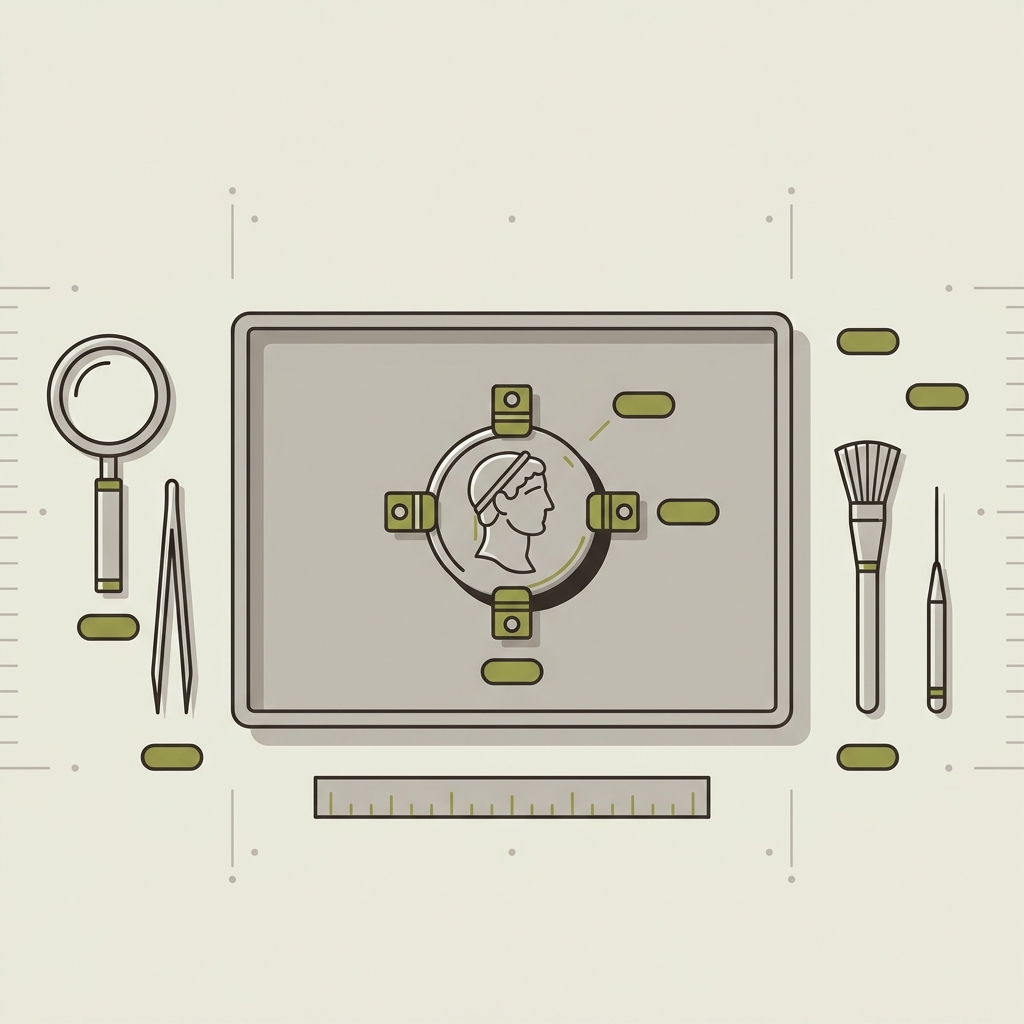
Recap the workflow: begin with careful photographs and condition notes, use visual comparison against museum and numismatic catalogues, record weight and dimensions, run simple non technical checks, consult public records where available, and escalate to accredited experts if doubts remain. Recording and sharing clear documentation speeds expert review and preserves collection history Online Coins of the Roman Empire, American Numismatic Society and Institute for the Study of the Ancient World.
Next steps: if you are satisfied with your checks, keep detailed records and include condition and provenance notes with any sale. If you remain uncertain, request a written opinion from an accredited numismatic body or a conservation laboratory. If the coin is potentially valuable or tests are mixed, seek staged non invasive analysis before considering any invasive testing Portable Antiquities Scheme guidance.
Yes, you can perform non invasive checks such as photographing the piece, recording weight and dimensions and using simple tests like a magnet or specific gravity. Note mounts can affect readings and consult a conservator if critical features are obscured.
No, portable XRF provides useful surface composition data but cannot by itself confirm circulation history or provenance. pXRF results should be combined with visual comparison, measurements and expert interpretation.
Provide high resolution photos of both faces and the edge, clear condition and restoration notes, weight and measured dimensions, and any provenance or prior documentation you have.
More from Aurora Antiqua
References
- Online Coins of the Roman Empire, American Numismatic Society and Institute for the Study of the Ancient World
- Online Coins of the Roman Empire: Search, American Numismatic Society
- American Numismatic Society: Silver Quinarius of Augustus, Emerita, 25 BCE
- AN UNKNOWN COIN DIE OF AUGUSTUS (27 BC, 14 AD), Journal of Ancient History and Archaeology, DOI
- Investigating Ancient “Bronzes”, J. Paul Getty Museum and Getty Conservation Institute, Los Angeles
- Reproducing bronze archaeological patinas through intentional burial, Heliyon (Elsevier, Open Access)
- International Association of Professional Numismatists (IAPN), IBSCC
- Application of multi-modal 2D and 3D imaging and analytical techniques, npj Heritage Science (Springer Nature)
- Archaeological materials, Icon, The Institute of Conservation (UK)
Browse the Aurora Antiqua catalogue
Every piece is independently identified, dated, and documented. Shipped insured from Belgium with DHL Express, free within the EU.