


Looking for the real thing? Browse authentic ancient signet rings, each piece one of one, individually authenticated, with documented provenance. For the background, see the guide to ancient jewelry.
What an ancient signet ring was: definition and historical context
Short definition
An ancient signet ring can be defined, in practical terms, as a small metal or stone-mounted finger ring whose bezel carries an engraved image or intaglio that could be used as a personal seal and a public sign of authority. Museum and reference treatments emphasize that these rings often combined jewellery and a sealing device, so they may function both as worn objects and as tools for making impressions on clay or wax; this dual role is central to how the term is used in material studies and in many textual traditions Encyclopaedia Britannica.
Where and when they were used
Archaeological typologies show long chronological and geographic continuity for signet technology across the ancient Near East, with secure examples from Late Bronze Age and Iron Age contexts through later Greco-Roman periods. The form and use of finger-ring seals varied by region and period, and typological studies link particular bezel shapes, intaglio styles, and materials to broad date ranges while still treating specific attributions as estimates rather than fixed statements The Metropolitan Museum of Art. See related objects in our Ancient Roman rings collection.
A signet ring in biblical contexts often signified delegated authority and could function as a sealing device, but its specific use depends on regional and chronological practice, so material evidence and documentation should guide interpretation.
Materials and typologies: what signet rings looked like
Common metals and stones
Collectors and museum catalogues typically describe ancient signet rings as made in gold, silver, or bronze, often with an engraved hardstone such as carnelian, agate, or amethyst set into a bezel. These materials were selected for durability and for the clarity they could lend to an impression when used as a seal; hardstones in particular were a common medium for detailed intaglio carving that could survive repeated impressions Encyclopaedia Britannica.
Bezel shapes and intaglio carving styles
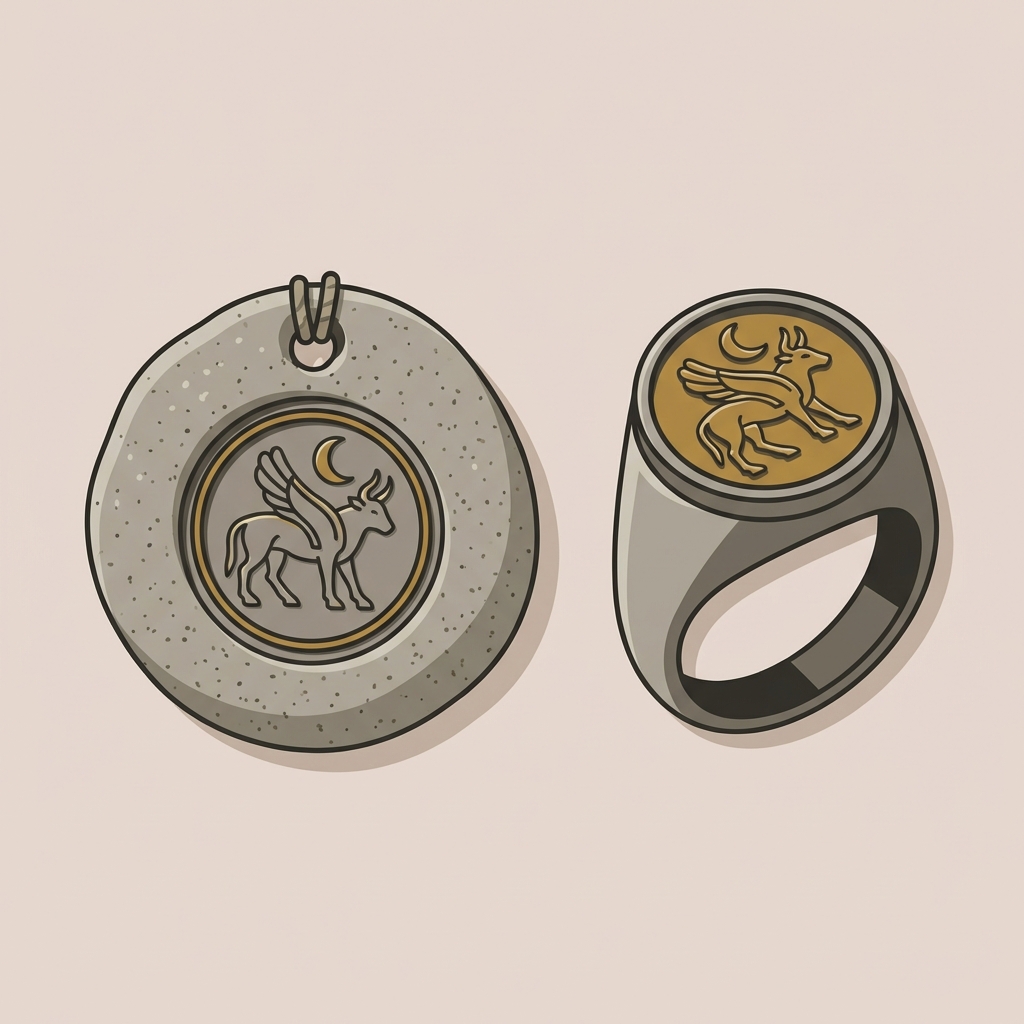
Physically, the parts to inspect on any ring include the bezel, which bears the engraved design; the hoop, or the circular band that fits the finger; and the shoulders that link bezel and hoop. Intaglio carving ranges from simple geometric punches to finely worked figural scenes, and the shape and depth of an intaglio can affect whether a ring would serve primarily as a worn object or as an effective sealing device for clay or wax impressions The Metropolitan Museum of Art.
How typologies help date rings
Typology is a comparative method: specialists match materials, bezel shapes, and carving styles against securely dated museum examples and excavation finds to produce a dating estimate. Museum catalogues and object studies provide the comparative corpus that helps place an object in a period or workshop tradition, while also warning that single-source typologies can be misleading if they are treated as definitive rather than as one line of evidence The Metropolitan Museum of Art.
How signet rings were used: sealing, authority and symbolism
Practical sealing use in administration
The primary practical function attested in both archaeological assemblages and administrative texts is sealing: transferring an index of authority onto clay or wax to authenticate containers, documents, and other items. Sealing assemblages, such as impressions and clay bullae, show that seals were integral to bureaucratic practice and record-keeping across many Near Eastern polities Israel Museum collection research.
Three quick checks to request in a listing
Ask for documentation before purchase
Public symbol of delegated authority
Beyond administration, rings appear in narrative sources as symbols of delegated authority or transferred status. Biblical stories that describe a ruler giving a ring to a subordinate use that image to signify legal empowerment and social elevation; in literary contexts the gift of a ring stands as a compact way to show that authority has been delegated rather than held personally Fit for a Queen and Oxford Bible Commentary.
Overlap of legal and symbolic functions in texts
Modern scholarship cautions against treating rings as only jewellery or only legal devices. Recent studies recommend integrating object-based evidence, administrative texts, and close reading of narrative sources so that the ring’s multiple roles are acknowledged and the specific uses in any given story are assessed with contextual nuance Journal of Near Eastern Studies.
Reading biblical scenes materially: Joseph, royal transfer, and literary use
Genesis 41 in material culture perspective
The Joseph-Pharaoh scene in Genesis 41 uses the ring as a compact sign of elevated status and delegated responsibility, and readers who compare the narrative with material culture should note the story’s combined administrative and symbolic language. The narrative functions as a literary marker that communicates new legal standing for Joseph rather than as a technical manual of sealing practice Oxford Bible Commentary and see the general overview at The Signet Ring - Bible History Online.

Other biblical transfer scenes and their meanings
Other biblical passages employ ring-giving to signal authority, ownership, or matrimonial and familial bonds, and these texts often use the ring-image to compress complex legal and social changes into a single, readable act. Interpreting those passages materially benefits from parallels in epigraphic and administrative records but requires care to distinguish literary technique from documentary routine Near Eastern Archaeology Review. For a short encyclopedic treatment of seals see Seal, Seals.
Limits of reading narrative as a direct administrative report
It is important to recognize limits: a narrative that shows a ring being handed to a character does not automatically mean that the ring was used in every administrative culture to make impressions directly. In some regions or periods a separate seal matrix or stamp-seal would be used, so a textual transfer scene should be read as evidence of symbolic transfer, which may or may not map neatly onto particular sealing routines in a given time and place Near Eastern Archaeology Review.
Variation in sealing practice: rings versus other seal types
Regional and chronological differences
Excavation assemblages indicate variation in sealing technology and administrative habit: some administrations favored finger-ring seals, while others more commonly used cylinder seals, stamp-seals, or separate matrices. Whether a ring appears in a story says little about which method was predominant in a particular archive without supporting archaeological or archival evidence The Metropolitan Museum of Art.
Examples of separate seal matrices and stamp-seals
Archaeological contexts preserve stamped impressions, clay bullae, and occasional impressions that suggest the use of stamp-seals or matrices kept apart from wearable rings. These finds show that sealing practice could involve specialized tools, and that rings sometimes served as personal identifiers while administrative impressions were produced with other implements Journal of Near Eastern Studies.

What excavation assemblages tell us
Sealings, bullae, and clay tags from administrative sites help reconstruct how sealing worked in practice; they allow scholars to observe which instruments were used for official impressions and to trace changes over time in administrative technique. Those assemblages are essential evidence when assessing whether a ring in a text or listing was likely used directly as a pressing tool or primarily as a wearable sign of identity Israel Museum collection research.
If you encounter an ancient signet ring today: what to check (for collectors)
Documentation and provenance checks
If you are considering a listing for an ancient ring, request clear provenance and documentation that tie the item to collection history, prior ownership notes, or verification letters. Treat dating as an estimate that depends on the supporting documentation and on comparison with museum catalogues rather than on a single photograph or a brief label L'anneau sigillaire d'Arégonde, femme de Clotaire Ier, découvert à Saint-Denis, Bulletin de la Societe. If you need to ask the seller follow up through the listing on the site listings.
Condition and restoration notes to read carefully
Condition notes and restoration notes are central. Ask whether any stabilization or repair work was done, which parts were left untouched, and how that work affects the structure and appearance of the bezel and the intaglio. Wear consistent with age, patina, and the state of the hoop and shoulders are all details that help specialists and informed buyers assess an object’s history Encyclopaedia Britannica.
When to seek specialist input
If a listing claims administrative sealing use or a secure dating, seek corroborating object-based or epigraphic evidence before accepting those claims. Professional reports, lab analysis where available, and independent specialist opinion can help clarify uncertain attributions and prevent over-interpretation of visual similarity alone Journal of Near Eastern Studies.
Common mistakes and myths about the biblical signet ring
Over-reading narratives as precise administrative reports
A common error is to assume that every narrative reference to a ring proves that a finger-ring was used to impress sealing material in the same way across periods and places. Literary scenes often compress legal and social changes into symbolic acts, and those acts can be persuasive without being documentary in the modern archival sense Near Eastern Archaeology Review.
Conflating all seal types with finger-ring use
Another mistake is to conflate cylinder seals, stamp-seals, and finger-ring seals as interchangeable. They are related technologies with overlapping functions, but their use, mobility, and administrative status can be quite different depending on the archive and the era under consideration The Metropolitan Museum of Art.
Misstating materials or dating without tests
Finally, asserting a precise metal, stone identification, or a tight date range without testing or documentary support is risky. Use conditional phrasing such as appears to be or dating estimate when presenting material identifications that are not corroborated by lab work or provenance documentation Finger ring, intaglio, London Museum (formerly Museum of London).
Practical examples and short scenarios: interpreting three real-world listings
Scenario A: a ring with clear provenance and conservation report
Scenario A describes a listing that provides a detailed collection history, photographs of past labels or auction entries, and a conservation report stating exactly what was stabilized. For such an object, the checklist is: confirm the chain of custody, compare typological details with museum examples, and review the conservation notes for any alterations that affect the bezel or intaglio; these steps make it reasonable to accept the seller’s dating estimate as provisional and evidence-based J. Paul Getty Museum Collection Policy, Board of Trustees.
Scenario B: a ring described mainly by visual similarity
Scenario B is a listing that relies primarily on visual similarity to museum images and brief, unsourced dating language. Here, ask for independent verification such as a verification letter or a clear collection history, and be cautious about accepting sealing-function claims that are not supported by impressions, bullae, or documentary parallels The Metropolitan Museum of Art.
Scenario C: a ring claimed as the biblical ring how to evaluate
When a listing suggests that an object is the ring from a biblical story, treat the claim as interpretive advertising rather than an evidentiary conclusion. Request provenance that can be traced historically, ask for any epigraphic or archival links, and remember that narrative fit is not the same as archaeological proof; rigorous corroboration is required before treating a ring as a specific narrative object Near Eastern Archaeology Review.
Conclusion: integrating objects and texts when reading the biblical signet ring
Summary of the balanced approach
The signet ring in biblical narratives functions both administratively and symbolically, and readers do best when combining material culture, epigraphy, and textual exegesis to understand those scenes. Archaeological assemblages and object studies help ground textual images in the practices of past administrations but do not convert narrative shorthand into a complete procedural manual Journal of Near Eastern Studies.
Practical final checklist
When you encounter an "ancient signet ring" in a listing or catalogue, ask for collection history and documentation, inspect condition and restoration notes, compare typology with museum examples, and seek specialist input for sealing or dating claims; treat dating as an estimate tied to evidence rather than as absolute Encyclopaedia Britannica.
See provenance and restorations on @auroraantiqua
Please consult the documentation and any specialist reports associated with a listing before drawing firm conclusions about use or date.
Next steps and further reading
For readers interested in further study, follow museum catalogues and recent scholarship that combine object-based analysis with administrative and epigraphic contexts, and when possible review conservation reports and provenance statements to form an evidence-based judgement about any ring offered as an antiquity our news and blog page and The Metropolitan Museum of Art.
In biblical narratives a ring often signifies delegated authority or a legal transfer of status, serving as a symbolic marker rather than a detailed administrative report.
Sometimes rings were used to make impressions, but archaeological evidence shows that administrations also used cylinder seals, stamp-seals, or separate matrices, so use varied by place and period.
Request provenance and conservation reports, compare typology with museum examples, and seek specialist input or lab analysis before accepting specific dating or sealing-function claims.
More from Aurora Antiqua
References
- Finger ring, intaglio, London Museum (formerly Museum of London)
- L'anneau sigillaire d'Arégonde, femme de Clotaire Ier, découvert à Saint-Denis, Bulletin de la Societe
- J. Paul Getty Museum Collection Policy, Board of Trustees
- Object ID, International Council of Museums
- Signet Ring, Victoria and Albert Museum, London
- William Wytlesey's ring, Victoria and Albert Museum, London
- global.oup.com
- Fit for a Queen: Jezebel’s Royal Seal, Biblical Archaeology Society, biblicalarchaeology.org
- Seal, Seals, jewishvirtuallibrary.org