


Looking for the real thing? Browse genuine signet rings for sale, each piece one of one, individually authenticated, with documented provenance. For the background, see the guide to ancient jewelry.
What an ancient greek signet ring is and why the Bible mentions signet rings
An ancient greek signet ring is, in plain terms, an ancient ring that bears an intaglio or engraved device and that could be worn as personal ornament while also serving to impress a seal into soft media for authentication. This definition links the object as a piece of jewelry to the practical sealing function that appears in ancient texts and administrative practice. The phrase ancient greek signet ring here highlights the material form most familiar from classical and Hellenistic contexts while acknowledging that similar rings circulated across the wider Near East. For a short overview of signet history see Victor Mayer's history of signet rings.
The biblical passages that prompt this questionnotably Genesis 41:42 and Esther 8:2present rings being placed on hands or transferred between people as a sign of delegated authority, and in those narratives the ring is associated with the power to act in the name of a ruler. For a close reading of the Genesis passage, see the relevant text of Genesis 41:42 for the narrative detail about Pharaoh placing a ring on Joseph's hand, which readers traditionally interpret as a visible token of delegated power Genesis 41:42 (Bible Gateway). For an alternative overview of signet history see Berganza's article on signets.
How Genesis 41:42 and Esther 8:2 describe transfer of authority using rings
Genesis 41:42 tells a brief story element in which Pharaoh places his signet ring on Joseph's hand and clothes him in fine garments, an action that many scholars read as both symbolic and practical: symbolic because it visibly marks Joseph's new status, and practical because a ruler's ring could be used to seal orders or documents in an administrative system. That reading is consistent with how ancient administrative authority is described in primary texts and later curatorial summaries Seals and sealing in the ancient Near East (British Museum).
Follow @auroraantiqua for behind-the-scenes context and documentation
For curated examples of ancient rings with condition notes and documentation, Aurora Antiqua presents pieces with clear provenance remarks and restoration notes to help you compare objects and claims without pressure to purchase.
Esther 8:2 records a similar transfer: King Ahasuerus giving Mordecai the king's signet ring. The passage has been read as indicating that Mordecai received not only symbolic honor but also the practical authority to seal documents in the king's name, which matches wider descriptions of imperial Persian practice where rings could confer sealing power Esther 8:2 (Bible Gateway).
It is important to be cautious in moving from narrative detail to technical assumption: the biblical texts link rings with power and sealing in many cases, but they do not always describe the physical act of impressing a seal in every scene. The texts therefore leave room for both symbolic reading and an interpretation grounded in administrative practice summarized by museum curators Seals and sealing in the ancient Near East (British Museum).

Material culture background: what museums and curators say about signet and intaglio rings
Museum overviews show a broad material vocabulary for signet and intaglio rings across the Mediterranean and Near East: metals such as bronze, silver, and gold and hardstones such as carnelian and agate were commonly used for intaglios that could be pressed into soft media. Curators emphasize that both the form and the choice of material affected how a ring was used and perceived Rings, Heilbrunn Timeline of Art History (The Met). See Aurora Antiqua's Ancient Greek Rings collection for related market examples and category references.
These curatorial resources also document motif variety: mythological scenes, animals, and portraiture appear on Greek intaglios across periods, while schematic or regional designs appear in Near Eastern corpora. That mixture of motifs is visible in many collection catalogues and helps explain why a single ring type can be both personal ornament and a sealing device Engraved gems and intaglios (The Met).

Curatorial notes and museum essays routinely warn that many published examples lack full scientific provenance or residue analyses that would directly tie a ring to sealing use; these gaps are an important reason to treat claims linking particular objects to biblical scenes with care and to favor catalogued objects with documented collection history Seals and seal impressions, The Israel Museum.
Characteristics of ancient Greek signet rings: materials, motifs, and sealing traces
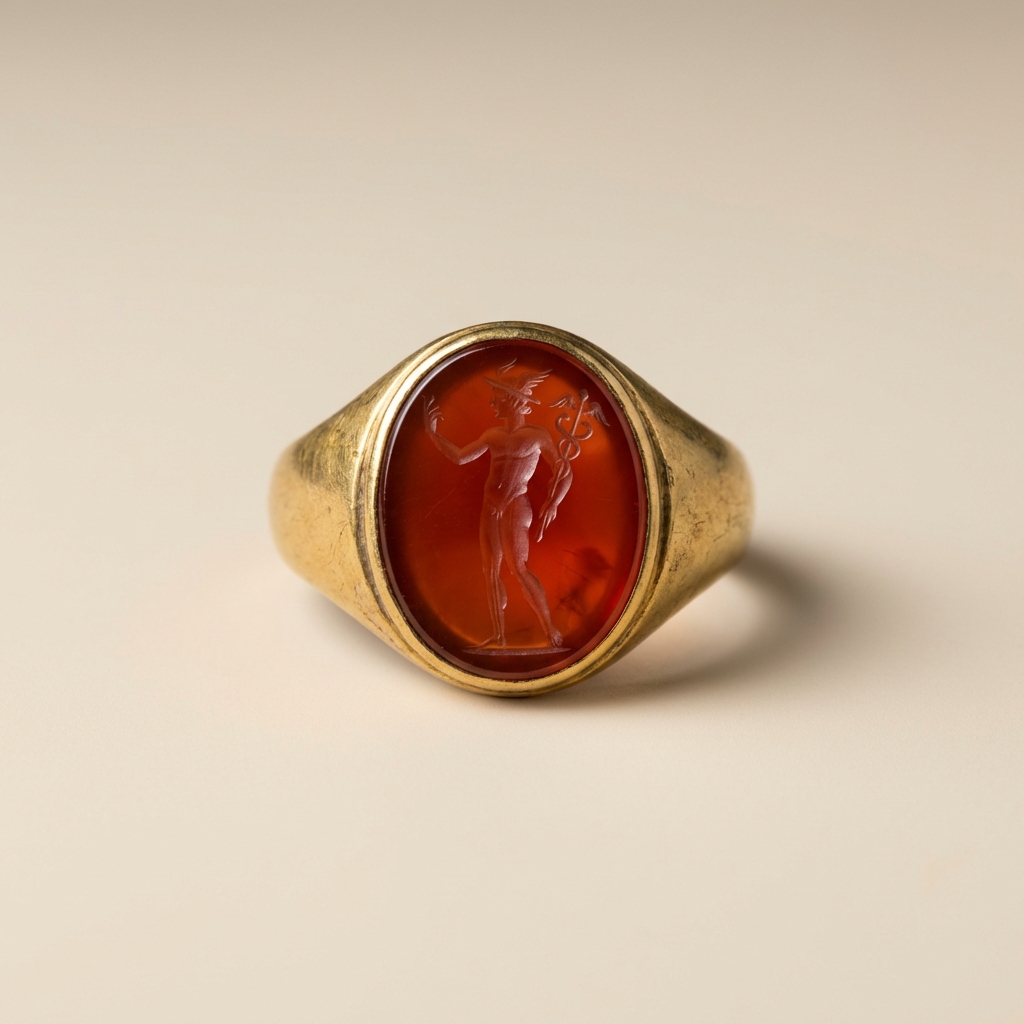
Greek signet rings of the classical and Hellenistic periods commonly appear in bronze, silver, and gold, and when used for intaglios they often incorporate hardstones such as carnelian or agate because those materials take a fine incision and retain detail for impressing seals. Curatorial summaries discuss how material choice influences durability and the quality of an impression Rings, Heilbrunn Timeline of Art History (The Met).
Motif styles range from naturalistic Hellenistic portraits to more schematic archaic designs, and common subjects include mythological figures, animals, combat scenes, and occasionally personalized emblems. These motifs can serve decorative purposes, identify the wearer, or act as a device for sealing, and the overlap in function is a recurring point in museum literature Engraved gems and intaglios (The Met).
When examining a ring for sealing traces, curators look for wear patterns around the intaglio, residues in depressions, and impressions that match known sealings. However, many published examples lack these residue analyses, so a ring that looks appropriate by motif and material still requires documented sealing evidence to establish it as a working administrative seal Seals and sealing in the ancient Near East (British Museum).
A simple framework: how signet rings functioned legally and socially in the ancient Near East and Mediterranean
To make sense of varied uses, consider a three-part framework: sealing function, identity function, and status function. First, the sealing function: a device carved as an intaglio could be impressed into clay or wax to authenticate documents or orders in administrative contexts, a practice widely discussed in curatorial overviews Seals and sealing in the ancient Near East (British Museum).
Biblical narratives present rings as tokens of delegated authority and likely sealing devices; surviving Greek intaglio rings share materials and motifs that could serve similar sealing and identity roles, but linking a particular artifact to a biblical instance requires provenance, typology, and sealing evidence.
Second, the identity function: the carved device served as a personal emblem or family mark that could be read by officials and associates. Third, the status and authority function: rings often indicated office or delegated power, as the Genesis and Esther passages suggest, where a ruler's ring functions as a token of official capacity Genesis 41:42 (Bible Gateway).
How to evaluate claims that a particular ring is the kind described in the Bible
Collectors and readers can use a short decision checklist: verify documented provenance prior to the mid 20th century when possible, compare typology and motif to published corpora, look for evidence of sealing use such as impressions or residue studies, and consult specialist catalog references or museum catalogues. These evaluation steps reflect standard curatorial cautions about provenance and sealing evidence Seals and seal impressions, The Israel Museum.
A short checklist to review provenance, typology, and sealing evidence
Use as a first-pass review
When provenance is missing or incomplete, be cautious: typological resemblance alone cannot confirm that a ring performed the legal sealing role described in biblical narratives. Many museum and curatorial essays note that absence of residue analyses or full collection history limits confident claims about administrative use Seals and sealing in the ancient Near East (British Museum).
Practical advice for non-specialists: favor items with documented collection history and clear restoration notes, ask sellers or catalogues for any sealing impressions, and if necessary consult a specialist or a reputable museum catalogue before treating an object as a direct parallel to biblical signet rings Rings, Heilbrunn Timeline of Art History (The Met).
Common mistakes and pitfalls when linking rings to biblical stories
A common error is conflating symbolic or literary use with technical administrative function: a narrative may use a ring as a literary shorthand for authority without intending to describe a working seal in technical terms. Museum essays underscore the need to separate symbolism from documented administrative practice Seals and sealing in the ancient Near East (British Museum).
Another frequent pitfall is relying solely on stylistic resemblance to assign cultural origin or date; motif similarity can be misleading without contextual provenance or scientific dating. As curatorial sources stress, typology is useful but not definitive when used in isolation Seals and seal impressions, The Israel Museum.
Marketing language or incomplete catalogue entries can amplify these mistakes by implying direct biblical connection where documentation is thin. For collectors, clear restoration notes and collection history are crucial to avoid these pitfalls and to set reasonable expectations about what a ring can be said to represent.
Practical museum examples and how to read them as a collector or reader
Major collections provide useful model entries: a well-documented catalogue record will include material, dimensions, motif description, provenance or collection history, and any conservation work. The Met and the British Museum offer collection essays and object entries that illustrate these standards and that show how motif and material details are recorded for readers to compare Engraved gems and intaglios (The Met). See the V&A entry for a signet example (V&A signet ring) and compare with market listings such as the Aurora Antiqua rings collection.
When a catalogue entry notes sealing impressions, residue analysis, or a matching clay impression, that strengthens an argument that a ring functioned as a working seal. Conversely, entries that list only stylistic parallels and lack collection history should be treated as suggestive rather than conclusive Seals and sealing in the ancient Near East (British Museum).
As a collector, use museum entries as templates: look for precise material description, clear photos of the intaglio, any notes on impressions or residue, and transparent restoration notes; these elements help you map a museum-standard record onto a market listing and judge how closely an object aligns with biblical-era sealing practices Rings, Heilbrunn Timeline of Art History (The Met).

Takeaways: what the Bible says, what the objects show, and what remains uncertain
The Bible presents signet rings as instruments of authority and as objects that could be transferred to confer delegated power; passages such as Genesis 41:42 and Esther 8:2 frame rings in both symbolic and administrative ways that align with broader ancient sealing practice Genesis 41:42 (Bible Gateway).
Museum-based material culture shows clear overlap with the kinds of rings that could be used for sealing, especially Greek intaglio types in stone and metal, but there is not a perfect equivalence and specific claims require documented provenance, typology, and, when possible, sealing evidence Seals and sealing in the ancient Near East (British Museum).
For collectors and readers the practical next steps are to consult the primary passages, use museum catalogues as comparison models, and prioritize objects with transparent provenance and any indication of sealing use before accepting a direct connection to a biblical administrative role. See the Aurora Antiqua homepage for category links and example listings.
Identifying a specific biblical ring from a surviving artifact is rarely possible without strong provenance, matching typology, and direct evidence of sealing use; most claims remain tentative without this documentation.
Greek signet rings were commonly made in metals such as bronze, silver, and gold, and often used hardstones like carnelian and agate for intaglios, which hold fine carved detail suitable for seals.
Ask for documented provenance, catalog references, clear condition and restoration notes, high-resolution photos of the intaglio, and any evidence of seal impressions or residue analyses.
More from Aurora Antiqua
References
- Finger Ring with Frog, The Cleveland Museum of Art
- A Corpus of Roman Engraved Gemstones from British Sites, University of Michigan Press / BAR Publishing
- L'anneau sigillaire d'Arégonde, femme de Clotaire Ier, découvert à Saint-Denis, Bulletin de la Societe
- William Wytlesey's ring, Victoria and Albert Museum, London
- Signet Ring, Victoria and Albert Museum, London
- Ring, Victoria and Albert Museum, London
- ring, Victoria and Albert Museum, London
- Amulet, Victoria and Albert Museum, London
- Signet Ring, Victoria and Albert Museum