


Looking for the real thing? Browse genuine signet rings for sale — each piece one-of-one, individually authenticated, with provenance.
What an ancient signet ring means in a Viking-age context
An ancient signet ring, in archaeological terms, is a personal ring that bears a carved matrix or recessed intaglio intended to make a reproducible impression on a soft material, typically wax or clay; this purpose distinguishes it from rings made primarily for ornament or display. Museum catalogues and collection guides set out this distinction when they describe bezel morphology and reversed carving as key indicators of sealing function British Museum
Across the Viking Age and in Anglo-Scandinavian communities, rings were widely worn as personal jewellery and visible markers of status, but most excavated examples are not securely identified as document-sealing signet rings. National collections and syntheses show a wide variety of ornamental forms, and only a limited subset meet the technical criteria that would make sealing a plausible use Nationalmuseet
While Viking-age communities widely wore rings, archaeological and documentary evidence shows that routine use of finger-ring signets for official sealing is not commonly attested; stronger evidence appears in later Anglo-Scandinavian elite contexts where continental sealing practices were adopted.
Some Viking-age rings carry motifs or runic marks that can function as personal marks or identifiers, and these features can be suggestive without proving routine sealing. Interpreting such marks depends on findspot, associated objects, and any documentary or impression evidence that links a ring to administrative practice British Museum
Common Viking-age ring types, materials and wear patterns
Typical Viking-age rings and Anglo-Scandinavian examples were made in a range of metals, commonly bronze, silver, and less frequently gold, and could include set gemstones or intaglios. Metal choice and construction vary by period and region, and museum catalogues describe common decorative programs such as interlace, animal motifs, and simple engraved devices British Museum

Gemstones and intaglios in Viking contexts are sometimes decorative, set in raised bezels, or simply used as cabochons, and such settings are not in themselves evidence of sealing. A recessed or sunk bezel that protects an engraved device is technically more compatible with regular pressing for impressions, but context remains decisive in interpretation Nationalmuseet

Physical features that support identifying an ancient signet ring
When evaluating whether a ring could have functioned as a signet, focus first on the bezel and intaglio: a deliberately sunk or recessed bezel, a device carved in reverse suitable for making a mirror impression, and evidence of hardened wear along the surface used for pressing are the most diagnostic physical features. Collections and identification guides list these as primary criteria for seal-ring identification British Museum
Microscopic and wear-based evidence can strengthen or weaken a sealing claim. Microscopy may reveal linear abrasion patterns or surface hardening consistent with repeated contact, or alternatively the random polish expected from general handling. Residue analysis and comparison with known impressions can provide more direct support but are not always available; when present, such technical work should be described in the object documentation or publication British Library
Quick visual checklist to spot a recessed bezel and reversed carving
Use 10x loupe and good light
Other useful physical checks include the symmetry and clarity of any carved device, the depth of the cut relative to ring wear, and whether the device features reversed lettering or motifs that would read correctly in an impression. These observations, combined with findspot information and any associated archival notes, form a practical starting point for further testing British Library
Archaeological and documentary evidence: how common were signet rings?
Finds recorded in national databases and museum collections show that rings with clear intaglios or recessed bezels compatible with sealing are relatively limited compared with the overall corpus of Viking-age rings. Reporting and cataloguing practices in national schemes make it possible to survey the frequency of candidate pieces and to identify examples with stronger contextual links to administrative or elite use Portable Antiquities Scheme - Annual Report 2023 and the Finds Recording Guides for finger-rings.
In the British Isles, particularly in Anglo-Scandinavian contexts of the later tenth and eleventh centuries, there is stronger archaeological and documentary indication that elites adopted seal-ring use under continental influence; documentary sources and imported practices can be tracked in this period and region. Comparative syntheses place Viking jewellery and administrative practice on a spectrum and note increasing adoption of continental sealing conventions over time The Oxford Handbook of the Viking Age
Comparative studies show that Carolingian and later medieval continental traditions have more consistently attested sealing practices in legal contexts than the earlier Viking material, and that ecclesiastical and trade contacts helped spread sealing techniques. Open questions remain about rural use and whether impressions sometimes came from portable matrixes rather than finger-rings, so prevalence estimates must be cautious and based on context-specific records The Metropolitan Museum of Art
Practical checklist for collectors evaluating an ancient signet ring
1. Request provenance and finds-record entries: ask the seller for collection history, excavation records, or a Portable Antiquities Scheme or museum accession number. Documentation of findspot and collection history is often decisive when a ring is claimed to be a working seal Portable Antiquities Scheme - Annual Report 2023
2. Look for publication or accession references: published catalogue entries, museum records, or peer-reviewed discussion strengthen interpretive claims. If a ring appears in a finds database or a museum catalogue, that record will typically note bezel form, intaglio type, and any relevant analysis British Museum
3. Ask for detailed condition and restoration notes: a clear statement of what was stabilized or repaired, plus magnified images of the bezel and intaglio, helps distinguish natural wear from later alteration. Condition descriptions and restoration notes should accompany a responsible listing and are commonly used by curated sellers to set expectations
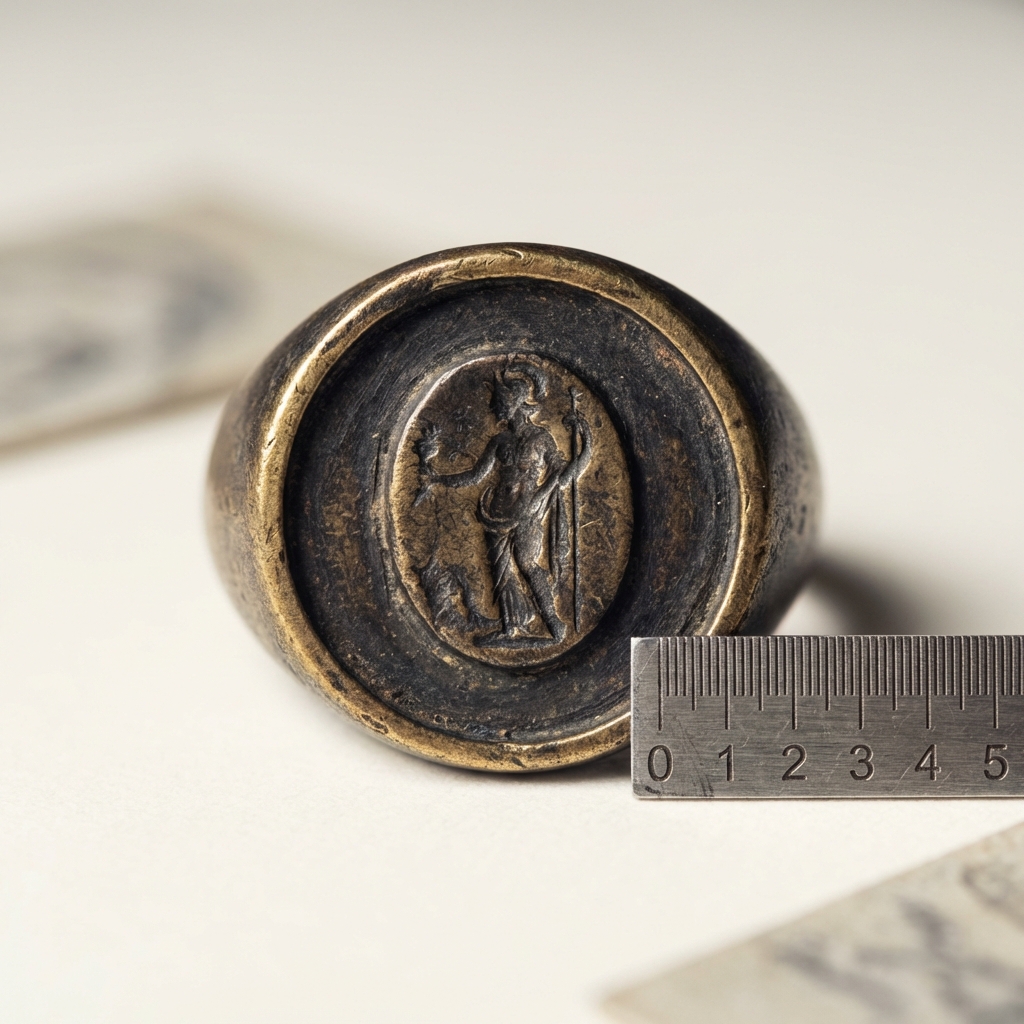
4. Seek evidence of paired impressions or technical analysis: request any impressions, residue reports, or microscopy notes that compare a ring with known seal impressions. Technical confirmation is particularly useful where the bezel shows ambiguous marks that could be decorative rather than designed for sealing British Library
5. When in doubt, request expert input or withhold purchase: if provenance is incomplete, impressions are lacking, and technical reports are absent, treat the sealing claim as ambiguous and consider seeking an independent specialist opinion or choosing another piece. Conservatively phrased catalogue language is a legitimate red flag if it is absent
How museums and finds databases classify and record possible seal rings
Museums and national finds schemes typically record bezel form, whether the device is incised or intaglio, findspot, collection history, and publication references in catalogue records; such structured details allow later researchers and collectors to assess sealing claims against consistent terminology and criteria Portable Antiquities Scheme - Annual Report 2023
Institutional guides and collection pages on seals describe standard identification terms and the kinds of technical work that support sealing claims, making them useful comparison tools for collectors who want to verify seller statements. These guides also underline the value of publication and museum registration as part of a transparent documentation trail British Library
While registration and publication strengthen interpretive claims, such records are not a substitute for impressions or secure contextual evidence. A museum accession or catalogue note that describes a ring as a possible seal should ideally be read alongside any technical analysis and findspot documentation before accepting a sealing function as proven British Museum
Common misidentifications and pitfalls when assessing ancient signet ring claims
One frequent error is mistaking decorative intaglios, punched dots, or non-recessed gem settings for true seal matrices. Decorative devices can resemble seal imagery, but without a recessed bezel or a reversed carving they are unlikely to have been used as reproducible matrices British Museum
Stylistic similarity to known seal types can be persuasive but is not conclusive. Workshop attribution or motif parallels should be treated as supporting context rather than proof. Comparative syntheses caution against over-reliance on style alone when findspot and technical data are absent The Oxford Handbook of the Viking Age
Follow @auroraantiqua for behind-the-scenes finds and condition notes
Before buying, consult publication records or request clear condition and provenance details; treat sealing claims as evidence-led, not assumed.
Later repairs, modern re-cutting of a bezel, or historic alterations can create misleading impressions of a sealing function. Condition notes and restoration documentation are essential to distinguish original carving and wear from later interventions that imitate or obscure original features British Library
Practical examples and a concluding checklist
Scenario 1, plausible signet: a bronze ring recovered with a recorded findspot, described in a museum entry, contains a sunk bezel with a device cut in reverse, and a published impression matches the carving. In that case, publication and paired impressions together make a strong argument for sealing function British Museum. A comparable report is described in a signet ring discovery.
Scenario 2, ambiguous: a ring offered with attractive ornament and a carved device but no findspot, no publication, and only seller photographs. Without technical imaging, impressions, or registration in a finds database the sealing claim should be treated as uncertain and described cautiously in any listing Portable Antiquities Scheme - Annual Report 2023
Final checklist: require provenance or finds registration, ask for publication or museum accession numbers, request clear restoration and condition notes, seek impressions or technical analysis when available, and prefer conservatively phrased attributions when evidence is incomplete. These steps help collectors and researchers make evidence-based judgments without overstating certainty British Library
Curated sellers who present ancient ring listings, including curated ancient rings spanning Roman, Greek, Byzantine, Islamic, Celtic, medieval, and post medieval periods, often include provenance and restoration notes to help buyers evaluate claims. When present, those notes provide useful context but should still be read critically and cross-checked with independent records where possible
Look for a deliberately recessed bezel, a device carved in reverse for impressions, hardened wear consistent with repeated pressing, and supporting provenance or publication; without those elements a sealing claim is ambiguous.
No, most Viking-age rings appear to be decorative or status jewellery; only a limited number show the physical features and contextual evidence compatible with regular sealing use.
Request findspot or collection history, finds-database or museum accession numbers, publication references, condition and restoration notes, and any impressions or technical reports that compare the ring with known seals.