


Looking for the real thing? Browse genuine signet rings for sale, each piece one of one, individually authenticated, with documented provenance. For the background, see the guide to ancient jewelry.
What an ancient signet ring was and why it mattered
A signet ring in ancient Greece functioned primarily as a personal seal, fitted with a carved intaglio that could be impressed into clay or wax to authenticate documents and mark ownership. This functional use as a seal is central to understanding the ancient object while recognising that the same ring also operated as wearable display and personal identifier in daily life, especially from the Archaic through the Hellenistic periods Metropolitan Museum of Art glyptic overview
Across centuries the form and social role of the signet ring shifted, but the basic purpose remained related to identity and authentication: an image carved into a hardstone or a metal matrix served to link a person to an administrative act or to an owned object. Whether used in private correspondence, household administration or commercial exchange, the signet ring’s impression could stand in for an individual’s signature in contexts that required a secure mark Aegean and Cypro-Aegean Non-Sphragistic Decorated Gold Finger Rings, American Journal of Archaeology
Compare a candidate ring to museum catalogue entries and request specific photos
Use high resolution photos for intaglio detail
Collectors and students should hold both functions in mind: the practical sealing function and the ring’s role as a visible personal emblem. The balance between these roles can vary with period, owner and context; many published examples show rings that were clearly used as seals while also carrying imagery chosen for personal or amuletic significance Metropolitan Museum of Art glyptic overview
When evaluating an object described as a signet, pay attention to the intaglio form, the presence of an impression in site-appropriate clay or wax in records, and condition notes that signal wear consistent with repeated use rather than a purely decorative item Ashmolean Museum notes on seals
Materials and common shapes: what signet rings were made of
Typical mounts for ancient signet rings were bronze, silver and gold, as recorded in museum catalogues and reference works; these metals formed the hoop and bezel that held a carved stone or metal matrix in place Encyclopaedia Britannica entry on seals Ancient Greek rings collection
For the intaglio itself hardstones such as carnelian, agate and jasper were commonly used because their toughness and fine grain allowed clear carving and durable impressions. These stones often appear cut to fit a rounded or oval bezel and are carved with incised lines and drilled details to hold fine motifs Walters Art Museum searchable collection V&A signet-ring record
Shape cues help with quick evaluation: many Greek examples use low oval or slightly convex gem shapes set into simple bezels, while higher domed seats or elaborate shoulders can point to later fashions or regional workshops. Look for how the gem sits in the bezel, the shape of the hoop and symmetry of the shoulders when comparing to catalogued parallels Encyclopaedia Britannica entry on seals
How signet rings were made: carving and mounting techniques
Carving an intaglio combined hand-incised lines with micro-drilling where tiny drilled points define eyes, hair curls or other fine details; this mixed technique allowed engravers to achieve a surprising level of detail on small hardstone surfaces Overview of ancient gem engraving techniques
Metal mounts were commonly formed or cast, with lost-wax casting used to create detailed settings before the gem was fitted into the bezel. After casting, the bezel would be finished and the gem secured by pressure or small peening adjustments to the metal Ashmolean Museum notes on seals
Shape cues help with quick evaluation: many Greek examples use low oval or slightly convex gem shapes set into simple bezels, while higher domed seats or elaborate shoulders can point to later fashions or regional workshops. Look for how the gem sits in the bezel, the shape of the hoop and symmetry of the shoulders when comparing to catalogued parallels Encyclopaedia Britannica entry on seals
Toolmarks from engraving and fitting can survive on both gem and metal and, when recorded carefully, can aid specialist dating or workshop attribution. Recognising such traces requires close-up imagery or hands-on examination by a conservator or glyptic specialist Overview of ancient gem engraving techniques
See restoration and provenance details on @auroraantiqua
Read the checklist below for concrete photo requests and condition notes to ask for when you evaluate a listing.
For collectors the practical upshot is simple: ask for macro photographs of the intaglio and bezel junction, and look for micro-drilled details and consistent toolwork; these craft traces are part of the evidence that separate a worked hardstone seal from a later copy or crude imitation Overview of ancient gem engraving techniques
Wear consistent with repeated impressioning, such as flattened high points on an intaglio or matching wear on the bezel, can support a functional sealing interpretation, but specialist advice is often needed to read these traces correctly Ashmolean Museum notes on seals
Common motifs and what they could mean
Carved motifs on Greek signet rings include portrait heads, deities, animals, monograms and geometric devices; these images could function as personal identifiers, amuletic symbols or markers of status depending on the owner and context Talismans, Visitatori salutem, Szepmuveszeti Muzeum, Museum of Fine Arts Budapest
Portrait heads and deity figures could indicate personal devotion, family association or claimed descent, while animals and mythological creatures often served as recognizable emblems that a wearer might associate with protection or identity. Monograms and geometric devices served a more straightforward identifying or heraldic role in many catalogued examples Metropolitan Museum of Art glyptic overview
It is important to treat motif interpretation cautiously: the same motif can appear across social ranks and functional contexts, so a single motif rarely proves administrative rank or a fixed meaning without supporting provenance or contextual evidence Philip Kiernan and Klaus-Peter Henz, Rings from the Forbidden Forest, Cambridge University Press
Primary functions in practice: sealing, identity and display
In practice, signet rings were used to impress a controlled image into sealing material to authenticate a closure or document; surviving sealings and references in administrative contexts make this use clear in many documented cases Metropolitan Museum of Art glyptic overview
Wearing the ring on the hand meant the owner carried a portable emblem of identity, useful both for daily recognition and for signalling social ties or status when meeting others. This wearable aspect blends display with the practical sealing function in many museum examples Walters Art Museum searchable collection
The overlap between administrative use and personal or amuletic use is common: one owner might use a ring to seal business papers and also choose imagery intended to protect or represent family lineage. Context-where the ring was found, how it is described in collection records, and whether impressions survive-matters for interpretation Metropolitan Museum of Art glyptic overview
How experts and museums attribute and date signet rings
Typological comparison against museum collection records and published catalogues provides the most reliable starting point for dating and attributing a signet ring; direct parallels in well-documented collections let scholars place motifs, mount styles and manufacturing traits in chronological frameworks Walters Art Museum searchable collection
Where catalogues include condition notes and prior ownership history, typology becomes significantly more useful; without provenance or detailed condition reporting, stylistic dating alone can be uncertain and should be framed as a best estimate rather than a firm date Metropolitan Museum of Art glyptic overview

Laboratory analyses and specialist reports can add confidence, for example when gem identification, metal alloy analysis or microscopic recording of toolmarks are available, but such reports are not always published with private sales and so are an important request to make when attribution matters Metropolitan Museum of Art glyptic overview
For collectors, the combination of typology, condition notes and any published parallels in museum catalogues is the practical route to a responsible attribution; when these are absent, expect uncertainty and ask sellers for more documentation or a specialist opinion Walters Art Museum searchable collection Ancient Roman rings collection
Identification checklist for collectors
Begin with the bezel motif and intaglio technique: request close-up photos of the carved face, looking for hand-incised lines and micro-drilled points that indicate traditional engraving methods Overview of ancient gem engraving techniques
Next check metal patina and surface wear: a consistent patina on the mount and wear patterns on the gem surface are more informative than motif alone and can indicate repeated use as a sealing device Encyclopaedia Britannica entry on seals Rings collection
The original purpose of a signet ring in ancient Greece was primarily to function as a personal seal to authenticate documents and mark ownership, while also serving as wearable display and a personal identifier depending on context.
Review restoration and condition notes carefully: clear statements about what was stabilised, repaired or left untouched help you understand which features are original and which are later interventions Overview of ancient gem engraving techniques
Finally, request provenance information and any specialist or laboratory reports; even a short collection history or a comparison to a museum catalogue entry will raise confidence in a listing, whereas vague or missing provenance should prompt caution Walters Art Museum searchable collection
How restoration and preservation affect interpretation
Restoration notes typically specify which areas were stabilised, where repairs were made and what surfaces were left untouched for study; these disclosures are essential for assessing how much original surface remains and which marks can be read as ancient Overview of ancient gem engraving techniques
Repairs can alter bezel fit, obscure toolmarks on the gem or change the appearance of patina, which complicates stylistic dating and functional interpretation. Transparent conservation documentation helps separate restored areas from original craft traces Overview of ancient gem engraving techniques
Prefer listings that describe restoration as stabilisation or minimal intervention and that include photos of the repaired areas and pre-restoration condition when possible; such transparency supports a clearer reading of the object’s original technique and use Overview of ancient gem engraving techniques
Provenance and documentation: what boosts confidence
Useful provenance details include collection history, prior ownership notes and any verification letters that accompany a piece; when a piece can be linked to a named collection or a published catalogue entry, attribution becomes more secure Walters Art Museum searchable collection
Museum records and published catalogue entries offer the best parallels for comparison because they provide consistent typological language, condition reporting and, in many cases, a documented find history; these records help ground dating and interpretation Metropolitan Museum of Art glyptic overview British Museum signet-ring
When provenance is absent or vague, treat any attribution as provisional and ask for more evidence; sellers who provide transparent documentation and condition notes make it easier to evaluate an item responsibly Walters Art Museum searchable collection
Museum parallels and published examples to consult
Major public collections that hold comparable Greek signet rings and engraved gems include the Metropolitan Museum of Art, the Walters Art Museum and the Ashmolean; consulting their online records can reveal direct parallels in motif, mounting and manufacturing technique Metropolitan Museum of Art glyptic overview Getty Museum example
Use object records to compare multiple attributes: motif, bezel shape, metal type, intaglio technique and condition notes. A strong parallel will match several of these features rather than just the motif alone Walters Art Museum searchable collection
When a seller references a museum parallel, follow that lead by finding the cited catalogue entry and checking its images, description and dating rationale; this step clarifies whether the comparison stands up under scrutiny Metropolitan Museum of Art glyptic overview
Common mistakes and pitfalls collectors make
A frequent error is to assume that a familiar motif proves age or administrative rank; motifs circulated widely and can appear on both ancient and modern objects, so motif alone is a weak basis for attribution Encyclopaedia Britannica entry on seals
Another pitfall is ignoring restoration and provenance gaps. Missing condition notes or photos that hide the bezel junction make it impossible to assess whether a gem has been refitted or whether toolmarks are original Overview of ancient gem engraving techniques
Finally, beware confident dating statements unsupported by catalogued parallels or specialist reports; responsible sellers will describe dating as an estimate and point to specific comparisons rather than asserting certainty Metropolitan Museum of Art glyptic overview
A practical buying checklist for ancient rings
Ask the seller for clear condition notes, close-up photos of the intaglio face and bezel junction, and specific images showing any toolmarks or micro-drilled details Overview of ancient gem engraving techniques
Request restoration notes and any specialist or laboratory reports that identify gem type or analyze metal alloy; these documents materially raise confidence when they are available Walters Art Museum searchable collection
Prefer listings that compare the object to museum parallels or published catalogue entries and that state dating as an estimate informed by typology and condition rather than a firm fact Metropolitan Museum of Art glyptic overview
Finally, if purchase is contemplated, ask for a short condition and provenance summary you can keep with the object; a clear written note about what was restored, stabilised or left untouched is invaluable for future study and care Overview of ancient gem engraving techniques
Example scenarios: reading three typical listings
Scenario A: a ring with museum provenance and catalogue parallels. When a listing cites a known collection, provides a catalog reference and includes condition notes and high-resolution images, it becomes reasonable to accept the attribution as supported by comparative material in public records Walters Art Museum searchable collection
Scenario B: an attractive listing with minimal provenance. A visually convincing intaglio and an appealing mount are not substitutes for condition notes and close-up images; without these, buyers should ask for more documentation or expert input before relying on stylistic claims Metropolitan Museum of Art glyptic overview
Scenario C: a repaired or heavily restored piece. If restoration notes indicate significant reshaping or refitting of the gem, the original toolmarks may be obscured and impressions altered; such cases require careful documentation and, ideally, specialist commentary to understand how repair affects attribution Overview of ancient gem engraving techniques
Concluding summary: what we can responsibly say about original purpose
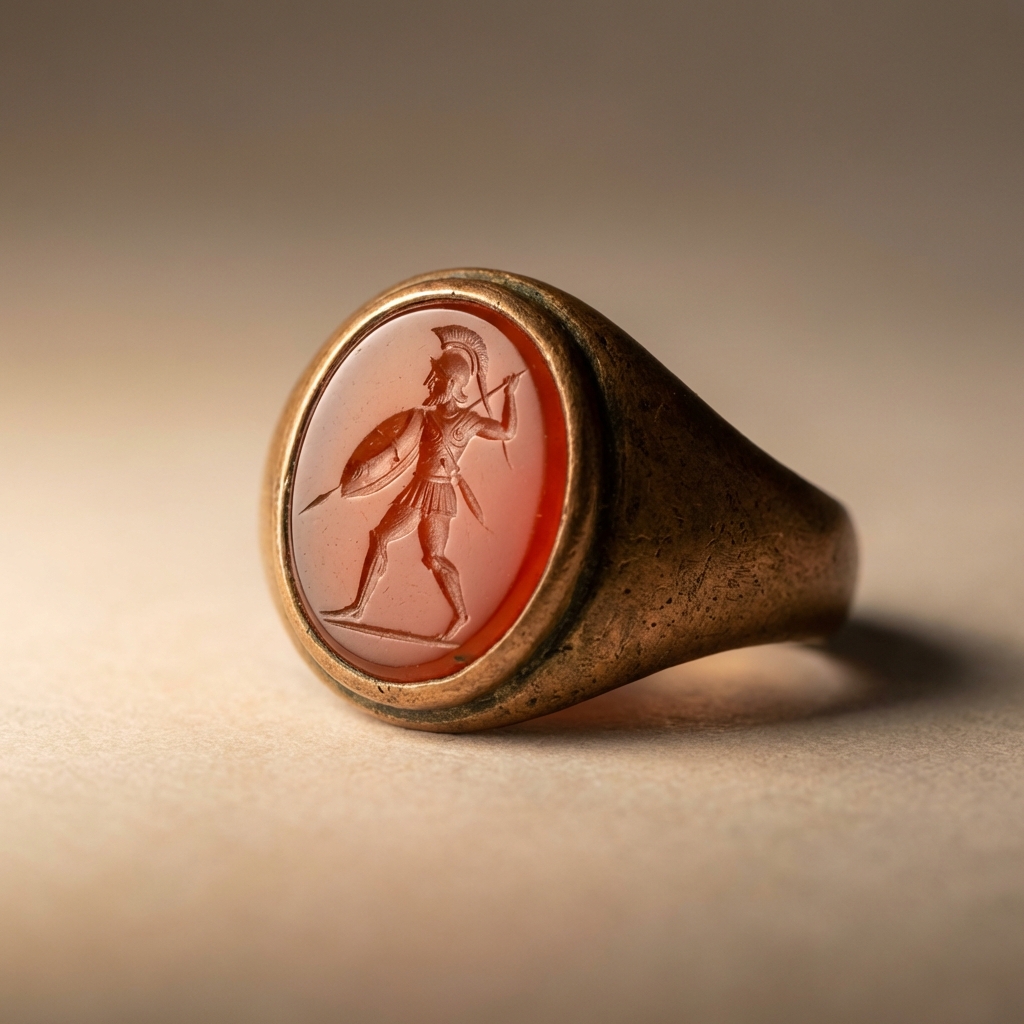
Summing up, the original purpose of the Greek signet ring was primarily as a personal seal used to authenticate documents and to mark ownership, while also functioning as wearable display and a personal emblem depending on context. This interpretation is consistent with glyptic scholarship and museum catalogues that record both sealing use and visible, worn rings in collections Metropolitan Museum of Art glyptic overview
For collectors interested in acquiring such rings, the most informative cues are the intaglio technique, material, wear consistent with repeated impressioning, transparent restoration notes and any provenance or specialist testing reports. When in doubt, consult museum records or seek a specialist assessment before accepting firm claims about date or original function Walters Art Museum searchable collection
They bore a carved intaglio that could be impressed into clay or wax to produce a controlled image serving as a personal seal, linking the owner to the sealed object or document.
Mounts were commonly bronze, silver or gold, while hardstones such as carnelian, agate and jasper were typical for carved intaglio seals.
Request high-resolution photos of the intaglio and bezel junction, clear restoration and condition notes, and any provenance or specialist reports that accompany the item.
More from Aurora Antiqua
References
- Aegean and Cypro-Aegean Non-Sphragistic Decorated Gold Finger Rings, American Journal of Archaeology
- Talismans, Visitatori salutem, Szepmuveszeti Muzeum, Museum of Fine Arts Budapest
- Philip Kiernan and Klaus-Peter Henz, Rings from the Forbidden Forest, Cambridge University Press
- Catalogue of the Engraved Gems and Finger-Rings in the Ashmolean Museum, II: Roman, BAR Publishing, via Fulcrum
- boucle d'oreille, Louvre site des collections, Musée du Louvre, Département des Antiquités grecques
- Engraved Gem with a portrait of Demosthenes inset into a gold ring, The J. Paul Getty Museum, Los Angeles
- Finger Ring with Frog, The Cleveland Museum of Art
- Signet Ring, Victoria and Albert Museum
- Ring inset with intaglio representing Artemis, The Getty