


Looking for the real thing? Browse our full ring collection, each piece one of one, individually authenticated, with documented provenance. For the background, see the guide to ancient jewelry.
What is an antique widows ring? Definition and historical context
An antique widows ring, often discussed under the wider category of mourning jewellery, is a commemorative ring associated with bereavement and remembrance; collectors and curators also refer to these as mourning rings or funeral rings in catalogues.
Mourning rings in the archaeological and museum record are documented from the 17th century onward, with a marked increase in variety and visible conventions in the 18th and 19th centuries; this pattern is described in museum overviews and specialist essays rather than as a single prescriptive rule Victoria and Albert Museum overview.
Typical diagnostic motifs that help identify these rings include dark or black enamel, inscribed names or dates on the inner band or bezel, and small hair compartments or hair-work set into the design; such features appear repeatedly in museum catalogues as useful identifiers Metropolitan Museum nineteenth century jewellery entry.
Follow @auroraantiqua for behind the scenes finds and condition notes
Read the practical identification checklist below and then review curated listings to compare documented examples with your piece.
A useful way to think about an antique widows ring is as a small artefact carrying iconography and personal inscription that links it to a funeral event or a period of formal mourning; condition notes, restoration notes, and provenance can change how we interpret a ring and should be read alongside the object.
Aurora Antiqua lists rings with contextual condition and provenance notes where available so buyers and researchers can see the basis for dating or attribution before considering a purchase.
Which finger did widows traditionally wear the ring on? Regional and period patterns
Across English-language museum records and curatorial essays, a common pattern emerges: in Britain and many Anglophone contexts mourning rings were typically associated with the ring finger, often worn on the left hand in later practice; this reflects a tendency seen in many object records rather than a universal rule Victoria and Albert Museum overview.
At the same time, continental and local practices sometimes preferred the right hand or other fingers, and earlier customs show different placements depending on local tradition and the social setting; surviving estate inventories and collection catalogues often record such variation British Museum mourning rings collection notes.
Because historical practice varied by place, time and family, it is safest to treat finger choice as a historically patterned habit rather than a strict rule: catalogue entries and probate inventories illustrate many exceptions.
Victorian mourning customs and the left versus right hand
Victorian etiquette manuals and contemporary essays linked mourning jewellery to formal stages of mourning, and they offered recommendations about which items to wear during full mourning versus half mourning; these prescriptive sources were influential in shaping visible conventions Victorian Web essay on mourning practices.
At the same time, surviving rings and personal correspondence show that practice did not always follow etiquette precisely: class, family preference and regional custom all affected whether a ring was worn on the left ring finger, the right hand, or kept for occasional display British Library essay on Victorian mourning.
Museum and curatorial records show that ring-finger wear, often on the left hand in later British practice, was common but not universal; collectors should use inscriptions, hallmarks, hair-work and provenance to inform attribution and defer to conservators for care.
In short, Victorian rules often prescribed ring-finger wear as a visible signal of mourning, but personal and local choices resulted in a variety of placements that appear in period records and museum entries.
How mourning rings were issued and used in family and funeral practice
Funeral distribution of rings created family-specific conventions: rings given at a funeral or to close kin commonly carried inscriptions with a name and date, and these funeral rings often formed part of a commemorative set exchanged by relatives Museum Wales overview.
Because family-distributed rings were often intended to circulate among heirs or to mark a single event, the inscription and any accompanying note or letter can be an important clue when reconstructing provenance and understanding how and when a ring was intended to be worn.
Stages of mourning affected visible jewellery choices: sources describe differences between full mourning, when display was minimal and sombre items were preferred, and later stages when some jewellery could be reintroduced; however, how strictly these stages were observed varied by household and class British Library essay on Victorian mourning.
How to identify an antique mourning or antique widows ring: a practical checklist
Start with the physical features. Look for black or dark enamel on the bezel or shoulders, inscriptions with a name and date on the inner band or bezel, and a discrete hair compartment or sealed hair-work compartment; museum catalogues and specialist references list these as reliable diagnostic features Victoria and Albert Museum overview.
Next, examine marks and construction. Check for hallmarks or maker marks inside the band and compare any marks with established hallmark references; such marks can narrow date ranges when present Metropolitan Museum nineteenth century jewellery entry.
Inspect condition and restoration notes. Modern repairs and re-enamelling can mimic period features; ask the seller for clear restoration notes and high-resolution photos of the interior and any compartments before accepting an attribution.
Start with the physical features. Look for black or dark enamel on the bezel or shoulders, inscriptions with a name and date on the inner band or bezel, and a discrete hair compartment or sealed hair-work compartment; museum catalogues and specialist references list these as reliable diagnostic features Victoria and Albert Museum overview.
Next, examine marks and construction. Check for hallmarks or maker marks inside the band and compare any marks with established hallmark references; such marks can narrow date ranges when present Metropolitan Museum nineteenth century jewellery entry.
Inspect condition and restoration notes. Modern repairs and re-enamelling can mimic period features; ask the seller for clear restoration notes and high-resolution photos of the interior and any compartments before accepting an attribution.

Compare with dated museum examples. Use catalogue entries, detailed photographs and our highlights collection to see how similar features were executed at particular periods and in different workshops; this comparative step is central because stylistic motifs and manufacturing details change over time Metropolitan Museum catalogue guidance and consult specific museum examples such as the British Museum example.
Finally, treat dating as provisional unless supported by clear documentation or testing: inscriptions and stylistic similarity can point to a likely period, but they do not replace provenance records or scientific analysis when precision is required.
Dating and attribution: hallmarks, inscriptions and provenance
When present, hallmarks and maker marks are among the strongest tools for narrowing a date range, because hallmark systems have documented patterns that specialists can consult; always request clear images of any marks and compare them with authoritative hallmark references Victoria and Albert Museum overview.
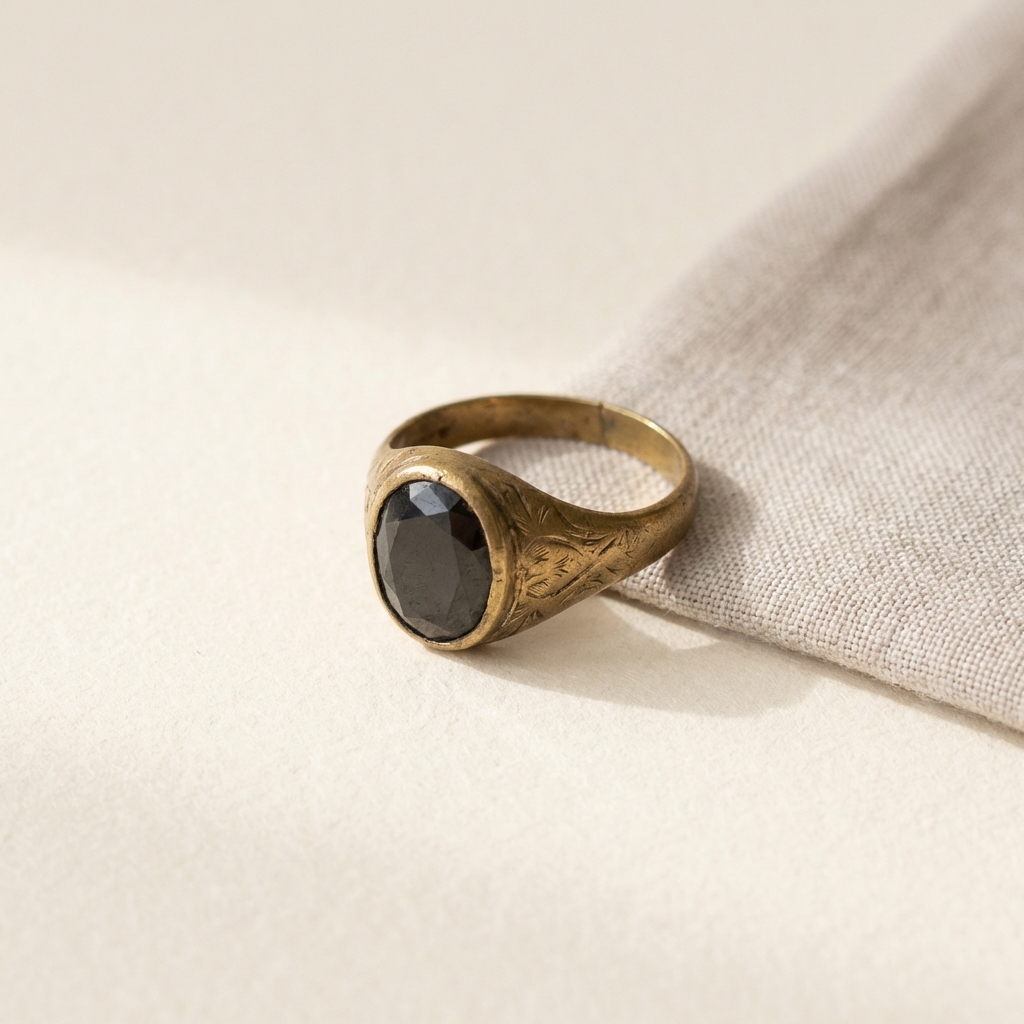
Inscriptions with names and dates help connect an object to a documented event, but on their own inscriptions require contextual support: examine whether the engraving style, letter forms and wear are consistent with the proposed date and compare with dated museum examples for corroboration Metropolitan Museum nineteenth century jewellery entry.
Provenance and collection history increase confidence in an attribution when they include contemporary letters, estate inventories or documented ownership chains; absent such documentation, regard attributions as estimates that benefit from specialist review or scientific tests.
Caring for and wearing an antique widows ring today
Handle with care: avoid abrasive cleaning and keep the ring away from strong household chemicals, particularly where enamel or hair-work is present, because these materials are chemically sensitive and can be damaged by improper cleaning Canadian Conservation Institute guidance on jewellery care.
Store in a stable environment with moderate humidity and temperature and separate from reactive materials; photograph the ring and record condition notes to track any changes before attempting wear or conservation.
practical steps to stabilise and document a fragile mourning ring
Keep records of any treatment
Consult a conservator for active corrosion, fragile hair compartments, or structural instability; a conservator can stabilise delicate fittings and advise on whether occasional wear is safe without risking the object Canadian Conservation Institute guidance on jewellery care.
Before buying, request hallmarks, provenance documentation and high-resolution photos and consider a specialist opinion when significant sum or uncertain attribution is involved.
If you intend to wear an antique widows ring occasionally, limit exposure to water, cosmetics and cleaning agents and prefer short, infrequent wear rather than continuous use; professional stabilisation of fragile components reduces risk.
Deciding whether to wear a mourning ring now: etiquette and modern sensibilities
Contemporary choices range from wearing a ring occasionally as a private commemoration to keeping it as a display piece; consider family wishes, cultural sensitivity and the ring's physical condition when deciding how to use an inherited piece Victorian Web essay on mourning practices.
For many people, the most respectful option is to discuss intentions with other family members and to ensure any delicate elements are stabilised by a conservator before regular wear. In some cases a ring may be better preserved in a collection box or shown under controlled conditions if it has fragile hair-work or active corrosion.
Common mistakes and how to avoid misidentification
A frequent error is assuming an inscription alone proves period authenticity; inscriptions can be later additions or modern forgeries, so verify inscriptions against wear, engraving style and independent references Victoria and Albert Museum overview.
Another common mistake is mistaking modern repairs or re-enamelling for original features; always ask for restoration notes and close images of joins, solder lines and the interior band to spot later work Canadian Conservation Institute guidance on jewellery care.
Before buying, request hallmarks, provenance documentation and high-resolution photos and consider a specialist opinion when significant sum or uncertain attribution is involved.
If you inherit a mourning ring: step-by-step actions
Immediate care steps: do not clean the ring, photograph it from multiple angles including the interior band, and note any inscriptions or visible hallmarks; these photographs form the baseline record for later comparison and for conservators Canadian Conservation Institute guidance on jewellery care.
Compile provenance: record any family stories, labels, letters or estate documentation that mentions the ring and keep these records with the object; such context can dramatically increase confidence in an attribution when combined with physical evidence Metropolitan Museum guidance on nineteenth century jewellery.
When to seek specialist help: contact a conservator for fragile hair compartments, and a qualified jewellery historian or certified appraiser when you require a formal assessment or wish to document dating for insurance or archival purposes.
Buying an antique widows ring: documentation and condition checklist for collectors
Ask sellers for high-resolution images from multiple angles, clear condition notes, restoration notes that specify any repairs, and any provenance or collection history they can provide; these documents help you evaluate the listing and its claims Victoria and Albert Museum overview.
Sample questions to copy: request close images of hallmarks, interior inscriptions, the bezel and any compartment lid, and ask for a statement of what has been stabilised or repaired. If the seller cites a museum comparison, ask for the catalogue reference or image used for comparison.
Remember that transparent disclosure about restoration and condition is a positive sign: reputable sellers provide measured condition notes and note where they rely on stylistic comparison rather than documentary provenance.
Examples in museum collections: what to compare against
Museum catalogue entries typically list materials, inscriptions, motif descriptions and the reasoning behind dating; these entries are practical comparators when you examine a candidate ring and can help you identify characteristic features of a period or workshop Victoria and Albert Museum overview and see specific accessioned examples such as the V&A collection example.
Look for catalogue notes that mention black enamel, hair-work compartments, and inscriptions with dates or names, since such diagnostic features are frequently recorded by curators and can be compared with an item under review British Museum collection entry.
Bear in mind that catalogue detail varies and that some entries lack full provenance or testing records; use museum comparison as a strong but not definitive step toward attribution and seek professional input when necessary.
How Aurora Antiqua approaches antique mourning rings and documentation
Aurora Antiqua functions as an expert curation reference and a trust layer for buyers interested in one of a kind ancient rings and small artefacts, offering contextual writeups and condition notes for listed items.
When possible, listings include condition notes, restoration notes and provenance references so potential buyers can judge the basis for dating and attribution; readers should treat these notes as part of the evidence chain and seek independent checks for any high-value or uncertain claim.
Conclusion: wearing and stewarding antique widows rings with care
In summary, ring-finger use was a common pattern in Britain and many English-language records, especially in later practice, but regional and period variations mean finger choice should be treated as a patterned habit rather than a fixed rule Victoria and Albert Museum overview.
When assessing an antique widows ring, follow the identification checklist, prioritise clear images and provenance notes, and avoid abrasive cleaning or amateur fixes; consult a conservator for fragile components and keep documentation with the object to support future study.
In many British and Anglophone records the ring finger, often on the left hand in later practice, was the common choice, though regional and family variation was frequent.
Look for black or dark enamel, inscriptions with names or dates, hair compartments, hallmarks, and compare the piece with dated museum examples; treat dating as provisional without supporting documentation.
Not always; avoid daily wear if the ring has fragile hair-work, active corrosion, or unstable repairs, and consult a conservator to stabilise delicate elements before regular use.
More from Aurora Antiqua
References
- The Form of Solemnization of Matrimony, The Church of England
- Gimmel Ring, Victoria and Albert Museum, London
- Silver and plate, Icon, The Institute of Conservation (UK)
- Conserve O Gram 10/2: Caring For Silver And Copper Alloy Objects, National Park Service, US Department
- Archaeological materials, Icon, The Institute of Conservation (UK)
- Conserve O Gram 4/16: Creating A Microclimate Box for Metal Storage, National Park Service, US Department
- E.C.C.O. Professional Guidelines (II): Code of Ethics, European Confederation of Conservator-Restorers'
- Object ID, International Council of Museums
- Hallmarking guidance notes, British Hallmarking Council and the UK Assay Offices, GOV.UK
- Learning resources, The British Library