


Looking for the real thing? Browse authenticated ancient rings, each piece one of one, individually authenticated, with documented provenance. For the background, see the guide to ancient jewelry.
What is an ancient coin ring? Definition, types and historical context
An ancient coin ring is a piece of jewelry that incorporates a coin or coin imagery, either by reshaping a coin into a hoop, mounting a coin as a bezel, or setting an intaglio-bearing piece into a ring format. The phrase is used by curators and collectors to distinguish rings made by reshaping coin flans from rings that simply use a coin as a decorative bezel, and the distinction matters for dating and interpretation. The Metropolitan Museum of Art provides an overview of jewellery practices in antiquity that helps place these forms in a wider typology and use context, making this distinction useful for collectors The Metropolitan Museum of Art jewellery overview.
Forms commonly discussed by numismatists and jewellery historians include coin-converted hoops, where a coin was physically reshaped and sometimes folded to form a hoop; bezel-mounted coins, where the coin or a coin fragment was set into a metal surround; and hybrid pieces that combine intaglio carving with mounted or cut coin elements. Each form leaves different traces: reshaped coins show distinct metal flow and often partial legends, while bezel mounts preserve more of the original coin surface.
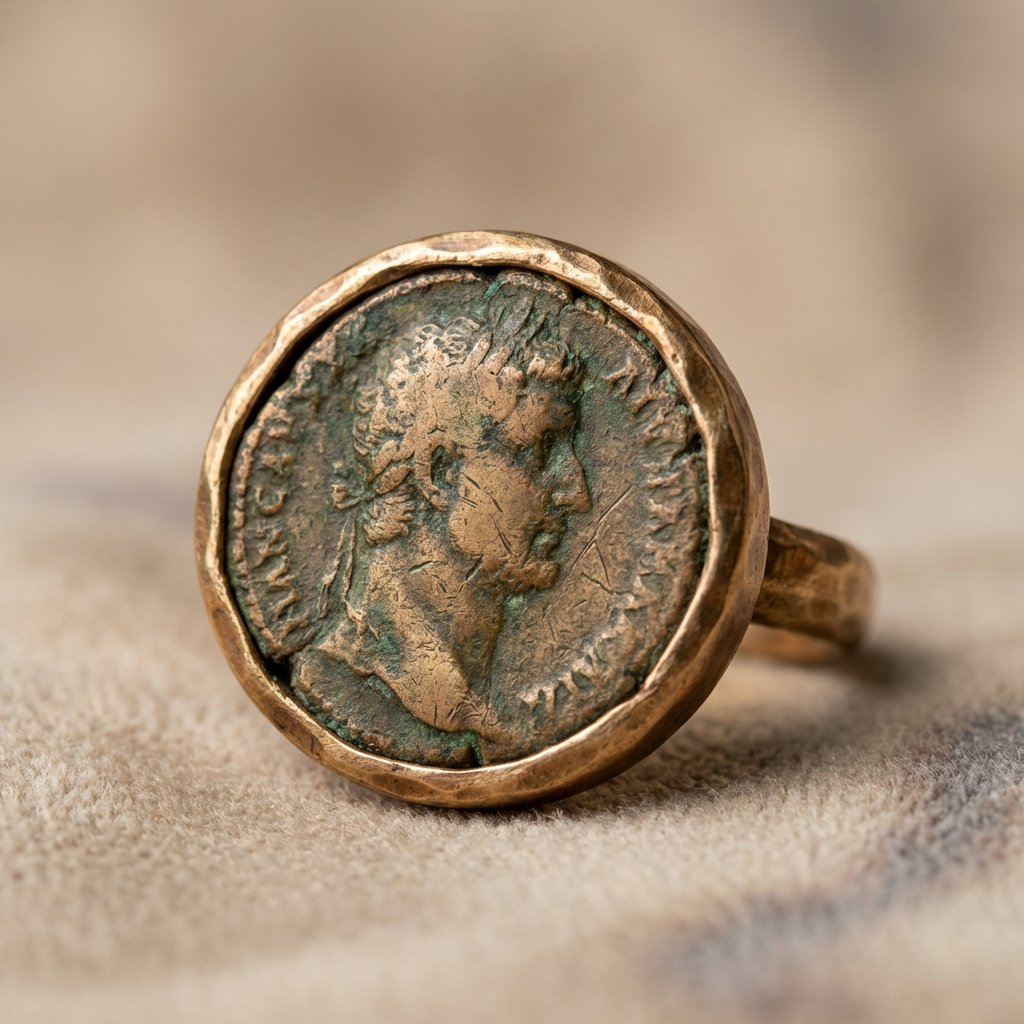
Chronologically, coin-based rings appear across a broad span of the Mediterranean world from late Hellenistic and early Roman contexts through Byzantine periods and later. Provenance statements and collection descriptions often date such objects within ranges rather than a single year, because stylistic features, workshop practice and find context are read together to produce a best estimate. When a listing claims a tight date, buyers should look for the basis of that dating, such as archaeological context or comparative catalogues.
In curated listings, clear condition notes and documentation will say whether the piece is a reshaped coin, a bezel-mounted coin, or an intaglio repurposed for a ring, and will note visible wear consistent with age. For example, a curated product entry might include images of the bezel, measurements, and a brief provenance summary for transparency.

Did people wear coin rings to attract money? Symbolism, amuletic use and folklore
Scholars working on amulets, magic and talismans in the ancient Mediterranean note that coinage and coin imagery could be used in symbolic or protective contexts, but the interpretation that a ring would reliably "attract money" is folkloric rather than empirically demonstrated. Overviews of amulet practices emphasise that the use of money-related imagery often sat alongside broader beliefs about protection, authority and social signalling Talismans, Visitatori salutem, Szepmuveszeti Muzeum, Museum of Fine Arts Budapest.
Coin imagery could invoke authority or social status when worn, for instance by displaying the portrait of a ruler or the emblem of a city, and such display may have been read by contemporaries as a claim to legitimacy, membership or favour. In other cases, particular motifs, inscriptions or metal types were chosen for symbolic reasons, including protection or commemoration; numismatic research on reuse of coin imagery shows intentional choices rather than purely decorative reuse Gold necklace with coin pendants, Inv. 17.190.1655, The Metropolitan Museum of Art.
That said, explicit claims that an ancient coin ring will bring material gain for a modern wearer belong to cultural belief and marketing language. When listings or sellers use phrasing like attracts money, buyers should treat such claims as part of a narrative around the object rather than a verifiable function, and place greater weight on documentation, context, and condition notes when assessing value and meaning.
How museums and conservators approach ancient metal rings
Museum conservation departments prioritise preserving original surface conditions such as patina, recording any restoration work, and favouring non-destructive analysis before considering invasive tests; this approach helps keep interpretive information intact for future study British Museum conservation and scientific research.
Conservation reports typically describe the surface patina, structural stability, any modern repairs or stabilisation, and whether previous cleaning or soldering occurred. These condition notes are meaningful for buyers because they document what was changed, what was left untreated, and how stable the object is for wear. A clear restoration note that specifies, for example, consolidation of fragile areas or the addition of a support saddle is part of responsible disclosure.

See restoration and provenance details behind the listings
See condition-note examples and restoration descriptions on curated listings to understand how museums and reputable sellers report stabilisation and repairs.
Where visible repairs or stabilisation exist, conservators explain the reason and method in their reports and often include before-and-after imaging. Transparent reporting allows buyers to judge whether a piece fits their priorities as a collector of wearable history, a study piece, or a display object.
Scientific authentication methods explained: what XRF, microscopy and metallography can and cannot do
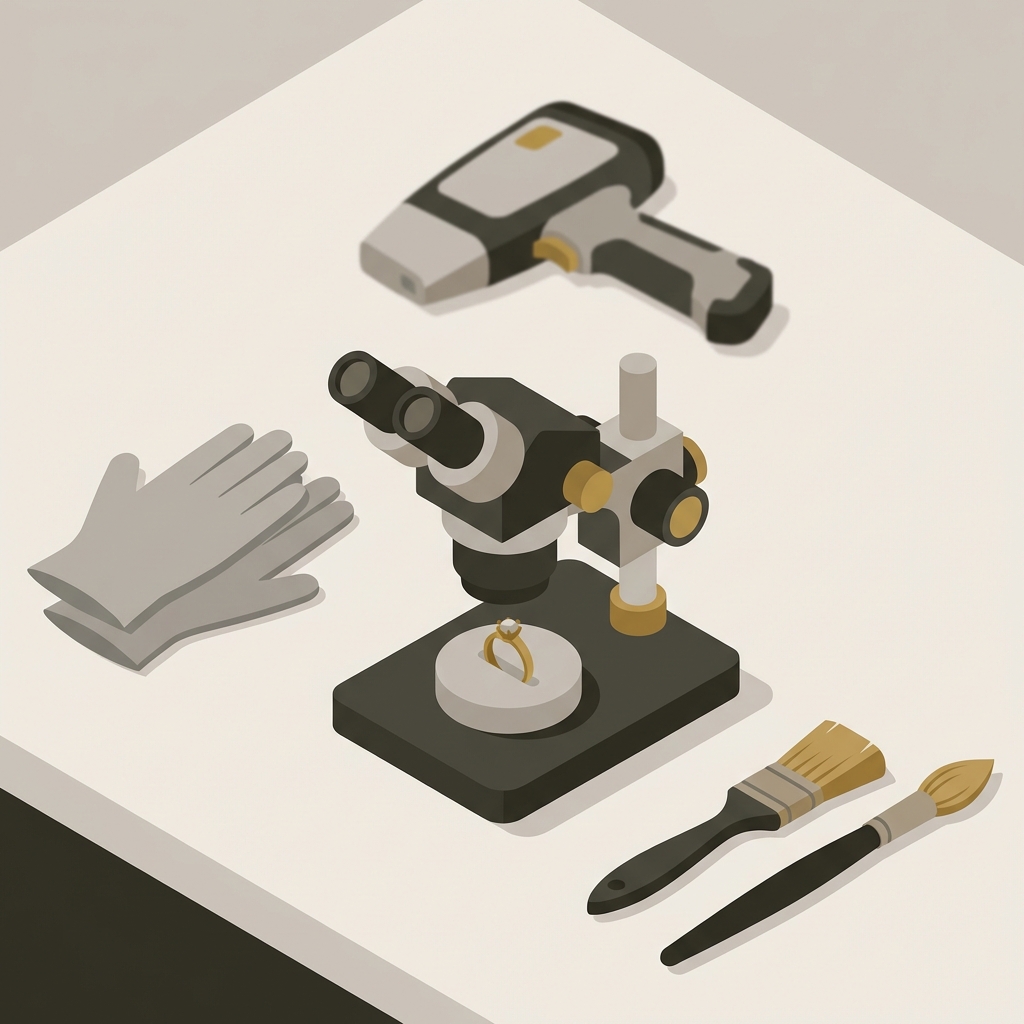
Several scientific approaches are used to study the composition and manufacture of ancient metal jewellery. Portable XRF provides a surface composition reading that can indicate alloy ratios and identify unexpected modern elements, microscopy can show wear patterns and tool marks, and metallography can reveal manufacturing structure when sampling is possible. Each method supplies evidence that must be interpreted within a wider comparative and contextual framework Journal of Archaeological Science: Reports review of scientific methods.
Portable XRF is useful as a non-destructive, rapid first step to check for consistency with expected alloying practices, while high-magnification microscopy helps distinguish wear consistent with long use from recent tooling marks. Metallographic study can be decisive about microstructure but often needs a small sample or a well-justified cross-section, which makes it less commonly available for market checks, see the Getty metallography guide Nanostructured Silver Found in Ancient Dacian Bracelets from Cehei Hoard, Salaj, Romania, Nanomaterials (MDPI), via PubMed Central.
Portable XRF is useful as a non-destructive, rapid first step to check for consistency with expected alloying practices, while high-magnification microscopy helps distinguish wear consistent with long use from recent tooling marks. Metallographic study can be decisive about microstructure but often needs a small sample or a well-justified cross-section, which makes it less commonly available for market checks. Non-destructive tests are therefore the preferred starting point for buyers and curators, see CoinWeek on X-ray technology How X-Ray Technology Helps Authenticate Coins: PCGS.
Checklist for which test reports to request from a seller
Ask for raw data where possible
Results from these methods are not infallible. Portable XRF reads surface layers, which can be affected by corrosion or conservation; microscopy requires expert interpretation to avoid mistaking recent abrasion for ancient wear; and metallography, while precise, depends on suitable sampling and specialist labs. Buyers should see scientific reports as part of a cumulative case that includes provenance and condition notes rather than a single definitive stamp of authenticity.
How to evaluate an ancient coin ring before you buy: a step-by-step buyer checklist
Start by asking for provenance and documentation. Useful provenance items include a chain of prior ownership or collection history, any paperwork from previous sales or auctions, and explicit notes about how the object left its find context if applicable. International due-diligence guidance recommends that buyers and dealers establish a transparent documentation trail before acquisition to reduce the risk of illicit trade Code of Ethics, International Council of Museums (ICOM), Paris.
Next, inspect condition and restoration notes carefully. Request high-resolution images showing all sides, close-ups of the bezel or any joins, and scale with measurements. Look for clear statements about patina, consolidation, soldered joins, or modern added metal. If restoration is recorded, the notes should specify materials used and why treatment was necessary; this information helps you assess whether the object is suitable for wear or display.
Ask for scientific testing when the documentation or condition raises questions. A portable XRF report can flag unexpected alloying, while microscopy images can show whether surface wear patterns are consistent with long-term use. If a seller provides lab names or raw data, verify the lab’s independence and ask whether the analyst has relevant experience with antiquities and metals.
Prioritise red flags: vague or missing provenance, inconsistent or low-quality photographs, absence of condition notes, and refusal to discuss export permits or prior ownership. When in doubt, request a short verification letter from a recognised specialist or ask for time-limited access to an independent expert for a second opinion.
Use a documented checklist during communication with the seller. A simple checklist helps keep queries consistent across listings and makes it easier to compare items. Practical checklist items include: clear provenance statement, detailed condition notes, unedited high-resolution images, measurement data, and any available scientific reports.
Common mistakes and pitfalls when buying coin rings
A common mistake is accepting marketing language at face value. Phrases that promise a ring will attract wealth or bring luck are cultural narratives and should not replace provenance and condition evidence. Treat such claims as part of the object’s folk history rather than a substitute for documentation.
Another pitfall is ignoring incomplete documentation or undisclosed restoration. Listings that omit condition notes, provide only a single low-resolution photo, or are vague about previous repairs should be treated with caution. Responsible sellers and institutions typically disclose stabilisation work and provide before-and-after images when significant treatment was performed British Museum conservation and scientific research.
Buyers sometimes over-rely on visual similarity to museum pieces without asking for underlying documentation. Two visually similar items can have very different legal and ethical histories; confirming ownership history and export legality is part of ethical collecting and reduces the risk of acquiring illicit material.
Practical examples and scenarios: reading listings and asking the right questions
Scenario A: A bezel-mounted coin ring listed with a concise provenance statement, three high-resolution photographs showing the bezel and inner band, a condition report that documents an ancient patina and a small modern solder on the inner hoop, and a recent portable XRF reading supplied as a PDF. In this scenario, the combination of clear images, condition notes and a non-destructive test report allows a buyer to evaluate the piece with reasonable confidence. When listings align with comparative examples in museum catalogues, the assessment is strengthened The Metropolitan Museum of Art jewellery overview.
Scenario B: A coin-converted ring offered with a single, low-resolution image, a listing that emphasises luck and attracting money, and no provenance or condition notes. The inner band shows what could be a modern repair in the photo but no restoration disclosure is offered. In this case, the absence of documentation and limited imagery are red flags; a buyer should request full images, measurements, condition notes and any export or ownership documents before considering purchase.
No direct, reliable causal link is demonstrated by scholarship; such claims are best seen as cultural or marketing narratives. Collectors should prioritise provenance, condition notes and scientific testing when assessing an ancient coin ring.
Sample questions to send a seller include: Can you provide a chain of ownership or prior sale records? Have any conservation treatments been performed and are they documented? Do you have raw XRF data or a lab name for the analysis? Has the object been exported or imported with permits? Are there higher-resolution images of the inner band and bezel?
When weighing evidence, treat provenance, condition notes and testing as complementary. A strong provenance can compensate for limited testing, and a clear scientific report strengthens provenance claims. If the pieces of evidence conflict, prioritise full documentation and independent expert opinion rather than marketing narratives.
Conclusion: separating belief from evidence and buying responsibly
Claims that an ancient coin ring will "attract money" belong to tradition and contemporary storytelling rather than a verifiable function; scholarship treats such claims as cultural belief while urging careful interpretation of symbolic use American Numismatic Society discussion of coin jewelry.
For buyers, the practical path is to prioritise provenance, clear condition notes and non-destructive scientific testing when needed, and to follow due-diligence guidance when questions about export or ownership arise. Aurora Antiqua presents curated pieces with condition and restoration notes to help collectors make informed decisions, but buyers should always request the specific documentation they need for their own confidence.
Check provenance statements and condition notes, request high-resolution images of the band and bezel, and ask for non-destructive testing such as portable XRF or expert microscopy; combine these with a documented chain of ownership for best confidence.
No. Tests like XRF, microscopy and metallography provide useful evidence about composition and manufacture but require expert interpretation and must be weighed alongside provenance and conservation records.
Claims about attracting money are cultural or marketing language; evaluate the object on provenance, condition notes and documented restoration rather than on folk claims.
More from Aurora Antiqua
References
- Talismans, Visitatori salutem, Szepmuveszeti Muzeum, Museum of Fine Arts Budapest
- Gold necklace with coin pendants, Inv. 17.190.1655, The Metropolitan Museum of Art
- Octagonal Pendant, The Cleveland Museum of Art, Ohio
- Signet Ring, Victoria and Albert Museum, London
- Archaeometallurgy: Guidelines for Best Practice (HEAG003), Historic England
- Nanostructured Silver Found in Ancient Dacian Bracelets from Cehei Hoard, Salaj, Romania, Nanomaterials (MDPI), via PubMed Central
- Investigating Ancient “Bronzes”, J. Paul Getty Museum and Getty Conservation Institute, Los Angeles
- Code of Ethics, International Council of Museums (ICOM), Paris
- Stolen Works of Art Database, INTERPOL