


Looking for the real thing? Browse our Ancient Roman ring collection, each piece one of one, individually authenticated, with documented provenance. For the background, see the guide to Roman jewelry.
What is a roman bronze ring? Definition and context
Brief definition and why it matters to collectors
A roman bronze ring is typically an ancient ring made from a copper-tin alloy, most often described in listings as bronze or copper alloy and presenting wear consistent with age and burial conditions. Collectors should expect sellers to use terms like ancient ring, patina, provenance, and condition notes when describing these objects, and to see cautious, conditional language about dating and material where testing is not available.
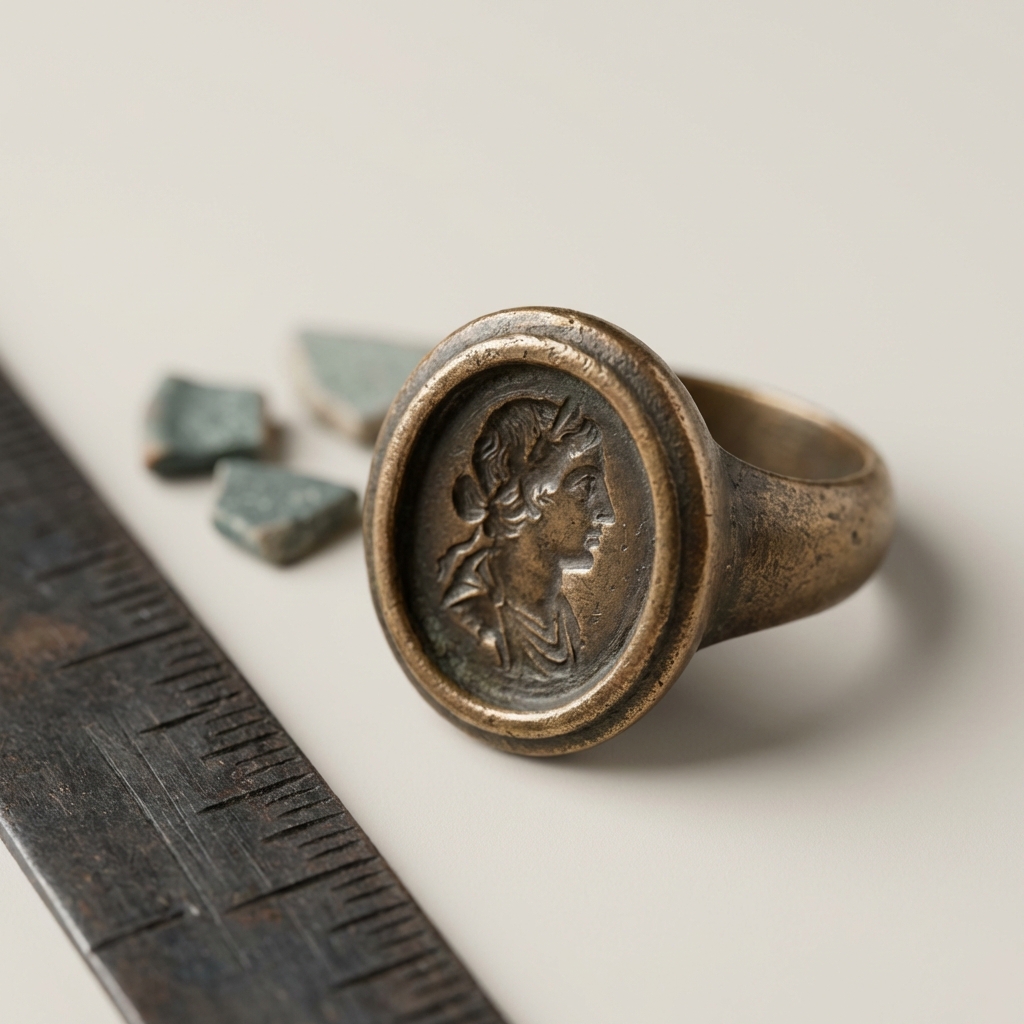
In curated listings, a clear description will include a period estimate, condition notes about surface and structure, and any available provenance or documentation; such practices help buyers understand what they are seeing and what conservation steps may be needed.
Rings from Roman contexts vary, from plain hoops and signet styles with intaglio settings to bezel rings set with carnelian or glass imitations, and many descriptions mention the bezel, shoulders, and hoop as key structural elements to check in photos.
Because many catalogues and sellers use similar vocabulary, knowing the glossary terms-patina, restoration notes, provenance, condition notes, and intaglio-helps buyers read listings with more precision and ask targeted questions about conservation and history.

How a roman bronze ring was made: alloys, casting, and craft
Copper-tin bronze composition and why it was chosen
Historically, copper-tin bronze was a preferred alloy for small personal items because it offers reliable castability and can capture fine detail in intaglio designs, which made it suitable for rings and small decorative objects; this metallurgical advantage helps explain why ancient jewelers used bronze for many personal pieces rather than larger structural items, as discussed in a synthesis of ancient metallurgy Journal of Archaeological Science review.
At the workshop level, alloy composition could vary, and many listings will use the term bronze or copper alloy without firm chemical identification, so conditional phrasing such as appears to be bronze or described as copper alloy is typical until testing confirms composition.

Typical manufacturing techniques for rings: casting, finishing, and gem settings
Small rings were commonly produced by casting methods like lost-wax or simple sand casting, after which finishing work shaped bezels and shoulders and an intaglio might be cut or set in a gemstone or glass to complete the piece.
These craft decisions interacted with alloy choice: bronze flows well into fine molds and holds surface detail, which is why it remained the material of choice for decorative and ceremonial rings even as iron became more important for tools and weapons.

Follow the behind the scenes of ancient rings on @auroraantiqua
When evaluating listings, review condition notes and provenance carefully; sellers that provide clear restoration notes and good photographs help collectors judge whether a piece needs professional stabilization, as Aurora Antiqua typically indicates in item descriptions.
Why bronze declined for functional use: iron, steel, and economics
Mechanical limits of bronze versus iron and steel
From a materials perspective, bronze is softer and less suited to high stress or structural roles than iron and later steel, which made iron a better choice for tools, weapons, and infrastructure as those technologies spread and improved; comparative materials overviews explain these mechanical differences ASM International overview.
For rings and small objects the mechanical limits were less critical because casting detail and surface finish were often the priority, but for load-bearing applications the advantages of iron and steel became decisive over time.
Industrial-scale changes that shifted demand
Large-scale improvements in iron smelting and the arrival of modern steelmaking processes such as the Bessemer and open-hearth methods sharply lowered the cost of iron and steel, making them economical for mass production and infrastructure during industrialization, a technological shift documented in industrial histories Encyclopaedia Britannica on the Bessemer process.
That economic shift did not erase bronze immediately, but it redirected demand: by the 19th century bronze was less used for structural goods and more reserved for decorative, artistic, and specialized alloy applications.
Bronze disease and conservation: why a roman bronze ring’s condition matters
What bronze disease is and how it appears
Bronze disease is a chloride-driven, active corrosion process that can present as green powdery deposits, localized pitting, and spreading deterioration; left untreated it can continue to damage an object and typically requires professional conservation to arrest, as described by conservation authorities Canadian Conservation Institute on copper alloys and the Museum Conservation Institute.
Bronze remained excellent for small decorative objects because it casts finely and develops a characteristic patina, but iron and later steel offered superior mechanical strength and, with industrial processes, became cheaper for structural uses; for collectors this means bronze rings are historically significant yet require careful condition assessment and potential conservation.
Practical conservation steps and what to expect in condition notes
If a listing notes green powdery crusts, flaking, or active pitting, those are red flags that a conservator should assess; conservators can stabilize items through mechanical cleaning, chemical treatments, or controlled desalination, and sellers should disclose any treatment in restoration notes so buyers know what was done. For further conservation perspectives see UCL Institute of Archaeology notes on surface condition (UCL bitstream).
Ask sellers for high-resolution close-ups of problematic areas and for any conservation reports or treatment histories; in many cases professional stabilization is a sensible part of the acquisition budget rather than an unexpected extra cost.
What to check when buying a roman bronze ring: a practical checklist
Documentation and provenance questions to ask
Request condition notes, any conservation treatment records, and the collection history or provenance details available for the piece; good documentation helps establish a transparent purchase and informs conservation choices.
When provenance is limited, focus on measurable details such as clear photographs of the bezel and hoop, measurements, weight, and any visible repairs that should be described in restoration notes.
A short condition checklist for evaluating photos and descriptions of rings
Use for preliminary listing review
Condition, photos, and red flags in listings
Look closely for indicators of bronze disease such as powdery green deposits, active flaking, and irregular pitting; stable patina is usually smooth and integrated with surface detail, while active corrosion often looks granular and detached.
Request images taken at multiple angles and under directional lighting to reveal pitting or losses, and ask whether any stabilization work was performed; sellers who provide restoration notes or conservator estimates reduce uncertainty for buyers.
Budgeting guidance for potential conservation costs
Factor potential conservation into the purchase price: a professional assessment and stabilization can be required for items with signs of bronze disease, and anticipating those costs helps avoid surprises after purchase.
For many collectors, budgeting for a conservator visit is a prudent practice when a listing suggests active corrosion, whereas stable patina with thorough condition notes may need only routine preventive care.
Decision framework: when to buy, restore, or pass on a roman bronze ring
Criteria to weigh: condition, documentation, cost of stabilization, and collecting goals
Weigh four practical criteria: is there evidence of active corrosion, how complete and credible is the provenance, what would conservator intervention likely cost, and how does the piece fit your collecting goals and risk tolerance; conservator estimates and clear condition notes are central to this decision.
If active corrosion is present and provenance is weak, buyers may decide to pass or to seek a conservative estimate before committing; conversely, a well documented piece with only stable patina can be a responsible acquisition for a collector willing to care for it.
Sample decision flow for different buyer priorities
For a display-focused collector who values wear consistent with age, a ring with stable patina and good photos may be acceptable, while a buyer seeking a wearable item should prioritize structural integrity and recent conservation reports.
When in doubt, ask for a conservator estimate; relying solely on photos risks underestimating hidden chloride contamination or active bronze disease that only proper testing and assessment can reveal.
Common mistakes and misconceptions about roman bronze rings
Mistakes buyers make when judging authenticity and condition
A common error is assuming a green surface is harmless patina; not all green corrosion is benign, and distinguishing stable patina from active bronze disease usually requires conservator input and careful inspection rather than a single photograph.
Another frequent mistake is trusting dating or material statements without documentation; many listings cautiously state period estimates and material descriptions and note that testing would be required for certainty.
Misreading patina versus active corrosion
Stable patina often preserves surface detail and can be protective, while active corrosion typically produces powdery residues and progressive pitting; restoration notes should say what treatments were done and why, so buyers understand whether a surface is original, stabilized, or restored.
When restoration is reported, read the notes closely to learn whether conservation aimed to stabilize or to alter appearance, and avoid assuming that restoration implies improved longevity without further care instructions.
Practical examples and scenarios: reading three sample listings
Scenario A, stable patina, clear provenance: A listing with detailed condition notes, collection history, and close-up images showing integrated patina and intact bezel suggests a straightforward purchase for a collector focused on wearable history.
Scenario B, visible active corrosion requiring stabilization: If photos show powdery green crusts and pitting, seek a conservator estimate and decide based on the repair cost relative to the piece's significance and provenance before proceeding; conservation authorities describe the risks of untreated chloride corrosion Getty Conservation Institute bronze disease guide and Getty's Conservation and Analysis project Artistry in Bronze.
Scenario C, attractive patina but sparse documentation: For an appealing object with limited provenance, insist on better photos and any available collection history; a conservative approach is to obtain more information or a pre-purchase conservation assessment when possible.
How modern metallurgy and markets shaped bronze’s niche uses
Modern metallurgy has produced stainless steels and engineered copper-alloys that take over many structural roles once occupied by bronze, while bronze itself remains important for artistic casts, restoration, and specialist alloys, a pattern reflected in recent market analyses Grand View Research bronze market report.
For collectors, the practical implication is that while bronze rings remain available and desirable for their casting detail and patina, expect conservation needs and clear documentation when buying an antiquity.
Conclusion: caring for and valuing a roman bronze ring today
Takeaways for buyers and collectors
Bronze kept enduring appeal for rings because of its castability and surface character, but iron and steel overtook bronze for functional and structural uses as metallurgy and industrial processes advanced; understanding this history helps explain why many preserved rings survive as decorative objects rather than structural components of larger assemblages Journal of Archaeological Science review.
Practical next steps are consistent: request condition notes and provenance, look for restoration notes and conservator reports when possible, budget for stabilization if there are signs of active corrosion, and prioritize sellers who disclose treatment and collection history.
Stable patina tends to be smooth and integrated with surface detail, while bronze disease shows powdery green deposits, active flaking, and pitting; ask a conservator when in doubt.
Cleaning can remove surface residues, but active chloride-driven corrosion often requires professional stabilization to prevent recurrence.
Restoration is not inherently negative, but buyers should expect clear restoration notes and disclosure of what was done before judging suitability.
More from Aurora Antiqua
References
- SF-A79B96, Roman copper alloy and glass finger-ring from Norfolk, Portable Antiquities Scheme, British Museum
- Internet Archaeol. 40. Atkinson and Preston. Objects of personal adornment, Internet Archaeology, Council
- Philip Kiernan and Klaus-Peter Henz, Rings from the Forbidden Forest, Cambridge University Press
- EAP, Estonian Journal of Archaeology Publications, Estonian Academy Publishers
- Microstructure and chemical composition of Roman orichalcum coins emitted after, Scientific Reports, Springer
- Investigating Ancient “Bronzes”, J. Paul Getty Museum and Getty Conservation Institute, Los Angeles
- Bronze disease, Conservation Wiki, American Institute for Conservation of Historic and Artistic Works (AIC)
- Reproducing bronze archaeological patinas through intentional burial, Heliyon (Elsevier, Open Access)
- Apport de l'analyse statistique des produits de corrosion à la compréhension, Revue d'Archeometrie
- 998, Smithsonian Museum Conservation Institute