


Looking for the real thing? Browse authenticated ancient rings, each piece one of one, individually authenticated, with documented provenance. For the background, see the guide to ancient jewelry.
Quick definition and why the ouroboros resists a single meaning
What people usually mean by the motif, ouroboros ring meaning
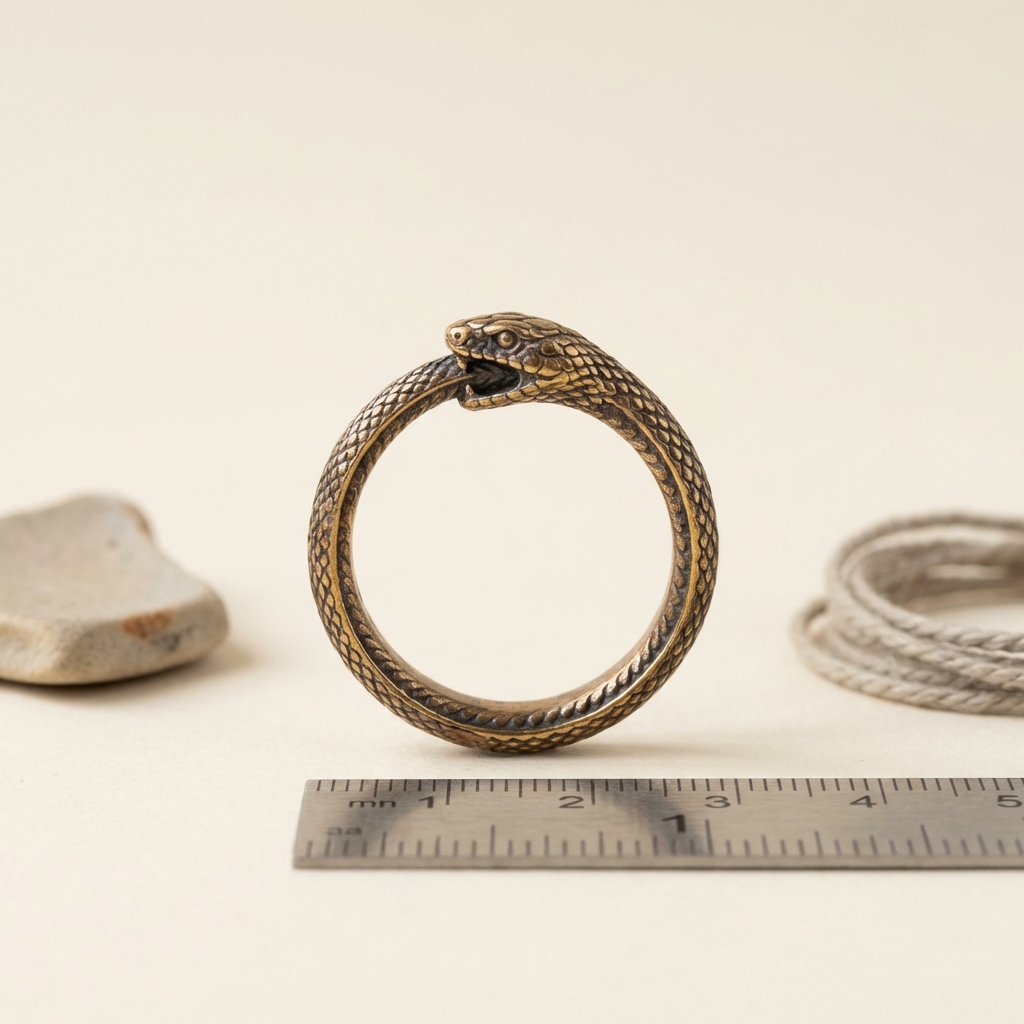
The image commonly called the ouroboros shows a serpent or dragon biting its own tail; readers most often associate it with cyclicality, self renewal, and the unity of beginning and end.
Major reference works and museum catalogues treat the motif as multivalent rather than fixed, so assigning a single symbolic claim to an object risks oversimplification, as noted in general reference treatments of the motif Encyclopaedia Britannica.
For buyers and collectors, the important practical point is that interpreting an ouroboros on a ring requires attention to dating, provenance, and object type before settling on a specific meaning.
A simple provenance checklist to use when evaluating an ouroboros ring listing
Use with seller questions
Earliest attestations: Egyptian funerary imagery and themes
Visual examples from funerary art
Visual types in ancient Egypt that prefigure the ouroboros often occur in funerary contexts where time, rebirth, and regeneration are central concerns; museum summaries link these early serpent figures to later nomenclature in Mediterranean traditions Encyclopaedia Britannica.
In Egyptian funerary belief, images that suggest cyclical time and renewal appear on coffins, amulets, and ritual objects, and those contexts shaped later readings when similar forms circulated into Hellenistic art.
Classical adoption: Greek, Hellenistic and Roman visual culture
How Greek and Hellenistic art adapted serpent imagery
As Mediterranean visual culture expanded, serpent motifs moved into Greek and Hellenistic art where they could carry meanings of renewal and cosmic order; museum collection notes document this transmission into the classical repertoire British Museum collection themes. For comparative objects within a collecting context see the Ancient Greek rings collection.
Rings and other personal objects incorporate serpent imagery for varied purposes, yet explicitly recognisable ouroboros rings are relatively uncommon in published catalogues, so each example benefits from close object based interpretation.

Late antique to medieval reinterpretations: Hermetic and alchemical readings
Alchemical symbolics: unity of opposites and chrysopoeia
From late antiquity into the medieval and early modern periods, Hermetic and alchemical texts reframed the serpent-eating-its-tail as an emblem of unity of opposites and cyclical transmutation, particularly in discussions of chrysopoeia and the philosopher's work, a development traced in overviews of alchemy Stanford Encyclopedia of Philosophy.
This textual reinterpretation influenced European receptions of the motif and encouraged readings that emphasize transformation, wholeness, and the recovery of a unified principle rather than only funerary renewal.

How the ouroboros appears on rings and how common it is
Survey of archaeological and catalogue evidence for ouroboros rings
Serpent motifs are common in ancient jewelry, but explicitly recognisable ouroboros rings are comparatively uncommon in the archaeological record and catalogues, which means broad claims about ring specific meanings should be tied to individual provenance and dating information British Museum collection themes. For comparative listings in our shop see the Ancient Roman rings collection.
Catalogues and archaeological reviews note that methodological limits, incomplete publication, and varying cataloguing terms can understate or obscure the true frequency of ouroboros motifs on rings, so absence in a catalogue is not definitive.
No. The ouroboros carries layered meanings across cultures and periods, so any interpretation of a ring should rest on object level evidence such as dating, provenance, and context rather than a single universal meaning.
When an ouroboros is present on a ring, context such as findspot, burial association, and associated objects often changes the interpretive balance between funerary, amuletic, and decorative readings.
What an ouroboros ring might have meant in its original context
Amuletic uses: protection and renewal

In funerary contexts, the motif may emphasize cyclical time and regeneration, while purely decorative uses are also possible when rings lack contextual finds or inscriptions that would indicate ritual purpose.
See behind the scenes with @auroraantiqua on Instagram
Please review condition notes and provenance documentation carefully before accepting symbolic claims about an object.
How to read the archaeological signals: funerary, amuletic, decorative
Evidence that favours a funerary reading includes a clear burial findspot, association with grave goods, and iconographic parallels in other mortuary objects; such contextual details make the interpretation of cyclic time and regeneration more plausible, and museum essays help identify those parallels Metropolitan Museum of Art collection essay.
Signs that support an amuletic reading include wear patterns indicative of being worn over time, discovery in domestic contexts, and explicit inscriptions or iconographic pairings that match protective formulas.
Quick practical checklist for buyers: dating, condition, and provenance
Key documentation to request
Ask for specific restoration notes, high resolution photos of solder joins and the ring interior, and any letters or collection history entries that indicate prior ownership or cataloguing; combined, these data points materially change how you evaluate the object's likely original function.
How to evaluate claims in listings and catalogue descriptions
Red flags and reliable signals
Red flags include vague dating, missing provenance, and sweeping symbolic claims presented without supporting findspot or publication details; conversely, named collection history, third party letters, and clear restoration notes are reliable signals that merit trust in the description Metropolitan Museum of Art collection essay. A useful accessible overview for modern readers appears in a popular piece on the motif The History Behind .. the ouroboros.
Use direct question prompts when contacting a seller, such as requesting detailed photos of the inner hoop, any maker marks, and explicit language about what was stabilised or left untouched in conservation notes.
Common myths and interpretive errors about the ouroboros
Overgeneralising a single meaning
A common mistake is to present the ouroboros as having one definitive meaning across cultures and time; scholarship and major catalogues caution that meaning shifts by period, genre, and object type, so single label narratives are often misleading Encyclopaedia Britannica.
Modern spiritual or marketing language frequently blends funerary, alchemical, and amuletic readings into a single claim, which can obscure the need for object level documentation to support any specific interpretation.
Short case studies: three example readings of a ring
Case 1: funerary ring with burial provenance
Scenario: a ring recovered from a documented burial, accompanied by grave goods and published in a catalogue. Key evidence: findspot and associated objects tip the reading toward funerary regeneration.
Case 2: well documented Hellenistic curio
Scenario: a ring with secure dating to the Hellenistic period, published provenance and no burial context. Key evidence: publication and stylistic parallels support a cultural or decorative reading, possibly also amuletic depending on wear patterns.
Case 3: modernly framed decorative piece with unclear provenance
Scenario: a ring offered with evocative symbolic language but lacking provenance and with only seller photographs. Key evidence: absence of documentation and vague dating mean the claim is speculative, so buyers should seek more evidence or refrain.
Practical care and conservation notes relevant to ancient rings
What restoration notes typically report
Patina and wear consistent with age are often cited as supporting evidence for antiquity, but photographic detail and microscopic images are advisable when available to verify such claims.
How contemporary makers and buyers reuse the motif
Synthesis of meanings in modern jewellery
Contemporary jewellers and spiritual communities commonly synthesize cyclicality, rebirth, and wholeness into a single marketed meaning for the motif, drawing on several historical strands that are not always identical in origin Encyclopaedia Britannica.
For buyers who value wearable history, curated sellers can provide contextual notes and condition descriptions that help situate a piece historically, while still reminding readers that documentation is the proper basis for specific claims. See related listings in our rings collection.
A final quick guide: questions to ask and next steps
Three immediate checks before you buy
Copy these three checks when contacting a seller: request a dated condition report, ask for documented provenance or collection history, and demand high resolution images of the ring interior and any joins.
Consult museum catalogues and collection essays for comparative examples, and treat symbolic labels as hypotheses to be tested against object level evidence rather than fixed statements of fact Encyclopaedia Britannica.
Further reading and references
Key museum essays and encyclopaedia entries
Start with broad reference entries and museum essays to understand the motif's range and reception. The Encyclopaedia Britannica entry provides an accessible overview, while collection themes in major museums record specific object types and contexts Encyclopaedia Britannica.
For the alchemical and textual reception history, general overviews of alchemy and specialised studies of esoteric texts are useful starting points for tracing how textual traditions reframed visual motifs Stanford Encyclopedia of Philosophy.
Historically it commonly signals cyclicality, renewal, or unity of opposites, but specific meanings depend on period, object, and context.
Serpent motifs are common, but clearly identifiable ouroboros rings are comparatively uncommon and require object level documentation for interpretation.
Request a dated condition report, clear provenance or collection history, restoration notes, and high resolution photos of the interior and joins.
More from Aurora Antiqua
References
- Talismans, Visitatori salutem, Szepmuveszeti Muzeum, Museum of Fine Arts Budapest
- Runer og runemagi, vikingernes skriftsprog, Nationalmuseet, Copenhagen
- Amulette contre le mauvais oeil, Persée, Echos d'Orient, later Revue des etudes byzantines
- Eye of Horus (Wedjat) Amulet, Egypt, Ptolemaic Period, Art Institute of Chicago
- Archaeological materials, Icon, The Institute of Conservation (UK)
- Auction Terminology, Christie's
- About us, International Association of Dealers in Ancient Art
- Ring, Victoria and Albert Museum