


Looking for the real thing? Browse genuine Greek rings for sale, each piece one of one, individually authenticated, with documented provenance. For the background, see the guide to ancient jewelry.
What the symbol means: the evil eye and ancient greek rings
The symbol commonly called the evil eye, often named nazar or mati in Greek contexts, is an apotropaic idea that appears in material and textual sources from antiquity through the modern period. In studies of Greek culture the motif is treated as a protective device meant to avert harm or envy, although meaning can vary with time and context Encyclopaedia Britannica.
In the study of ancient greek rings the presence of an eye motif on a bezel or intaglio does not automatically fix a single meaning. Scholarship notes continuity from classical, Byzantine and modern folk practice while also warning that local, chronological and functional differences change how a ring was used and spoken about in its own period Archaeopress volume on apotropaia.
How archaeologists and museums identify eye motifs on ancient greek rings
Curators and archaeologists look for specific hallmarks when they record rings as bearing eye imagery. Typical signs include an eye shaped bezel, engraved intaglio designs that represent an eye, or later additions such as glazed blue glass disks used in apotropaic jewellery British Museum collection highlights.
Get the condition note checklist
The checklist below is adapted from museum object handling and condition note guidance to help you request the right images and documentation.
Material and stylistic indicators matter. Bronze mounts with patina, tool marks consistent with hand engraving, and clean wear patterns around the hoop and shoulders can support an older date. By contrast, uniform bright glass set into a ring without patina often points to a later insertion or modern work.
Catalog entries that explicitly discuss findspot, date and parallels are the strongest evidence that a motif was originally intended as apotropaic; without such context an eye motif can be suggestive but not definitive. Museums commonly add notes about probable function and comparisons when they can cite archaeological provenance or associated finds Oxford Research Encyclopaedia of Classics entry.
Visual ID checklist for buyers of ancient greek rings
Photographs and measurements are the first line of assessment. Ask for high resolution images with a scale, multiple angles, and close ups of the bezel, underside, and any solder joins or repairs. A clear photograph that shows the ring next to a metric scale helps specialists judge proportions and wear.
- High resolution images from three angles, including close up of bezel
- Measurement in millimetres for hoop diameter and bezel dimensions
- Detail shots of any inscriptions, hallmarks or tool marks
The 🧿, called nazar or mati, is an apotropaic motif long attested in Greek material and folk culture; its interpretation depends on archaeological context, object details, and documentation rather than a single fixed meaning.
After images, look at condition notes. Original patina and wear consistent with age often appear as subtle, uneven surface changes rather than uniform coloring. Restoration notes should describe any consolidation, added backing pieces, or modern soldering that affects the appearance of the motif.
When provenance is stated, request further detail. A named collection, an accession or catalogue entry, or a findspot recorded in a dig report strengthens attribution. If a listing simply uses the language evil eye without supporting documentation, treat that as an interpretive claim rather than an established fact Metropolitan Museum conservation and safety guidance.
Why context matters: archaeology, iconography and cautious attribution
Context is the difference between possibility and strong attribution. Scholars advise that protective intent should be asserted only when supported by contextual or comparative data, such as associated deposits, inscriptions, or a series of similar objects from secure archaeological contexts Archaeopress volume on apotropaia.
Check museum accession records and catalogue entries for comparison
Use original catalogue entries where possible
Good contextual evidence includes a recorded findspot, an excavation report that mentions associated objects, or a museum catalogue entry that compares the item to dated parallels. Iconographic parallels across media help too; for example, comparable eye motifs on terracotta or architectural elements from the same region and period provide a stronger case for apotropaic intent.
Without these supporting points, an eye shaped decoration remains ambiguous. A ring could be personal ornament, an emblem of identity, or a protective object; distinguishing among these possibilities requires careful comparison and, when possible, independent verification such as museum accession data or specialist input Oxford Research Encyclopaedia of Classics entry.
How the evil eye motif persisted and changed in modern Greek practice

In modern Greece the motif continues in folk belief and contemporary jewellery where protection, identity and fashion intersect. Ethnographic and museum work describe how nazar and mati practices persisted, while also noting how markets and tourism have altered form and emphasis Benaki Museum ethnography.
Contemporary items that quote older forms can reuse eye imagery for identity or decorative appeal rather than strict apotropaic function. This does not erase traditional meanings, but it does mean that provenance and manufacturing methods matter when assessing whether a given piece is an historical ring or a modern adaptation.
Museums and researchers therefore treat continuity as a living process. The motif’s persistence demonstrates cultural resonance, but it also invites careful differentiation between objects that entered modern markets through continuous folk use and those that were remade or reassembled for sale.
Practical buying framework for collectors of ancient greek rings
Before purchase follow a short pre purchase checklist. Ask for provenance or collection history, detailed condition and restoration notes, large scale photographs, and any museum accession numbers. These steps help determine whether an item is likely an historical object, a later assembly, or a modern piece using traditional motifs Metropolitan Museum conservation and safety guidance.

For high value or ambiguous pieces consider third party verification. A specialist can compare tool marks, metallurgical evidence, or documented parallels in museum catalogues. When provenance is incomplete, scientific testing and independent assessment reduce uncertainty before a transaction proceeds.
Keep expectations measured. Sellers and curators use particular terminologies, and listings may use evocative language. Rely on objective documentation and, when possible, request references to museum catalogues or excavation reports that support any protective interpretation.
Common misidentifications and buyer mistakes to avoid
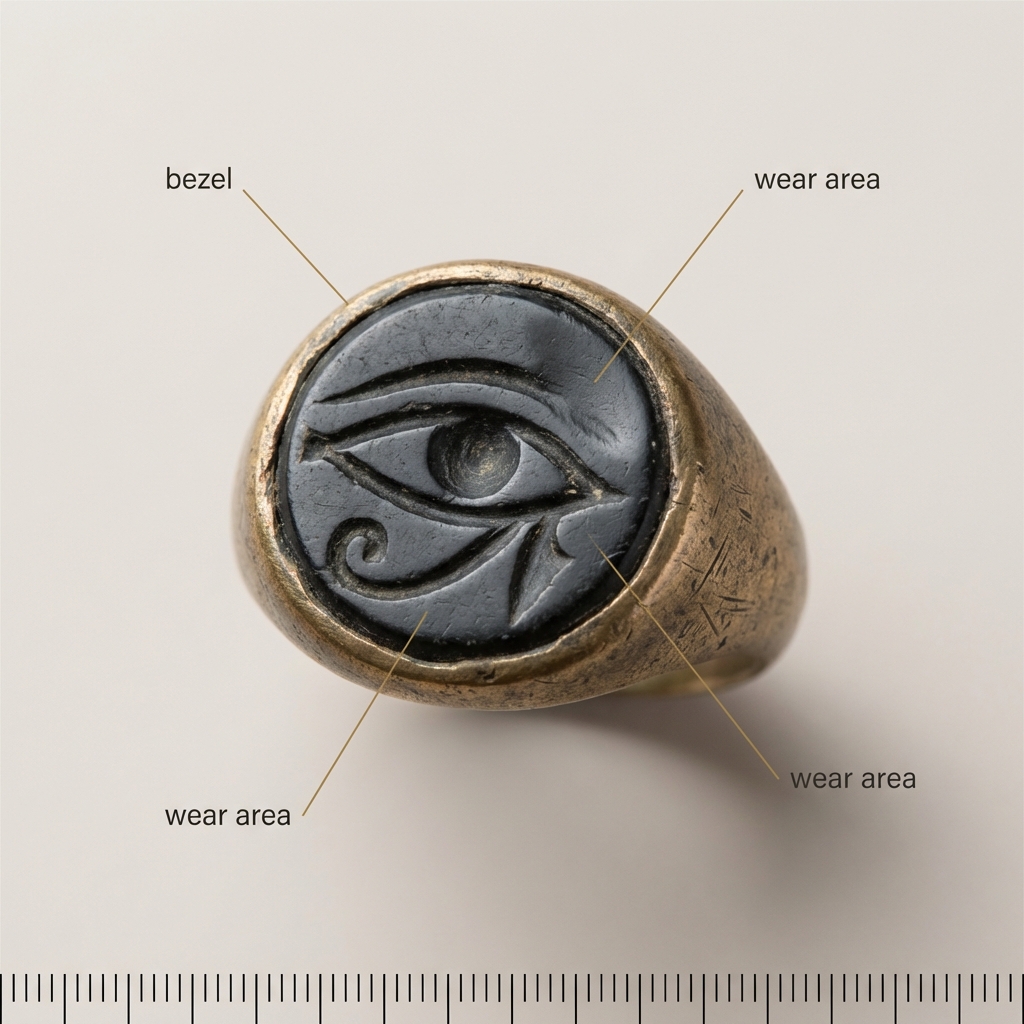
Modern additions commonly cause misidentification. A uniform bright blue glass disk set into a bezel without matching patina is often a later insertion and can be mistaken for historic glazed apotropaic glass. Buyers should be cautious when blue glass is the primary evidence for an ancient origin British Museum collection highlights (see the Rumble Museum entry Roman 'Evil Eye' Ring).
Another frequent error is to accept seller language at face value. A listing that declares an object to be an evil eye without provenance or conservation notes should be questioned. Documentation is the key to moving from suggestive description to plausible attribution.
Finally, do not assume that all eye motifs are protective. In some cases the motif is decorative or symbolic in another register. Asking for comparative examples and museum references helps avoid conflating decorative imagery with ritual function.
Short case studies: object examples and what they teach buyers
Museum catalogues offer useful models. For instance, entries that describe an intaglio ring with an engraved eye (see the V&A entry Ring | Unknown) will note the technique, likely date range, and any findspot or accession number that grounds the object in a context. That level of detail is what buyers should seek when evaluating a listing British Museum collection highlights.
A bronze ring with an eye shaped bezel and patina recorded in a collection catalogue teaches three things. First, material and wear details help establish relative antiquity. Second, a clear accession or provenance trail makes assignment to a period more credible. Third, the catalogue’s comparative notes provide the interpretive framework that supports a protective reading.
Use museum descriptions as templates. When a listing lacks the analogue fields you see in catalogues, ask the seller to provide the missing information before you commit to buy. This practice reduces the risk of relying on ambiguous or promotional descriptions.
How restoration and preservation affect eye motifs on rings
Conservation work can change appearance and interpretation. Stabilization, cleaning, and the addition of modern backings or adhesives often alter how a bezel reads visually. Good restoration notes distinguish between necessary conservation that preserves original material and restorative interventions that replace or alter parts of an object Metropolitan Museum conservation and safety guidance.
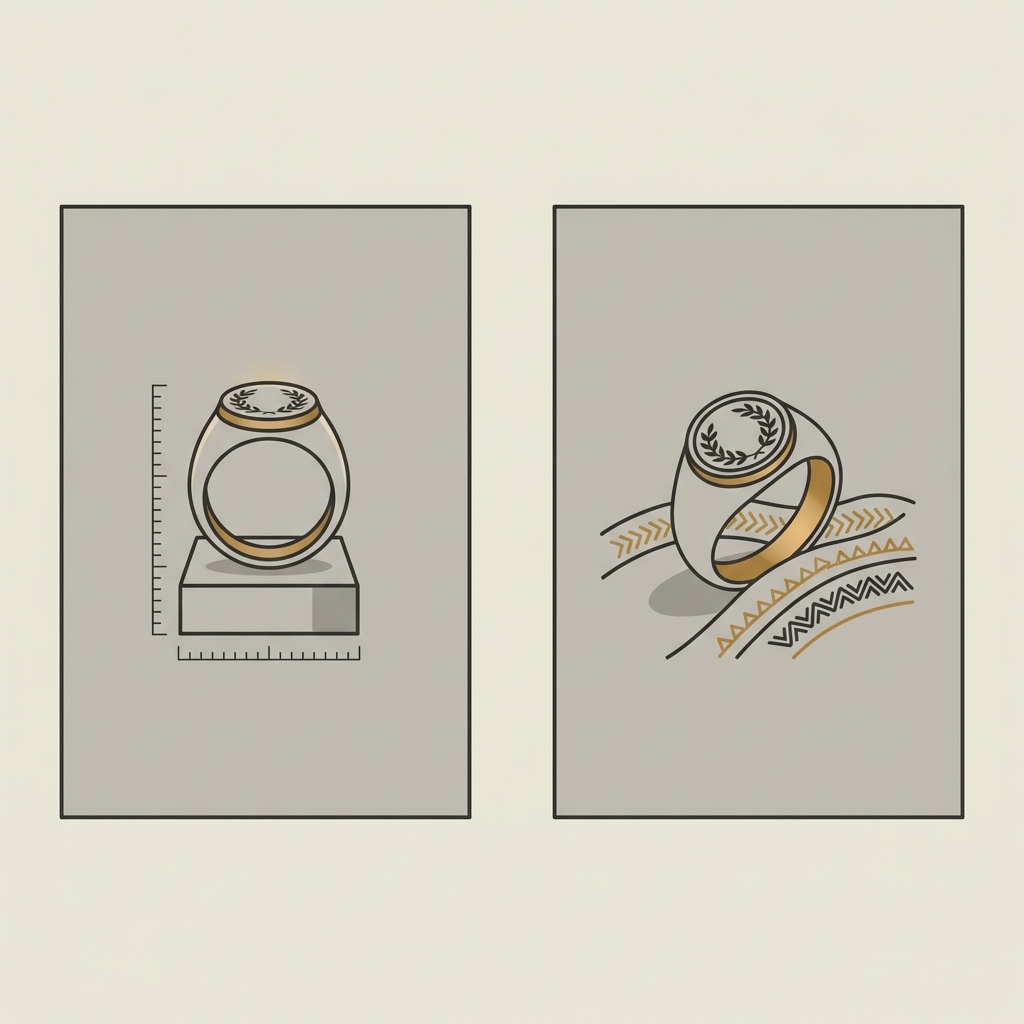
Look for restoration notes that state whether any material was replaced, consolidated, or reattached. Transparent notes typically list materials and methods used during treatment. If treatment is undocumented, that absence is itself an important signal and should prompt further questions.
Prefer sellers who provide clear conservation histories. That transparency helps you assess whether an eye motif is original, partly recreated, or a modern addition and supports safer collecting and display decisions.
Pricing, market signals and why value is not universal
Price reflects a combination of provenance, condition, rarity, and current taste, yet it does not guarantee a particular history or future outcome. Documentation such as accession numbers or clear collection history tends to increase buyer confidence and can affect desirability, but it is not a promise of future performance in any market.
Demand for motifs can influence prices. When a symbol like the evil eye resonates in contemporary culture, both original objects with good documentation and modern pieces using the motif may attract attention (see Bonhams press release here). That attention can raise prices, but it also increases the need for careful verification.
When in doubt, rely on documentation and specialist advice. If a listing lacks provenance or conservation notes that you can verify, treat any price as provisional until you have clearer evidence.
Quick guide: questions to ask before you buy an ancient greek ring
Essential questions help structure communication with a seller or curator. Ask for provenance or collection history including any accession numbers, request full condition and restoration notes, and insist on high resolution photographs with scale. These three items are the baseline for any considered purchase Metropolitan Museum conservation and safety guidance.
For higher value items add checks such as requests for excavation records, publication references, or a specialist report that compares the item to museum parallels. Scientific testing can be requested when provenance is incomplete and the object is a significant purchase.
Keep a concise record of replies. A clear paper trail of images, notes, and references protects both buyer and seller and supports later scholarly or conservation work.
Summary and responsible next steps for collectors
Key points to remember are straightforward. Look for eye shaped bezels or engraved intaglios as potential indicators, but prioritize provenance, condition notes and museum comparisons before assigning protective intent. When documentation is present it strengthens attribution; when it is absent treat protective claims as tentative Encyclopaedia Britannica.
Where possible consult specialists for high value or ambiguous pieces and favor sellers who provide transparent condition and provenance information. Aurora Antiqua offers curated listings that include condition notes and provenance references when available to support informed collecting decisions.
Further reading and trusted resources
For continued research consult museum catalogues and conservation guidance, and seek out recent syntheses that combine archaeological and ethnographic perspectives. These sources offer object level evidence and reasoned interpretation rather than simple labels Archaeopress volume on apotropaia.
Key resources include major collection pages and conservation departments that publish guidelines for object care, as well as ethnographic treatments of modern practice. Use these materials to form comparative questions for sellers or to prepare for specialist consultation.
Compare patina and wear, request high resolution images with scale, ask for condition and restoration notes, and seek provenance such as accession numbers or catalogue entries; when in doubt consult a specialist.
No, treat that language as interpretive. Ask for supporting documentation, conservation notes, and museum or publication references before accepting a protective attribution.
Clear provenance or collection history, accession numbers, detailed condition and restoration notes, and high resolution images with scale are most useful.
More from Aurora Antiqua
References
- Amulette contre le mauvais oeil, Persée, Echos d'Orient, later Revue des etudes byzantines
- Talismans, Visitatori salutem, Szepmuveszeti Muzeum, Museum of Fine Arts Budapest
- Amulette grecque trouvée en Syrie, Persée, Revue des Etudes Grecques
- Ring, Dumbarton Oaks Research Library and Collection, Trustees for Harvard University
- Earring, Victoria and Albert Museum, London
- Gold earring, Museum of Byzantine Culture Thessaloniki
- Trésor hellénistique trouvé à Délos en 1964, École française d'Athènes, via Persée
- Hellenistic Gold Eros Jewellery: Technique, style and chronology, BAR Publishing, Oxford, via Fulcrum
- Ring, Victoria and Albert Museum