


Looking for the real thing? Browse genuine Roman rings for sale — each piece one-of-one, individually authenticated, with provenance.
What is an ancient roman bracelet? Forms and historical context
The term ancient roman bracelet covers a diverse set of personal ornaments that can include rigid bangles, hinged cuffs, chain or torque constructions and tubular bronze bands; collectors encounter all of these categories in museum catalogues and excavation reports, so recognising the variety helps set realistic expectations about what a single object label might encompass British Museum collection

These forms are recorded from the Roman Imperial period through Late Antiquity and appear in different regions with local stylistic variation, meaning that style alone can rarely fix a precise date without archaeological context. Grave assemblages and hoards show that bracelets were used in life and placed in depositional contexts after death or in curated caches, an important observation for interpreting their social roles Journal of Roman Archaeology survey
Common typologies that help collectors and students sort listings include the rigid bangle, a closed circular band; the hinged cuff, which opens on a pivot for the wrist; chain or torque types made from twisted wire or linked sections; and tubular bands of bronze, which can be plain or decorated. Each of these categories has characteristic joins and profiles that are useful for preliminary identification and comparison with dated parallels Metropolitan Museum object typologies
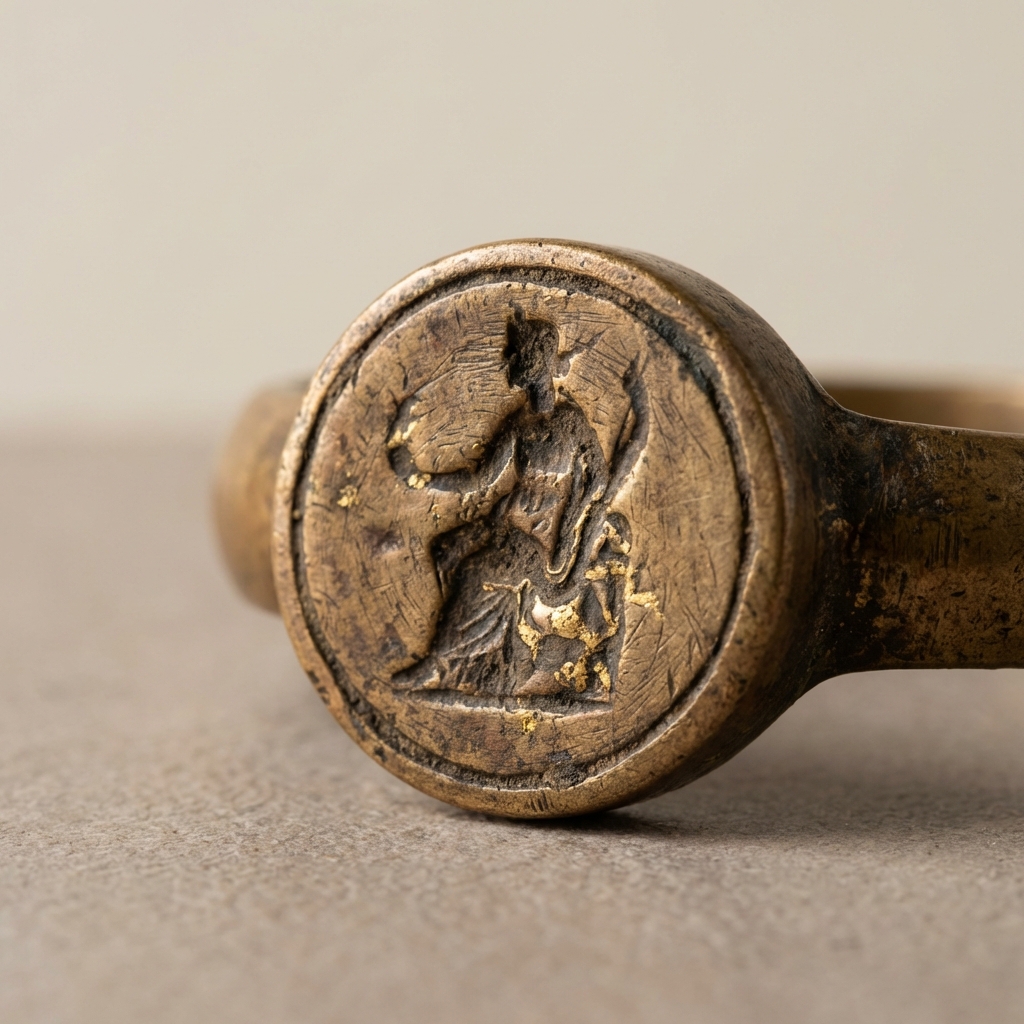
Regional differences matter: the Mediterranean core often shows finer precious-metal work while frontier provinces frequently supply more utilitarian bronze variants. Collectors should therefore read regional notes on listings and prefer examples with clear excavation or collection history when attempting period attributions.
Materials and manufacture of the ancient roman bracelet
Roman bracelets were made in a range of metals, with gold and silver used for higher-status examples and bronze or copper-alloys common for everyday wear; occasional glass inlays or semi-precious stones appear in some sets of finds, a pattern reflected in compositional studies and museum catalogues Oxford Research Encyclopedia catalogue essay
Typical production techniques include casting for basic forms, wire-twisting for ropes and torque styles, granulation and soldering for decorative granules, repoussé for low-relief surfaces, and intaglio setting where small carved stones or glass were set into bezels. These methods leave diagnostic marks such as casting seams, join lines at granulation contacts, and bezel toolmarks that can be examined visually or with low-power magnification archaeometallurgical review
Visible toolmarks and microstructure signatures can be supplemented with non-destructive compositional testing where available; XRF surveys and microscopic examination are common first-line methods that can support or challenge an initial stylistic reading when used alongside clear condition and restoration notes ICOM conservation brief
See the specialist process on @auroraantiqua
When considering a purchase, ask the seller for a clear condition description, high-resolution images of joins and any soldered areas, and the piece's documented provenance. Having those details in advance allows you to decide whether further testing or specialist review is needed.
Even with good photographs, small manufacturing traces such as fine granulation joins or patina-filled seams may require magnified images or expert examination to interpret; conserve a skeptical view where documentation or microscopic images are absent.
Symbols and meanings: what Roman bracelets communicated
Bracelet decoration ranges from pagan and civic motifs to animals, geometric patterns and phallic emblems; these motifs can serve as amuletic protection, personal devotion, or social display, but the same motif may mean different things in different periods and regions, which is why iconographic comparison to securely dated parallels is the standard interpretive method Metropolitan Museum iconography overview
For example, deities or divine attributes on an intaglio bezel might indicate a protective function for the wearer, while lavish figural work in gold more often points to status signalling; the distinction depends on context and should not be presumed from a motif alone.
Roman bracelets could be decorative, protective or a marker of social identity; their specific meaning depends on form, motif, material and archaeological context, and confident interpretation usually requires parallels from dated finds and compositional or microscopic evidence.
Iconographic interpretation benefits from cautious cross-checking: a motif identified as an amulet in one publication can be read socially in another if the same motif is found predominantly in funerary elite contexts. For readers trying to understand what a specific bracelet 'meant', assembling parallels from museum catalogues and excavation reports is the most reliable first step Grave goods survey
Burial, hoards and social use: where bracelets are found and what that says
Archaeological records show bracelets are frequently recorded as grave goods and within hoards, suggesting funerary use and episodes of deliberate deposition; museum catalogues and excavation surveys document these patterns across different regions and phases of the Roman world, which helps frame hypotheses about social signalling and gendered or age-related practices British Museum collection
Finding a bracelet in a burial does not automatically indicate elite status, nor does its presence in a hoard always mean wealth hoarding; context is crucial. For instance, small bronze bands occur in both modest burials and curated deposits on frontiers, whereas gold bracelets are more likely to be associated with higher-status assemblages in core provinces Hoard and burial contexts survey
Excavation reports and collection histories remain the best evidence for interpreting depositional patterns. When a listing includes collection history tied to a published excavation or catalogue entry, that provenance significantly strengthens interpretive claims compared with undocumented or anecdotal origins.
How collectors can identify and assess an ancient roman bracelet: a practical framework
Start with high-resolution photos and full measurements taken across the hoop or cuff, including internal diameter and cross-section; ask for close images of joins, bezels, and any areas of repair. Clear condition notes and restoration descriptions are essential to understanding what is original and what was altered ICOM best-practice guide
Request documented provenance or collection history and any available paperwork; provenance that links to a published catalogue entry or excavation report raises confidence in an object's context. If the seller can supply XRF data or references to microscopic examinations, these are useful next steps for assessing metal composition and toolmarks Oxford Research Encyclopedia guidance

When items lack documentation, treat them with caution; inconsistent patina, mismatched joins or visible modern toolmarks are red flags. A stepwise checklist-photographs, measurements, provenance request, and then scientific testing when needed-provides a reproducible workflow for both novices and experienced buyers archaeometallurgical review
Decision criteria: choosing which ancient roman bracelet is right to buy
Weigh documented provenance and condition as primary factors: a well-documented bronze cuff with complete collection history can be historically more informative than a visually attractive gold bracelet with no paperwork. Provenance and notes about restoration help determine whether a piece is primarily of aesthetic interest or of research value ICOM guidance
Consider how restoration affects interpretive value. Minor stabilising conservation that is clearly described in restoration notes often preserves the original fabric and context, while heavy reconstruction or added modern metal can reduce an object's integrity. Budget for potential conservation work and for the cost of specialist reports that may be needed to confirm composition or joins.
Factor workshop attribution and manufacturing signs into your assessment if these are documented; recognizable toolmarks and manufacturing techniques can support an attribution to a particular production tradition, but attributions without documentation should remain provisional pending specialist analysis archaeometallurgical review
Typical mistakes, restoration pitfalls and how to avoid them
A common mistake is relying solely on stylistic assessment: similar motifs and forms can be reproduced in modern copies, so stylistic agreement alone is insufficient for authentication. Collectors should pair stylistic reading with physical evidence such as patina, join examination and condition notes Oxford Research Encyclopedia
Over-restoration can create false impressions of completeness or age. Repairs that add new metal or obscure original joins should be described in restoration notes; where heavy reconstruction is present, the object's usefulness for study or display can be diminished and its market expectation should be adjusted ICOM conservation brief
Photo and documentation checklist for evaluating listings
Use this checklist when preparing questions for a seller
Red flags to look for include inconsistent patina across surfaces, toolmarks that match modern bench tools rather than period tools, and a seller who cannot supply clear images of joins and bezel interiors. When in doubt, request microscopic images or an independent specialist report.
Asking for non-destructive testing such as XRF is appropriate for metal composition questions; XRF results that contradict a claimed alloy or that show modern additions should prompt further scrutiny or refusal to buy until explained.
Practical examples and scenarios for collectors
Scenario 1: a gold hinged bracelet with an intaglio listed without paperwork. Begin by requesting full-diameter measurements, close images of the hinge and bezel, and any available condition notes. If granulation or solder joins are visible in the photographs, ask for magnified images; if the seller can provide XRF readings that show a consistent high-gold alloy and no modern soldering metals, the piece gains credibility, but absence of provenance still limits interpretive claims archaeometallurgical review
Scenario 2: a bronze tubular band described as a frontier find. Ask for excavation or collection history and images that show patina distribution and any repair seams. Bronze bands often show wear consistent with repeated use; a consistent, soil-filled patina in protected joins supports antiquity, while abrupt color differences or fresh toolmarks suggest later intervention grave goods and hoards survey
In both scenarios, if photographs and documentation are insufficient, request an independent specialist report or resist the purchase. When sellers provide verifiable provenance or links to published catalogues, the decision becomes data-driven rather than speculative; prioritize documentation over aesthetic preference when research value is a primary goal Oxford Research Encyclopedia advice
Actionable next steps: compile a short packet for any candidate piece consisting of labelled photos, measurement sheet, provenance notes, and a list of targeted questions for the seller. If needed, arrange for an XRF screening or a conservation assessment before committing to purchase.

Look for consistent patina, clear condition and restoration notes, diagnostic toolmarks at joins, and documented provenance; when in doubt, request non-destructive testing such as XRF and a specialist report.
No, motifs can be amuletic, devotional or social depending on date, region and context; secure interpretation requires comparison with dated archaeological parallels.
Request XRF or specialist reports when provenance is incomplete, when metallurgical questions arise, or before high-value purchases that require confirmation of alloy and manufacturing techniques.