


Looking for the real thing? Browse authenticated Ancient Roman rings, each piece one of one, individually authenticated, with documented provenance. For the background, see the guide to Roman jewelry.
What we mean by colour in Roman glass: definition and context
Why colour matters to collectors and historians
The term ancient roman glass jewelry appears here because colour in Roman glass often indicates both the materials used and the techniques that produced them, which affects rarity and how a piece should be described in a catalogue.
When specialist literature uses the phrase ruby glass it usually refers to a specific material effect created by colloidal gold nanoparticles rather than any generic red tone, and that distinction matters when assessing small mountings and beads, especially for jewellery items cited with brief catalogue descriptions Corning Museum of Glass overview.
Follow @auroraantiqua for finds and testing insights
This short guide includes a downloadable checklist summarizing the visual checks and documentation steps collectors can request when a listing claims gold-ruby glass.
How terms like 'ruby', 'red', and 'ruby glass' are used in catalogues
Catalogues and listings sometimes use the word ruby loosely to describe red tones, which can blur important material differences between colloidal-gold ruby glass and other red methods; always read the description for manufacturing or analysis details when available Metropolitan Museum of Art technical overview.
Because rarity is tied to production method and survival in collections, careful catalogue language and provenance entries are essential to understanding whether a red element might be true gold-ruby or a more common alternative.
Why colour matters in ancient Roman glass jewellery
Visual, cultural and material value
Collectors and historians value colour for visual impact, but also because colour encodes information about materials, workshop choices, and costs in antiquity; a true colloidal-gold ruby would have been technically demanding and expensive to make Metropolitan Museum of Art technical overview.
Color choices in the Roman world could reflect trade networks and workshop practice, so an unusual or high-cost colour in a jewellery setting can signal special production or later modification.
How colour guided workshop choices and consumer taste
Workshops selected colourants based on availability, desired appearance, and the customer's means; cobalt was favoured for stable deep blue effects, while more complex red recipes could be reserved for luxury items British Museum on Roman glass colorants.
For collectors this means that colour is not only aesthetic; it can point to probable workshop techniques and helps set expectations for documentation and condition notes in a listing.
What makes gold-ruby glass special: chemistry and technique
How colloidal gold produces a ruby red
True gold-ruby glass gets its red colour from colloidal gold nanoparticles formed during controlled reduction and precise heating steps, which create a distinctive internal scattering and hue not produced by simple colouring oxides Corning Museum of Glass overview.
The rarest Roman glass hue in jewellery is true gold-ruby glass, produced by colloidal gold nanoparticles formed under controlled reduction and heating; collectors should verify claims with clear images, provenance, restoration notes, and, when possible, non-destructive spectroscopy or SEM/EDS analysis.
Why the process was difficult and costly
The need for metallic gold and a tightly controlled reduction environment made production complex and costly, so surviving jewellery components with this effect are uncommon in museum holdings and specialist catalogues Corning Museum of Glass exhibition notes.
That scarcity influences how claims are assessed; many writers and curators treat gold-ruby attributions as notable and to be supported with explicit analysis or strong provenance where possible.
Other ways to get red: copper nanoparticles, gemstones and repairs
Copper-based red glass and how it looks
Red hues can also come from copper nanoparticles created by different synthesis steps and these copper reds have material and optical differences from colloidal-gold ruby glass, so visual comparison and analysis are needed to separate them Journal of Archaeological Science Reports on nanoparticles.
In practice, copper-based red can look similar in photos but often differs under magnification or specific spectroscopic tests.
Red gemstones and set-in stones versus true ruby glass
Another distinct route to red colour in jewellery is the use of cut or cabochon gemstones set into mounts; these are materially different from glass inlays and should be described as set stones if present, not as glass effects.
Finally, later repairs or modern enhancements can introduce red glass fragments or pigments into an old setting, which is why condition and restoration notes are crucial when evaluating a claim of gold-ruby.
Common colourants in Roman glass: cobalt, manganese and iron
How cobalt makes deep blue
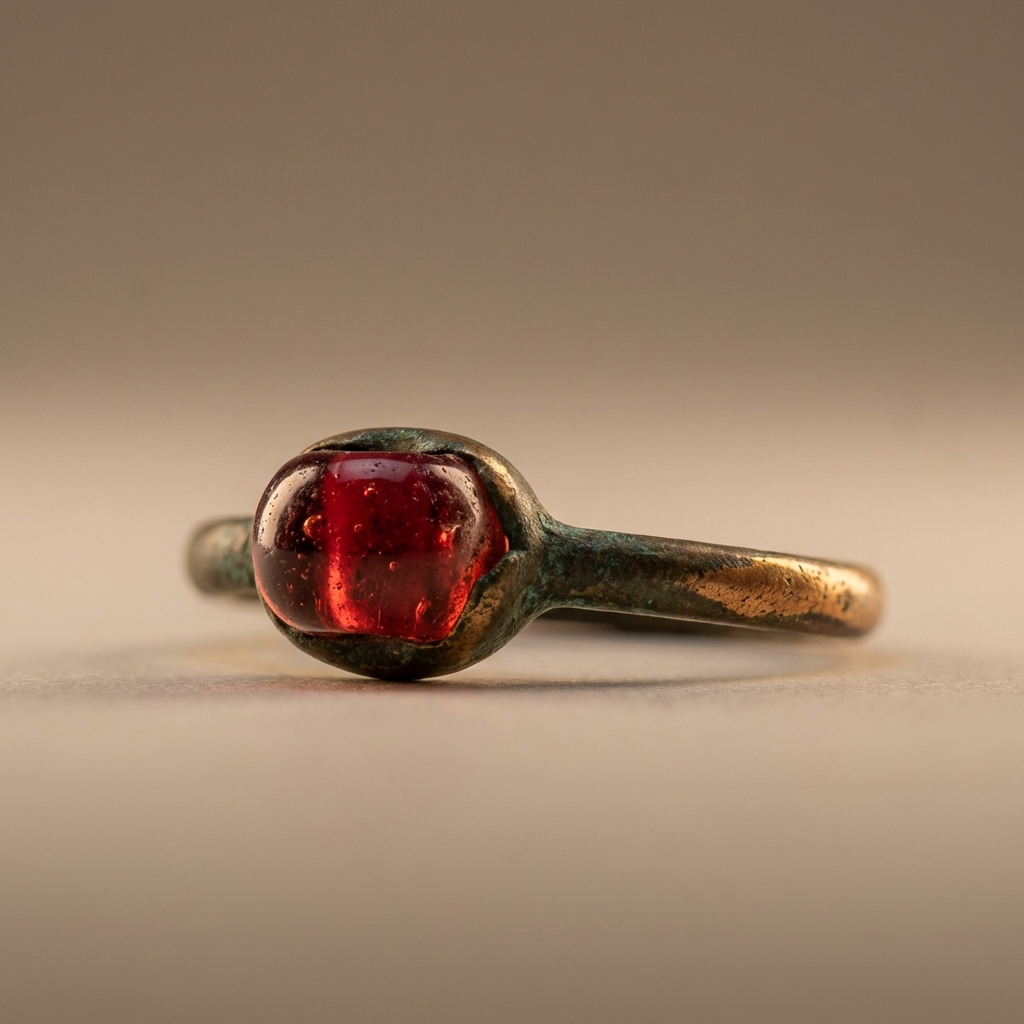
Cobalt compounds, commonly cobalt oxide, produce deep, stable blue glass that was widely used and more available than luxury red recipes in Roman glasswork British Museum on Roman glass colorants.
As a comparative point, the prevalence of cobalt blue helps explain why genuine colloidal-gold ruby remains notable when it appears.
Manganese and purple or pink tones
Manganese, iron and trace impurities combined with redox conditions can yield purple or pinkish tones without gold, and these hues are generally more common than true gold-ruby in archaeological assemblages Metropolitan Museum of Art technical overview.
When assessing images, look for subtle signs such as how colour depth varies at thin edges and where light transmits through fragments; such cues can suggest the types of colourants present.
Practical visual checks for buyers: what to look for in images and in person
Uniformity of colour and 'particle' sparkle under magnification
As a first filter, examine high-resolution photographs at magnification if provided: colloidal-gold ruby glass can show a slight particle-like sparkle and a uniform internal glow distinct from pigment or surface stain.
Ask sellers for macro photos and note whether the colour is consistent through the thickness or concentrated at the surface, and check whether the listing offers condition notes and provenance to accompany images Nanoparticles and red colour study.

Behaviour under strong light and UV
Strong transmitted light and targeted UV inspection can reveal whether the red effect sits throughout the glass or is a surface application; ask for images with backlighting and any notes on light tests when available Analytical Chemistry notes on methods.
Combine those observations with the seller's restoration notes and documented provenance to decide whether further testing is warranted.
Scientific and non-destructive testing: what methods collectors can request
When UV-Vis, Raman, SEM/EDS or other spectroscopy help
Non-destructive spectroscopy such as UV-Vis and Raman can identify nanoparticle signatures consistent with colloidal gold, while SEM/EDS provides elemental context that helps distinguish gold from copper or other colourants Analytical Chemistry conservation science notes.
For collectors, these tests are the most reliable route to move beyond visual assessment when a listing makes a gold-ruby claim; realistic reporting and clear spectral descriptions are important outcomes to request from a lab.
A short checklist for requesting basic non-destructive analysis
Keep requests concise
Limits of non-destructive methods and reporting expectations
Non-destructive techniques have limits: Raman can be hampered by fluorescence and SEM/EDS gives surface-biased elemental readings, so interpretation should combine multiple methods and be reported in plain language by the lab Journal of Archaeological Science Reports on techniques.
Expect a lab report to include spectra snapshots, elemental tables and a short interpretive paragraph stating whether signatures are consistent with colloidal gold, copper, or ambiguous results.
Provenance, documentation and catalogue language buyers should seek
Meaningful provenance elements
Ask for elements such as prior collection history, acquisition records, and any verification letters; these items do not prove material composition but they help place a piece in a collection history and can increase confidence in a claim when combined with analysis Corning Museum of Glass exhibition notes.
Clear provenance entries are particularly useful when a seller describes a small red bead or inlaid fragment as ruby, because that claim is exceptional and benefits from supporting documentation.
How documentation interacts with material analysis
Documentation and analysis are complementary: a report consistent with colloidal gold plus a clear collection history is stronger than either element alone, while a missing provenance record should prompt a buyer to request technical descriptions before proceeding.
A cautious approach is sensible: treat gold-ruby claims as exceptional and request technical descriptions or testing information when the written evidence is incomplete.
Condition, restoration and what to expect in listing notes
Common stabilization or repairs and how they are described
Listings often include restoration notes that specify what was stabilized, repaired, or left untouched; look for clear language such as which joins were consolidated or whether modern adhesives or insets were introduced Corning Museum of Glass exhibition notes.
Well-written restoration notes help you understand whether a red fragment is original, a later insert, or a modern repair that affects appearance.
How restoration can affect appearance without implying modern creation
Stabilization can change the way light travels through a fragment and therefore its apparent colour, so asking for unedited photos, detail shots of joins, and explicit restoration descriptions helps separate original colour from treatment effects.
If a listing lacks transparent restoration notes, that is a reason to pause or request more detail before accepting an exceptional gold-ruby claim.
A buyer's decision checklist for assessing a ruby-glass claim
Quick yes/no checkpoints
Use a short checklist: clear macro photos with backlighting, magnified detail shots, explicit restoration notes, provenance elements, and mention of analysis or lab reports should all be present before treating a claim as likely gold-ruby Nanoparticle analysis guidance.
Red flags include vague 'ruby' labels without detail, lack of magnified images, and unexplained modern-looking insets or adhesives.
When to pause and request testing or documentation
Pause and request testing when the piece is described as gold-ruby but lacks provenance or analytical notes; suggest UV-Vis or Raman first and SEM/EDS when elemental confirmation is necessary and the seller or owner permits analysis Analytical Chemistry notes.
For many collectors, a staged approach-visual checks, clear documentation, then targeted non-destructive tests-gives the best balance of cost and confidence.
Typical errors, mislabeling and common red flags
How catalogue language can mislead
Some catalogue entries use the word ruby loosely to describe red tones without technical backing, which can mislead buyers about rarity and material; always confirm whether the entry means colloidal-gold ruby or a general red description Corning Museum of Glass explanation.
When you see promotional descriptions that emphasize colour without technical detail, treat the claim as unverified until further documentation or testing is provided.
Examples of misattribution between red methods
Misattributions can occur when copper-red glass or a set gemstone is described as ruby glass; if the listing lacks clear photos of joins and magnification, ask specific questions about whether the red element is glass, stone, or a later repair Journal article on distinguishing nanoparticles.
Requesting concise lab language and images helps reduce the chance of buying into mislabelled rarity claims.
Practical scenarios and short case studies for collectors
Scenario: a small red bead offered as 'ruby glass' in a ring
Step 1: Ask for macro photos, backlit views, magnified detail, and any restoration notes. If the seller provides none, request provenance or a basic spectroscopic description before proceeding Corning Museum exhibition notes.
Step 2: If photos show uniform internal colour and particle-like sparkle, ask whether any analysis has been done; if not, consider a targeted UV-Vis or Raman check when feasible.

Scenario: a set gemstone versus a glass inlay
If the red element sits as a set cabochon test whether it is a stone by asking for refracted light photos and surface detail; stones and glass have different fracture and surface properties visible at magnification and in angled light.
When documentation is partial, favor conservative interpretation and ask for testing before accepting an attribution to rare gold-ruby glass.
Scenario: how to handle partial documentation
With partial documentation, prioritize clear images and a written statement about restoration. If those are insufficient, ask for a minimal non-destructive test or a qualified conservator's opinion; proceed only when the balance of evidence supports the claim.
When in doubt, treat gold-ruby as exceptional and request stronger evidence rather than assuming rarity based on a single red photo.
How to request testing and read a lab-style report
What to ask a lab or conservator
Ask a lab for clear deliverables: UV-Vis spectra, Raman spectra, and an SEM/EDS elemental table if permitted, plus a plain-language interpretation of whether results are consistent with colloidal gold, copper, or ambiguous signatures Analytical Chemistry guidance.

Also ask about sampling constraints and any risks; many labs can work non-destructively but will state limits in advance.
How to read spectral or SEM/EDS outputs in plain language
Look for phrases such as 'plasmon resonance consistent with colloidal gold' or 'elemental gold detected at the surface or in inclusions' rather than overly technical tables alone; a concise interpretive paragraph from the laboratory is the most useful part for collectors.
When results are ambiguous, ask whether additional complementary tests could reduce uncertainty and whether the lab can recommend a conservative interpretation for sale listings.
Summary and next steps for collectors
Key takeaways
Gold-ruby glass is the rarest Roman glass hue because it relies on colloidal gold nanoparticles formed through controlled reduction and heating, and surviving jewellery uses of this material are uncommon in collections Corning Museum of Glass overview.
For buyers, treat any claim of gold-ruby as exceptional: request clear images, magnified detail, provenance notes, and targeted non-destructive analysis when a listing asserts this rare material Journal of Archaeological Science Reports on nanoparticles.
Begin with high-resolution and backlit photos, look for a uniform internal glow and particle-like sparkle under magnification, request clear restoration and provenance notes, and ask for non-destructive tests such as UV-Vis or Raman if needed.
No. Many red tones result from copper nanoparticles, trace impurities, redox conditions, or set gemstones; only certain ruby glass cases involve colloidal gold and those are uncommon.
Request non-destructive spectral methods like UV-Vis and Raman and, where allowed, SEM/EDS elemental analysis; ask the lab for a short interpretive statement about whether results are consistent with colloidal gold.
More from Aurora Antiqua
References
- 16 CFR Part 23, Guides for the Jewelry, Precious Metals, and Pewter Industries, Federal Trade Commission, eCFR
- About us, International Association of Dealers in Ancient Art
- A non-destructive analytical study of cultural heritage object from Late, Springer Nature
- Auction Terminology, Christie's
- Chart of Commercially Available Gem Treatments (Gems & Gemology, Winter 2002), Gemological Institute of America
- Publication 561 (12/2025), Determining the Value of Donated Property, Internal Revenue Service (IRS), USA
- PubMed Central