


Looking for the real thing? Browse authenticated Ancient Roman rings — each piece one-of-one, individually authenticated, with provenance.
What Roman glass is: definition, common types and why it matters for collectors
Brief definition and typical object types, roman glass jewelry
In collecting contexts, "Roman glass" is a broad term for glass objects produced across the Roman world from roughly the first century BCE into the early centuries CE, commonly encountered as beads, pendants, intaglios set in bezels, small vessel fragments and sometimes decorative inlays on ancient rings and settings.
The soda-lime-silica recipes used in Roman technology gave a set of recurring visual traits, and understanding that background helps collectors make initial photographic assessments before requesting documentation or specialist checks, which can be decisive for high value pieces Corning Museum of Glass article on Roman glass colour and technology.
Visual identification matters because many wearable fragments appear in images with limited context; a careful first look at colour, patina, surface weathering and manufacturing marks is a practical filter that helps decide whether to pursue provenance records or conservation reports.

Collectors often find Roman glass embedded in jewelry, where the glass sits within a bezel or is worn as a bead; in these uses, condition notes and restoration notes from a seller provide crucial context about any stabilisation or repairs that affect appearance and handling.
A quick photographic checklist for an initial ID
Five visual checks to do with photos
Start with a simple photographic checklist: look for age-appropriate colour variation, evidence of natural iridescence or weathering crusts, seed bubbles or elongated air inclusions, tool marks or mould seams, and coherent provenance or documentation; each item is not proof by itself, but together they form a stronger picture British Museum identification notes for collectors.
Good photos to request include an oblique view to show wall thickness, a macro of any bubbles or trail lines, a close-up of the edge where a weathering crust might peel, and one image of the object in context with a scale; these views help reveal the macroscopic markers described below.
See condition notes and behind-the-scenes details on @auroraantiqua
This guide can help you compare listings that include condition notes and close-up photos before asking for provenance or conservation records.
Red flags that should prompt caution are perfectly uniform colour with no variation, mechanical symmetry that looks product-made, and an absence of any weathering on objects typecast as excavated; such signs do not prove forgery, but they do suggest further scrutiny or lab checks are warranted Studies in Conservation article on differentiation of weathering and artificial ageing.
If the photographic checklist raises doubts, ask the seller for restoration notes, cross-section photos or a magnified image of suspected weathering layers; these requests are routine for serious buyers and often resolve simple questions without expensive testing.
When visual signs conflict, for example clear production traces but a suspiciously uniform surface finish, that is a good moment to pause and request laboratory analysis or a conservation assessment before purchase British Museum identification notes for collectors.
Colour and appearance: typical Roman glass tones and what causes them
Common colour range and trace elements
Across the Roman Empire the dominant palette for glass objects leans to pale blue, aqua or turquoise, and olive-green tones, with occasional deeper cobalt hues; these colours are commonly linked to trace iron and other impurities in soda-lime-silica glass recipes used at the time Corning Museum of Glass article on Roman glass colour and technology.
In many cases, small compositional differences in the batch, and the presence of manganese or iron at trace levels, shift a piece between a greenish cast and a bluer tone, so expecting some variation within a group of beads or pendants is reasonable and often authentic.

Thin, window-like fragments and thin-walled glass that may have been used as inlays often appear paler, while thicker beads, intaglios and small pendant blanks show more saturated tones because depth of material intensifies perceived colour; noting wall thickness in photographs helps interpret hue correctly Smithsonian notes on ancient glass technology.
When examining a photographed intaglio set in a metal bezel, ask for a macro of the carved face and an edge view; worn ground facets around an intaglio or evidence of a fitted bezel can indicate long use in a ring or pendant and help separate original ancient settings from modern resets.
Surface weathering, iridescence and crusts: signs of burial or alteration
How hydration and leaching create iridescence
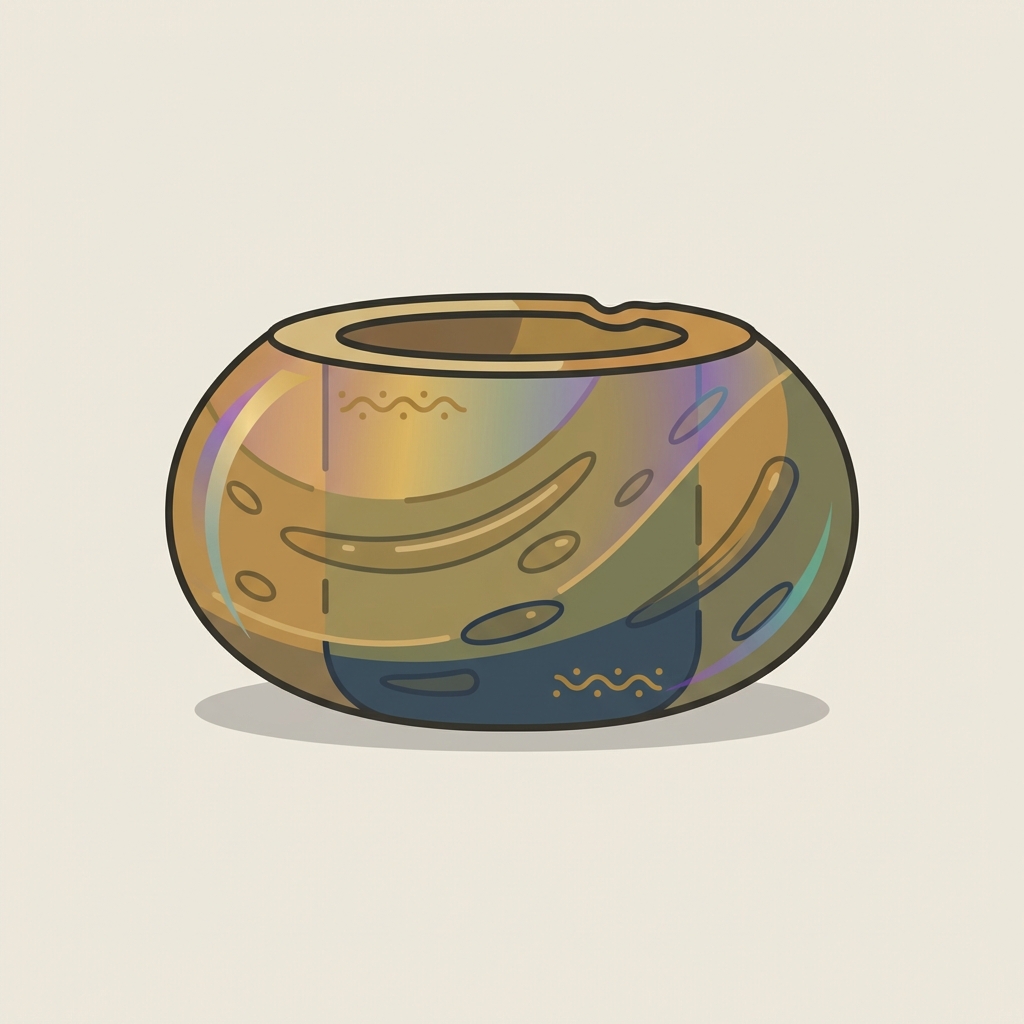
Long-term burial commonly produces surface iridescence, a subtle rainbow-like sheen, and peel-like weathering layers created by hydration and ion exchange; conservators treat these features as indicators of chemical alteration after deposition rather than original glass colour or finish Getty Conservation Institute guide on caring for glass. PNAS study on photonic crystals in Roman glass
Iridescence often appears as fine, layered sheens or striations that catch the light at different angles; vertical weathering crusts or delaminating layers can look fragile and may flake if handled roughly, so condition notes should always describe the stability of any crusts present. (See UCL discussion of iridescence.)
Collectors can use a combination of age-appropriate colour, production traces like seed bubbles and trail lines, and conservation-informed signs such as iridescence and crusts, together with provenance and restoration notes; when visual evidence conflicts, seek microscope inspection or compositional analysis.
Because some 19th and 20th century surface treatments can mimic natural-looking iridescence, microscope inspection and, if needed, elemental or compositional analysis are the tests conservators recommend when visual evidence is ambiguous Journal of Archaeological Science study on weathering mechanisms and iridescence. (See also Conservation Wiki: Iridescence.)
For collectors, an important practical point is that the presence of iridescence or crusts strengthens the case for burial alteration when it appears with production marks such as seed bubbles or trail lines; conversely, iridescence alone is not a sufficient proof of antiquity.
Manufacturing traces: bubbles, trail lines, pontils and uneven walls
What to look for in blown and moulded pieces
Small seed bubbles, elongated air inclusions and faint striations are common in Roman blown glass, where the working methods of free-blowing, trailing and occasional mould use left characteristic internal and surface signs that can be visible in good photographs Corning Museum of Glass article on Roman glass colour and technology.
Trail lines, stretched threads of glass applied as decoration, pontil scars from early working, and mould seams on pressed pieces are macroscopic indicators of historical working techniques and are useful visible markers in an initial photographic check British Museum identification notes for collectors.
Examples on beads, pendants and intaglios
On beads you may see elongated bubbles aligned along the axis where the bead was shaped, while pendants and intaglios sometimes show polishing marks or worn facets from long use at the bezel interface; asking the seller for magnified photos of these areas can clarify whether wear is consistent with age Corning Museum of Glass article on Roman glass colour and technology.
A loupe and photo checklist to verify visible production marks
Use 10x magnification if available
Uneven wall thickness, such as thin edges and thicker bodies, is common and should be visible in side-on photos; if a purported Roman bead shows perfectly uniform walls in cross-section images, that is a reason to ask for more documentation or testing British Museum identification notes for collectors.
Valuable provenance items include collection history, previous ownership notes, verification letters from recognised specialists, and clear restoration notes that outline what was stabilised, repaired, or left untouched; these documents add weight to an attribution but should be read critically British Museum identification notes for collectors.

When documentation is limited, condition notes that describe weathering stability and any consolidation carried out by a conservator can be especially useful; sellers who provide clear restoration notes help buyers understand tradeoffs about handling and display.
Request specialist analysis when visual signs conflict, for high-value purchases, or when suspected modern surface treatments could mimic natural weathering; microscope inspection often reveals layering or tool marks that are not visible in photos and can indicate artificial ageing Studies in Conservation article on differentiation of weathering and artificial ageing.
Compositional tests, such as non-destructive spectrometry or targeted elemental analysis, are valuable when provenance is weak and the object is costly, but for many modest purchases a combination of good photography, restoration notes and independent conservation advice is a sufficient next step.
Decision criteria: how to weigh visual signs, condition and paperwork
A practical scoring approach for collectors
A simple scoring approach can help: assign points for age-appropriate colour and patina, for presence of natural-weathering features, for production traces like bubbles and trail lines, and for coherent provenance documentation; pieces that score consistently across categories are more likely to be genuine candidates for purchase British Museum identification notes for collectors.
Keep the scoring transparent and conservative: allow deductions for ambiguous weathering, unexplained polish, or missing restoration notes, and treat a high score as a prompt to request a written condition report or conservation opinion rather than as conclusive proof.
How condition and restoration affect evaluation
Restored or stabilised pieces can be valid collector items if the restoration notes explain the materials and extent of work performed; look for clear language about adhesives, fills, and any surface consolidation, because these interventions affect both appearance and care needs.
Where restoration is extensive, factor the uncertainty into the score and consider a condition-led price adjustment or a requirement for a return right until an independent conservator has inspected the piece.
Common mistakes and pitfalls collectors make when assessing glass
Over-relying on iridescence alone
One frequent error is treating iridescence by itself as proof of antiquity; because some modern treatments can simulate a rainbow sheen, iridescence must be read alongside production traces and provenance to build confidence in an attribution Getty Conservation Institute guide on caring for glass.
Another common pitfall is assuming uniform colour equals age; some modern manufacturing processes create evenly coloured blanks that mimic ancient hues but lack the bubbles, wall variation and manufacturing marks typical of Roman working methods.
Misreading modern surface treatments
Polished facets on an intaglio that look old can sometimes be modern re-polishings; when in doubt request microscope images or a brief conservation note to clarify whether polishing is ancient wear or a modern intervention Journal of Archaeological Science study on weathering mechanisms and iridescence.
Photo-based scams also rely on flattering lighting and cropping; insist on standardized scale photos with neutral lighting and a ruler in frame, and be wary of heavily cropped images that conceal seams or repairs.
Practical examples and short case studies for wearable pieces
Bead example: colour, bubbles and wear
Imagine a pale aqua bead pictured with a side-on shot that shows thin, slightly irregular walls, a row of elongated bubbles along the axis, and faint surface iridescence; this combination of features supports a likely Roman origin, and further confidence comes from a clear collection history or condition notes describing stable weathering Corning Museum of Glass article on Roman glass colour and technology.
For that bead, ask the seller for an extra macro of the bubbles and a note on whether any surface consolidation was applied; these small checks are fast and often decisive for modest purchases.
Pendant/intaglio example: bezel fit and worn facets
Consider an intaglio set in a simple silver bezel with worn ground facets around the carved area and a slightly asymmetric profile where the glass meets metal; worn contact points and a fitted bezel can indicate long-term use as wearable history, especially if the seller provides restoration notes about how the setting was stabilised British Museum identification notes for collectors.
Request close-ups of the bezel edge and a view of the back of the intaglio to check for polishing or modern recarving; a confident attribution combines the physical signs with coherent provenance and condition documentation.
Conclusions and sensible next steps for buyers
Summary checklist to save or print
Save a short checklist: age-appropriate colour and subtle variation, natural iridescence or crusts read with caution, seed bubbles and trail lines, tool marks and uneven wall thickness, and coherent provenance or documentation; treat uniform colour, perfect symmetry, or missing weathering as prompts for more scrutiny British Museum identification notes for collectors.
Practical next steps are: request condition and restoration notes, ask for targeted photos (macro bubbles, edge views, bezel fits), and obtain a conservator opinion or compositional test for pieces with conflicting signs or high value.
Aurora Antiqua acts as a curator and reference layer that highlights condition notes, provenance where available, and clear restoration statements so buyers can make informed choices about wearable antiquities, while avoiding absolute claims about authenticity.
Look for age-appropriate colour variation, seed bubbles or elongated inclusions, trail lines or mould seams, and natural-looking iridescence or crusts; combine these signs with provenance and restoration notes for a stronger case.
No, iridescence commonly forms through long-term burial processes, but it can be imitated by modern treatments, so it should be assessed alongside production marks and documentation.
Request microscope inspection or compositional tests when visual signs conflict, when modern-looking treatments are suspected, or when the piece is high value and documentation is incomplete.
References
- https://www.cmog.org/article/roman-glass-colour-technology
- https://www.britishmuseum.org/blog/recognising-roman-glass
- https://www.tandfonline.com/doi/full/10.1080/00393630.2019.XXXXXXXX
- https://naturalhistory.si.edu/exhibit/ancient-glass
- https://www.sciencedirect.com/science/article/pii/S0305440321001234
- https://auroraantiqua.com/products/roman-silver-ring-auriga-red-jasper-intaglio-of-cock-drawing-a-chariot-driven-by-a-mouse-1st-3rd-century-ad-eu-57-us-7-5
- https://blogs.ucl.ac.uk/researchers-in-museums/2019/05/20/the-mystery-of-iridescence-in-glass/
- https://www.conservation-wiki.com/wiki/Iridescence
- https://www.pnas.org/doi/10.1073/pnas.2311583120
- https://auroraantiqua.com/collections/ancient-roman-rings
- https://auroraantiqua.com/blogs/questions-and-answers/roman-intaglio-rings-explained
- https://auroraantiqua.com/
From Aurora Antiqua
We sell authenticated ancient & medieval pieces — each individually researched against a 73,000-reference corpus and backed by a Lifetime Authenticity Guarantee. One of a kind, sold once, never reproduced.
Browse Ancient Roman Rings →