


Looking for the real thing? Browse genuine Roman rings for sale, each piece one of one, individually authenticated, with documented provenance. For the background, see the guide to Roman jewelry.
Where is romanjewelry made? A concise introduction
What this article covers
This overview explains where ancient Roman jewellery was produced and where Roman-style pieces are made today, and then gives a practical, evidence based set of steps collectors and buyers can use when they evaluate a listing. Readers will find a short synthesis of historical production centres, a review of workshop techniques, what findspot recording tells us about regional manufacture, how museums document materials and condition, the role of scientific testing, and a decision framework for authentic pieces versus reproductions.
Key takeaways in one paragraph
Evidence indicates ancient Roman jewellery was made both in major urban workshops such as Rome and Alexandria and in provincial workshops across the Empire; today, Roman-style items are produced by specialist artisans in places like Italy and Greece as well as by larger manufacturing hubs elsewhere, and buyers should prioritise clear provenance, condition and testing documentation when assessing a purchase. Metropolitan Museum of Art overview on jewelry in the Roman world
Learn more about condition, provenance and documentation
This site presents curated examples and educational notes to help you compare listings and documentation without pressure; consider signing up for updates if you want occasional research notes and behind the scenes context.
This introduction signals the practical tone of the piece: it is not a market appraisal but a guide to where items were likely made and the tests and documents that can support a confident purchase decision. The rest of the article breaks the topic into digestible sections with concrete next steps for buyers and collectors.
Ancient production: metropolitan workshops and provincial centres
Major urban workshops (Rome, Alexandria)
Roman jewellery production included specialised urban workshops in major cities where trained goldsmiths worked with a broad set of techniques and luxury materials, often supplying elite markets and producing pieces with fine detail and complex assembly; museum studies and object research describe these centres and the types of pieces associated with them. Metropolitan Museum of Art overview on jewelry in the Roman world
Provincial workshops and regional markets
Alongside metropolitan production, provincial workshops in regions such as Gaul and the eastern Mediterranean produced jewellery for local consumption and for regional elites, using both local alloys and imported gems; this pattern is visible in regional typologies and object catalogues that group finds by style and manufacturing traces. British Museum Roman Britain collection and galleries
Itinerant goldsmiths and local demand
Itinerant goldsmiths and travelling metalworkers also played a role in spreading forms and techniques, working in market towns and military sites to produce or adapt jewellery in situ; this helps explain how similar motifs appear across distant provinces even when local workshops produced significant volumes. British Museum Roman Britain collection and galleries
Techniques and materials in historical romanjewelry production
Casting, soldering and basic fabrication
Common manufacture began with casting and basic fabrication to create hoops, rings and settings, followed by finishing and soldering to assemble multi part pieces; these basic methods are described in museum object studies and conservation material. V&A resource on Roman and classical jewellery materials and craftsmanship

Granulation, filigree and surface detail
Finer surface work such as granulation and filigree required specialist skill and often marks a higher level of workshop expertise; these techniques are repeatedly documented in object catalogues and technical reports that identify how beads, minute granules and thin wires were attached to forms. Metropolitan Museum of Art overview on jewelry in the Roman world
Gemstones and intaglio engraving
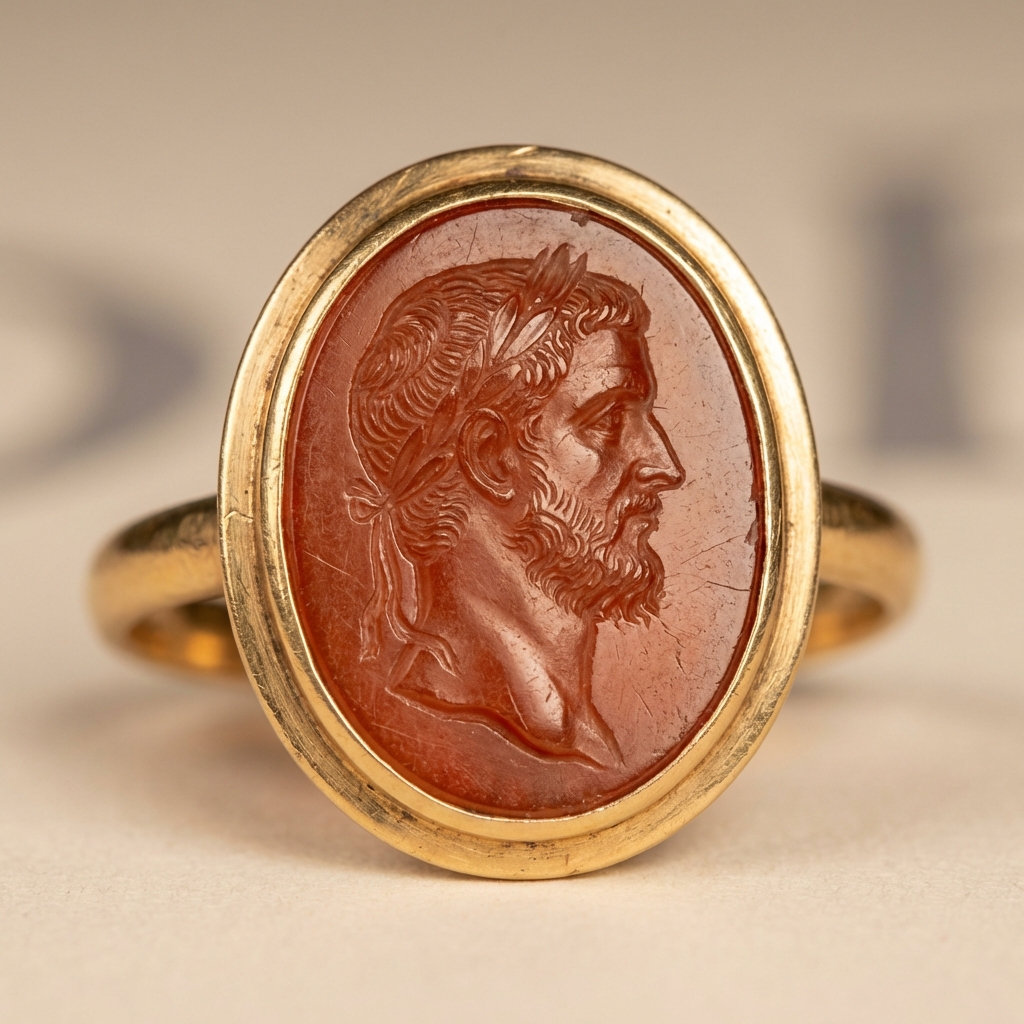
Gemstones such as carnelian, agate and amethyst were commonly set into bezels, and intaglio engraving appears frequently on signet rings and personal seals; museum collections and catalogue entries outline typical stone choices and engraving styles used across the Roman period. British Museum Roman Britain collection and galleries Archaeometric analyses and our blog post on intaglio rings.
What portable finds tell us about regional production
Findspot patterns and the Portable Antiquities Scheme
Systematic recording of portable finds shows many Roman jewellery objects are recovered in provincial contexts, which supports a model where local manufacture and consumption were widespread rather than entirely centralised. Portable Antiquities Scheme annual report 2023
Historically, Roman jewellery was produced in both metropolitan workshops such as Rome and Alexandria and in provincial workshops and itinerant contexts; today Roman-style pieces are commonly made by specialist artisans in Europe and by larger manufacturing hubs elsewhere, and buyers should prioritise provenance, condition notes and testing when assessing authenticity.
How provincial find volumes suggest local manufacture
High volumes of provincial finds, when combined with stylistic grouping and metallurgical traces, point to local production and repair networks that served regional demand rather than exclusive reliance on metropolitan imports. Portable Antiquities Scheme annual report 2023
Limits of findspot data and recovery bias
Findspot datasets are invaluable but have limits: reporting bias, varying recovery contexts and incomplete archaeology mean that findspot alone is rarely conclusive about workshop origin; interpreted carefully, however, such datasets remain a cornerstone for mapping production trends. Portable Antiquities Scheme annual report 2023
What museum catalogues and conservation reports reveal
British Museum, V&A and Met object studies

Museum catalogues and published object studies summarise typologies, link forms to dating ranges and describe the material evidence that supports workshop attributions; these resources are often the primary starting point for attribution and dating of Roman jewellery. British Museum Roman Britain collection and galleries
Materials, typologies and dating ranges
Catalogues document common materials such as gold, silver, bronze and semi precious stones, and they provide typological sequences that help place objects broadly within a dating window from the late Republic into early Imperial centuries for many types. Metropolitan Museum of Art overview on jewelry in the Roman world archaeometric studies
How conservation notes inform condition and restoration
Conservation and restoration notes in museum entries describe what was stabilised, what repairs were undertaken and what was left untouched, and these notes help buyers read condition statements in commercial listings and understand visible repairs or patina treatments. V&A resource on Roman and classical jewellery materials and craftsmanship
Modern production: artisan workshops and global manufacturing
Specialist artisans in Italy and Greece
Today a stream of specialist artisans in Europe, notably in Italy and Greece, produce high quality Roman-style jewellery using revived traditional techniques and close study of museum examples; these makers often emphasise hand finishing and period techniques. Art Newspaper feature on where Roman-style jewellery is made today See our ancient Roman rings collection.
Large-scale reproductions from global hubs
At the same time, larger scale production in global manufacturing hubs supplies museum inspired reproductions and costume lines at much lower cost, and these products differ in materials, methods and transparency compared with artisan work. Art Newspaper feature on where Roman-style jewellery is made today
Distinguishing artisanal recreations from commercial reproductions
Identifying whether an item is an artisanal recreation or a mass produced reproduction depends on visible technique, materials listed, declared making methods and any supporting documentation; asking makers for specifics about technique and sourcing is often decisive. V&A resource on Roman and classical jewellery materials and craftsmanship
Scientific testing and how it links objects to workshops
XRF and surface elemental analysis
Quick checklist for common scientific test report elements
Reports vary in detail
Surface elemental analysis such as XRF provides non destructive information about alloy composition and can suggest consistency with known Roman alloy recipes when interpreted alongside other evidence; such methods are widely used in object studies and conservation science. Metropolitan Museum of Art overview on jewelry in the Roman world
Isotope and metallographic approaches
Deeper approaches including metallography and isotope studies can reveal manufacturing traces and ore source signals that are often more telling about likely workshop practices, although these analyses require sampling and specialist interpretation. UNESCO policy brief on illicit trafficking and due diligence analytical studies
Practical limits of testing in the commercial market
In the commercial market, scientific testing is unevenly available: XRF is commonly offered or present in catalogues, while isotope or metallographic work is less common because it requires sampling, laboratory access and expert reporting; buyers should treat test results as part of a broader evidential set. UNESCO policy brief on illicit trafficking and due diligence
Legal and ethical considerations: provenance, export and illicit trade
UNESCO guidance and due diligence
International guidance stresses careful due diligence and transparent provenance to reduce the risk of illicitly traded objects entering the market; policy briefs and international bodies recommend documented ownership history and export paperwork before purchase. UNESCO policy brief on illicit trafficking and due diligence
Documentation and export legality
Buyers should request clear provenance, collection history or export documentation when relevant, since legal status and national restrictions can affect an object’s legitimate transfer across borders and its certainty of lawful origin. Portable Antiquities Scheme annual report 2023
Red flags and responsible sourcing steps
Common red flags include vague paperwork, sudden appearance without history, or provenance claims without supporting documents; practical steps include asking for paperwork, seeking third party opinions and preferring sellers who provide condition and restoration notes and clear collection history. UNESCO policy brief on illicit trafficking and due diligence
A practical decision framework: is this authentic or a reproduction?
Visual checklist for initial assessment
Begin with high resolution photos, clear measurements, close ups of joins and poppy wear areas, and a readable description of materials and condition notes; these basics help screen out many unclear listings before deeper checks are needed. Metropolitan Museum of Art overview on jewelry in the Roman world
Which documents to prioritise
Prioritise provenance documentation, collection history, conservation reports and any scientific test reports, weighing older, contemporaneous documentation more heavily than recent, unverified claims; the presence of catalogued collection history or third party reports increases confidence. UNESCO policy brief on illicit trafficking and due diligence
When to commission or request scientific testing
Request or commission testing when visual and documentary evidence leaves significant doubt and when the price or rarity justifies the cost; XRF is a common initial test while isotope or metallographic work is reserved for higher stakes cases. Metropolitan Museum of Art overview on jewelry in the Roman world
Buying scenarios: choosing between authentic, antique and reproduction
Collector seeking a documented antiquity
A collector aiming for documented antiquity should expect provenance, collection history, condition and restoration notes and, where possible, test reports; accepting absence of such documentation raises legal and attribution risks. UNESCO policy brief on illicit trafficking and due diligence
Buyer who wants wearable history but accepts reproduction
Buyers who want wearable history but accept reproductions should prioritise makers who state methods and materials, and confirm whether stones and mounts are modern; artisan makers in Europe often provide clearer disclosure while mass produced lines will usually have different material specifications. About us, International Association of Dealers in Ancient Art
Budget and condition trade-offs
Decisions about budget inevitably trade off condition, documentation and testing; reasonable expectations are that well documented antiquities are rarer and cost more, while well made reproductions offer accessible wearable references when clearly labelled as modern. V&A resource on Roman and classical jewellery materials and craftsmanship
Common mistakes and pitfalls buyers make
Accepting vague provenance claims
One common error is accepting brief provenance statements without documentation; such claims carry legal and attribution risk and should prompt requests for supporting paperwork or independent checks. UNESCO policy brief on illicit trafficking and due diligence
Over relying on photos or stylistic judgment alone
Stylistic judgement and photographs are useful but can be misleading because reproductions deliberately mimic period detail; combine visual checks with documentation and testing where needed. Metropolitan Museum of Art overview on jewelry in the Roman world
Ignoring condition and restoration history
Failing to ask about restoration history leaves buyers uncertain about repairs, stabilisation or modern additions; conservation notes from catalogues show how such work is normally recorded and what to expect in a transparent listing. V&A resource on Roman and classical jewellery materials and craftsmanship
Practical example walkthroughs: reading three listing types
Example A: a documented Roman ring listing
For a documented antiquity, look for old collection references, stable condition notes, clear photos of joins and patina, and any accompanying test reports; documents that tie an object to a recognised collection or published catalogue are significant evidence. British Museum Roman Britain collection and galleries
Example B: an artisan-made Roman-style ring
An artisan made piece should be described as modern, with the maker stating technique, materials and where it was made; such transparency helps buyers decide if they want a faithful recreation or a wearable modern piece inspired by antiquity. Hallmarking in the UK: consumer protection, GOV.UK, British Hallmarking Council / GOV.UK
Example C: a mass-produced reproduction
Mass produced reproductions often have standardised sizing, modern alloys and a lack of detailed condition notes; expect clear labelling as modern and ask for material specifications and country of manufacture if that matters to you. Compulsory Marks, The Company of Goldsmiths of Dublin, Assay Office Dublin Castle
Care, preservation and interpreting restoration notes
Common conservation treatments and what they mean
Conservation notes typically record stabilisation, cleaning choices and any repairs; understanding this language helps buyers know what was changed, what was stabilised and what was preserved as original surface. V&A resource on Roman and classical jewellery materials and craftsmanship
Conservative storage, limited daily wear, and avoiding chemical cleaners are common recommendations for ancient rings; follow specific conservation notes provided with an item and consult a conservator before wearing fragile pieces. V&A resource on Roman and classical jewellery materials and craftsmanship

Final thoughts: making responsible choices when buying romanjewelry
Historically, romanjewelry was a geographically diverse craft produced in metropolitan workshops and in provincial and itinerant contexts, and today Roman-style production follows multiple streams from artisan studios to larger manufacturers; understanding that diversity helps set realistic expectations when considering a purchase. Metropolitan Museum of Art overview on jewelry in the Roman world
When buying, prioritise clear provenance, condition and restoration notes, and scientific testing when the claim of antiquity is central to the purchase; Aurora Antiqua positions itself as a curatorial reference that emphasises documentation, condition notes and transparent listing practices to help collectors make informed choices.
Look for clear provenance and collection history, condition and restoration notes, and scientific test reports where available; combine visual checks with documentation and seek a specialist opinion when in doubt.
High quality artisan recreations are commonly produced in places like Italy and Greece, while larger scale reproductions are often manufactured in global production hubs.
Non destructive surface elemental analysis such as XRF, supported by metallographic and isotope studies when available, are the most useful scientific tools, though access to these tests varies in the commercial market.
More from Aurora Antiqua
References
- A Roman jeweller's hoard from Snettisham, Norfolk, Antiquity 60, no. 229 (July 1986), pp. 137 to 139
- Luxury Arts of Rome, The Metropolitan Museum of Art, New York
- About us, International Association of Dealers in Ancient Art
- Hallmarking Act 1973, The National Archives / legislation.gov.uk, UK
- Hallmarking in the UK: consumer protection, GOV.UK, British Hallmarking Council / GOV.UK
- Compulsory Marks, The Company of Goldsmiths of Dublin, Assay Office Dublin Castle
- Hallmarking Guidance Notes: practical guidance in relation to the Hallmarking Act 1973, the UK Assay Offices
- Gesetz über den Feingehalt der Gold- und Silberwaren (FeinGehG, German law on gold and silver fineness), Bundesministerium der Justiz
- Fighting the illicit trafficking of cultural property, UNESCO
- Client Challenge, Springer